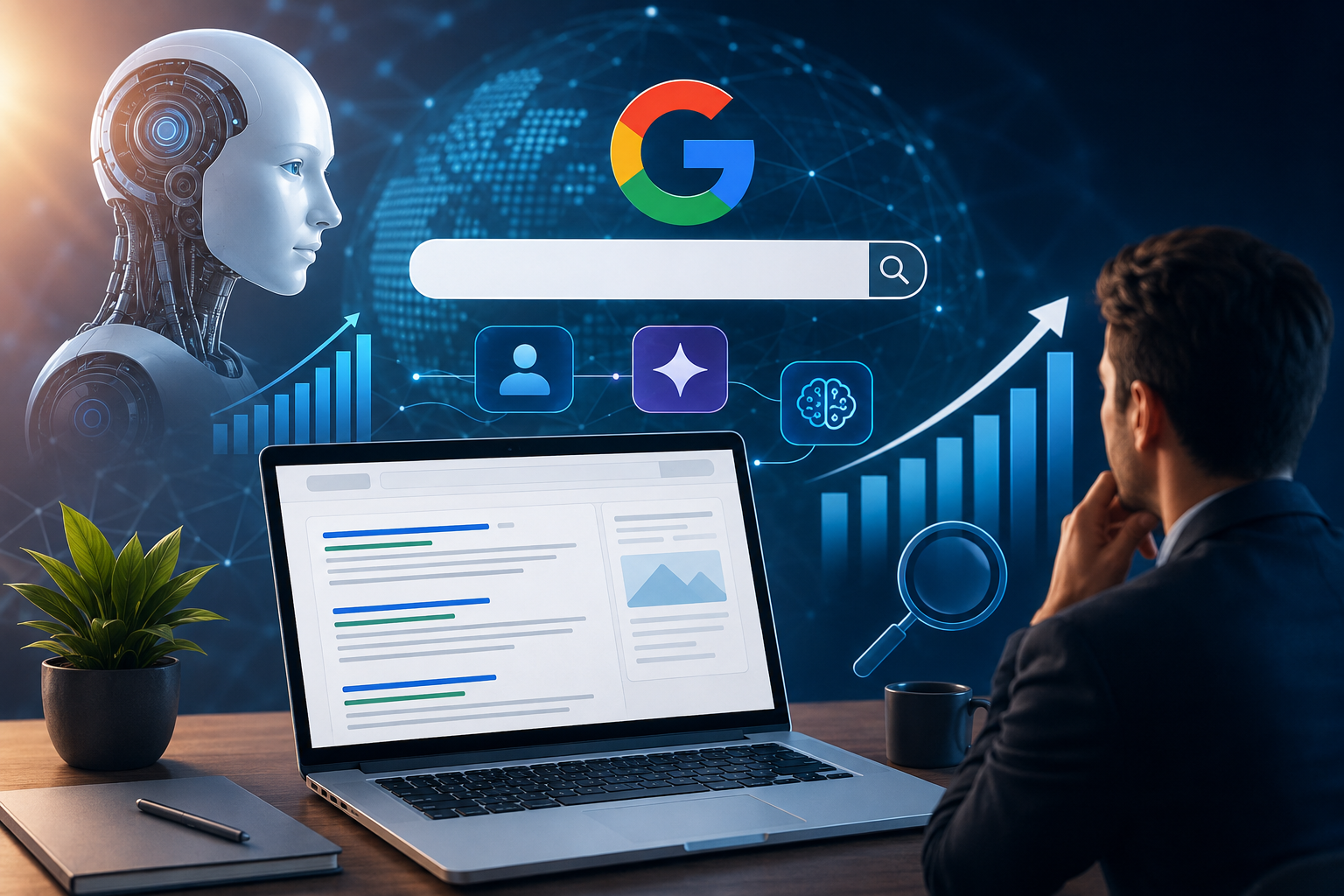
How AI Is Changing Google Search and What Businesses Must Do to Stay Visible
Table of Contents
- How Is AI Changing Google Search?
- What Are Google AI Overviews and AI Mode?
- Traditional Google Search vs AI-Powered Search
- Why This Change Matters for Businesses
- Is SEO Still Important in the AI Search Era?
- What Makes a Website More Useful for AI-Powered Search?
- The 10 Things Businesses Should Do Now
- How AI Is Changing Local Search
- How AI Is Changing Content Marketing
- What Businesses Should Stop Doing
- AI Search Strategy by Business Type
- A Practical 90-Day AI Search Visibility Roadmap
- How to Measure AI Search Visibility
- Common Myths About AI Search
- The Future of Google Search for Businesses
- Conclusion
- Frequently Asked Questions (FAQs)
Key Takeaways
- Google Search is becoming more conversational and increasingly capable of synthesizing information with generative AI.
- AI Overviews and AI Mode do not make SEO obsolete. Google’s current guidance says its generative-AI search features rely on its core Search ranking and quality systems.
- Businesses should focus on useful, original, trustworthy and experience-based content, rather than trying to manipulate AI systems with artificial “AEO” or “GEO hacks.”
- Search visibility is becoming broader than traditional blue-link rankings. A brand can be discovered through web results, AI-generated answers, local results, images, videos and other search experiences.
- Local businesses should pay particular attention to their Google Business Profile, reviews, local content, website information and consistent business details.
- AI can help businesses research, analyze and produce content, but publishing large amounts of generic AI-generated material is not a substitute for expertise.
- Businesses should measure not only rankings, but also impressions, clicks, conversions, branded searches, leads and the performance of content across search and other platforms.
- The winning strategy is not “AI instead of SEO.” It is strong SEO + original expertise + useful content + structured information + strong brand signals + continuous measurement.
How Is AI Changing Google Search?
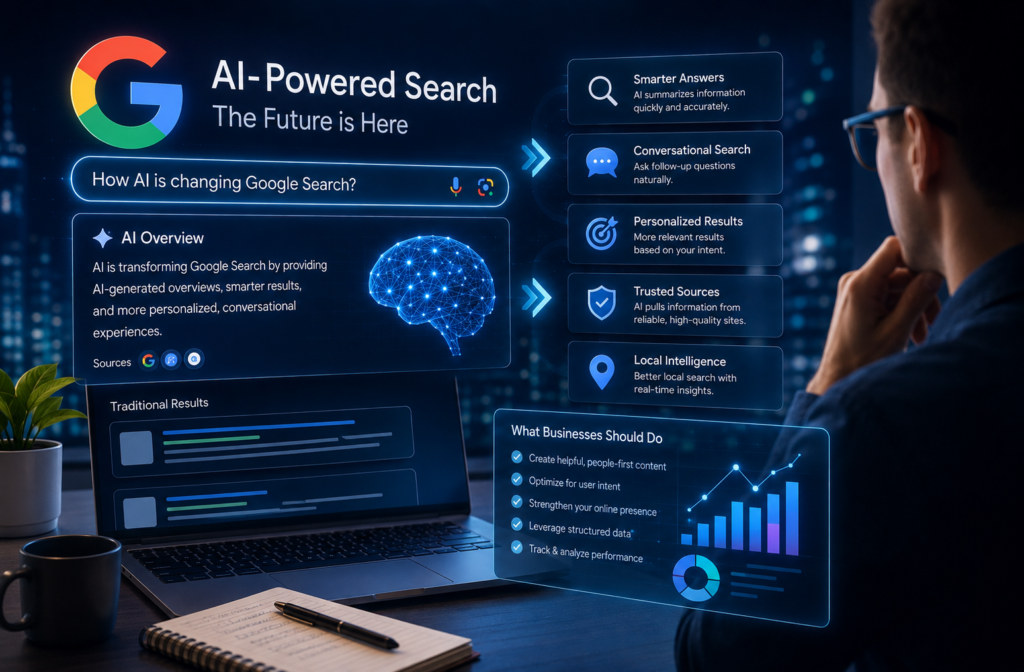
AI is changing Google Search from a system that primarily returns a list of webpages into an increasingly conversational experience that can help users understand complicated questions, compare options and explore a topic through synthesized answers.
For businesses, the important question is not simply “How do I rank on Google?”
The more useful question is:
“How do I make my business and content useful enough to be discovered, understood and trusted across the new ways people use search?”
Google’s current documentation confirms that generative AI features such as AI Overviews and AI Mode are built on Google’s existing Search systems. Google also says that standard SEO best practices remain relevant.
That means businesses do not need to throw away SEO.
They need to upgrade the way they approach it.
The shift is from:
Keyword → Page → Ranking
toward a broader system:
Question → Search → Multiple sources → AI synthesis → Website/content → Trust → Action
This creates both challenges and opportunities.
What Are Google AI Overviews and AI Mode?
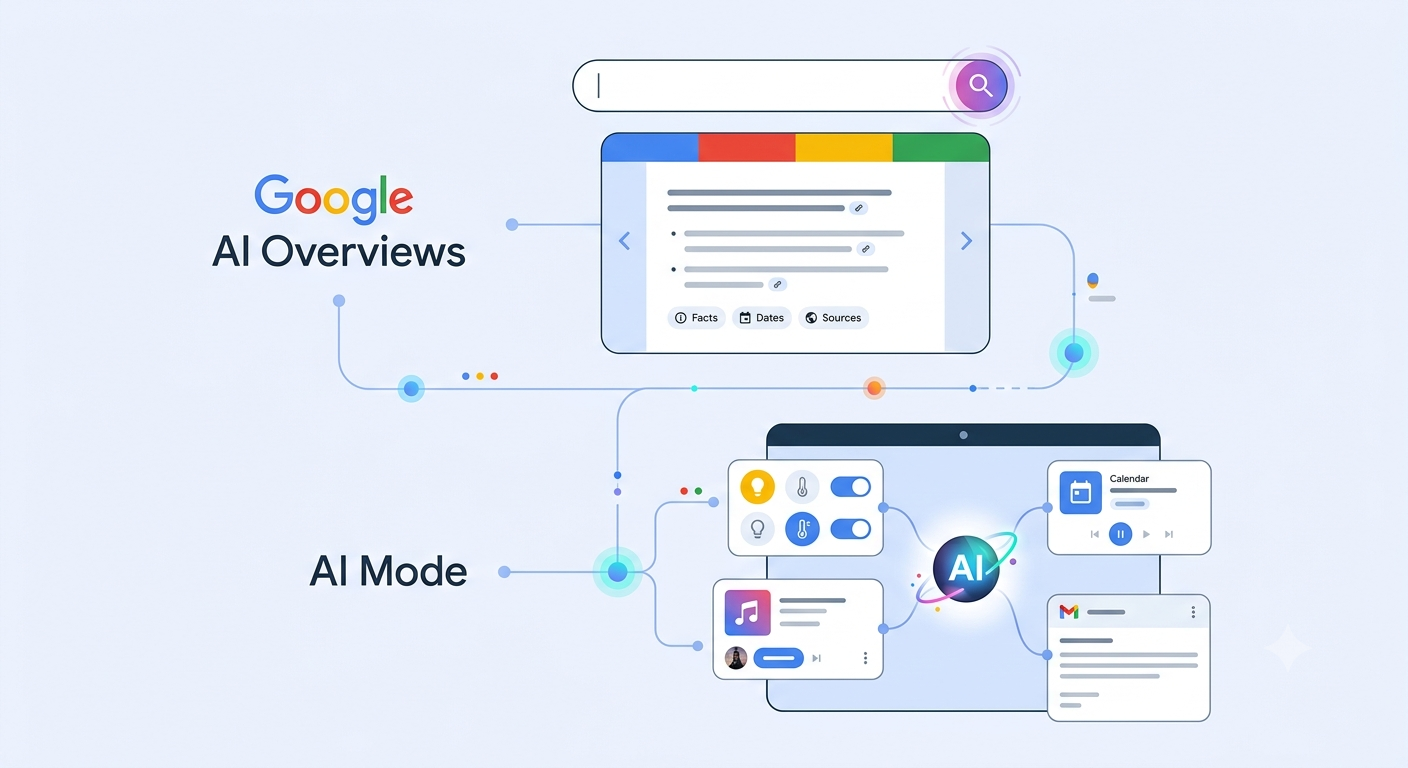
What are AI Overviews?
AI Overviews are AI-generated summaries that can appear within Google Search for certain queries.
Instead of requiring a user to open several webpages to understand a topic, Google can provide an AI-generated overview with supporting sources.
This changes the search experience because the user may receive useful information before clicking a traditional organic result.
For businesses, that raises an important concern:
Will users still visit websites?
The answer is not simply yes or no.
Some searches can be answered quickly without a website visit. Other searches naturally lead users toward deeper research, comparisons, products, services, reviews, pricing, local businesses or direct actions.
Google’s current guidance emphasizes creating valuable content for users rather than attempting to create content exclusively for AI systems.
What is AI Mode?
AI Mode represents a more conversational way of interacting with Search.
Instead of asking one short keyword-based question, users can ask longer, more detailed questions and continue the conversation.
For example:
Traditional search:
digital marketing agency Jalandhar
A user might then search:
best SEO services for small business Jalandhar
Then:
Google Ads agency Jalandhar
In a conversational search experience, the user may ask something closer to:
“I run a small clothing business in Jalandhar. I have a limited advertising budget. Should I focus on Instagram, Google Ads or SEO to get more customers?”
That is a much more complex search intent.
Businesses therefore need content that answers real decisions, not just isolated keywords.
Traditional Google Search vs AI-Powered Search

| Traditional Search | AI-Powered Search |
| Often keyword-focused | More conversational |
| User sees multiple results | User may receive a synthesized answer |
| Short queries are common | Longer questions are easier to ask |
| Individual pages compete for clicks | Multiple sources may contribute to an answer |
| Ranking is a major visibility metric | Visibility, mentions, citations and clicks become important |
| Search journey may involve many queries | One conversation can cover several related questions |
| Exact keyword targeting was heavily emphasized | Topic understanding and usefulness become increasingly important |
This does not mean keywords are dead.
It means keywords are no longer the entire strategy.
A good page should answer the underlying question, related questions and practical decisions surrounding the topic.
Why This Change Matters for Businesses
For years, many businesses approached SEO with a relatively simple objective:
“Get my website to position #1.”
That objective still matters, but it is no longer enough to describe the entire search environment.
Imagine a person searching:
“Best digital marketing agency for a small business in Jalandhar.”
They may encounter:
- Traditional organic results
- Local business results
- Reviews
- Maps
- Images
- Videos
- Business profiles
- AI-generated information
- Brand websites
- Third-party articles
- Social content
The user’s journey can move across multiple platforms before a purchase decision is made.
This means your business needs to be discoverable in multiple contexts.
The new visibility model
Think about search visibility as a funnel:
Discovery
↓
Understanding
↓
Trust
↓
Comparison
↓
Website visit
↓
Enquiry
↓
Conversion
SEO contributes to several stages, but content, reviews, branding, social media, video, local SEO and conversion optimization also matter.
Is SEO Still Important in the AI Search Era?
Yes.
Google’s current official guidance is unusually clear on this point: SEO best practices remain relevant because generative AI features in Search are based on Google’s core ranking and quality systems.
So businesses should not interpret AI Search as:
“SEO is dead.”
A better interpretation is:
SEO is becoming broader and more closely connected with content quality, brand authority, user experience and search intent.
What remains important?
Businesses should continue focusing on:
- Crawlability
- Indexability
- Search intent
- Helpful content
- Internal linking
- Relevant keywords
- Page structure
- Page experience
- Structured data where appropriate
- Local SEO
- Author and business credibility
- Original research and insights
- Relevant backlinks and mentions
- Images and videos
- Clear business information
Google’s AI-search guidance specifically emphasizes unique, useful and trustworthy content and says there is no special requirement to rewrite content solely for generative AI.
What Makes a Website More Useful for AI-Powered Search?
The biggest opportunity is information gain.
Information gain means your page provides something genuinely useful that is not merely a rearrangement of what every other website already says.
For example, compare these two articles.
Generic article
“Digital marketing is important because it helps businesses reach customers online.”
True—but almost anyone can write it.
Better article
“For a Jalandhar restaurant with a small monthly budget, Google Business Profile optimization and review generation may be more immediately useful than launching five separate paid campaigns. Start by fixing local visibility and conversion fundamentals before scaling advertising.”
The second example contains:
- Context
- Audience
- Location
- Business situation
- Decision-making
- Practical prioritization
That is much harder to replace with generic AI-generated text.
Google’s latest AI-search documentation specifically recommends content that goes beyond information already available everywhere and encourages publishers to contribute unique perspectives based on experience and expertise.
The 10 Things Businesses Should Do Now
1. Build Content Around Real Customer Questions
Stop creating articles simply because a keyword tool shows a keyword.
Start with customer problems.
Instead of:
“Digital Marketing Tips”
create:
“How Can a Small Business Get More Customers Through Google?”
Instead of:
“SEO Guide”
create:
“Why Is My Business Not Showing on Google Maps?”
Instead of:
“Social Media Marketing”
create:
“Google Ads vs Instagram Ads: Which Is Better for a Local Business?”
The second approach reflects real search intent.
2. Create Original, Experience-Based Content
This is one of the biggest opportunities for businesses.
Your website should contain information that demonstrates:
“We actually understand this.”
You can add:
- Real examples
- Before-and-after observations
- Industry-specific recommendations
- Screenshots where appropriate
- Original checklists
- Case studies
- Campaign lessons
- Mistakes you’ve encountered
- Expert commentary
- Local market observations
- Practical frameworks
Do not invent results.
If you have a genuine case study, explain it.
If you don’t, use clearly labeled hypothetical examples.
That distinction matters for trust.
3. Stop Treating AI as a Content Factory
AI can be extremely useful.
It can help with:
- Research organization
- Topic clustering
- Content outlines
- Brainstorming
- Editing
- Summarization
- Data analysis
- Content repurposing
- Drafting questions
- Identifying content gaps
But there is a major difference between:
AI-assisted content
and
AI-generated content published without meaningful human value.
The second approach can produce hundreds of pages that say essentially the same thing.
Google’s current guidance specifically encourages unique, useful content and warns against simply recycling information that could easily be generated by AI.
Better workflow
Human expertise
↓
AI-assisted research
↓
Human verification
↓
Original examples
↓
Expert editing
↓
Fact checking
↓
Publication
This is far stronger than:
Prompt → Generate → Publish
4. Strengthen Your Website’s Topical Authority
One article rarely establishes strong expertise around an entire subject.
Build clusters.
For example, a digital marketing website could have:
Pillar
Complete Digital Marketing Guide for Businesses
Supporting articles:
- SEO
- Local SEO
- Google Ads
- Meta Ads
- Content Marketing
- Social Media Marketing
- Video Marketing
- Email Marketing
- AI Marketing
- Analytics
- Conversion Optimization
Then connect related pages with meaningful internal links.
This helps users navigate the subject and gives search engines clearer contextual relationships between pages.
5. Optimize for Topics, Not Keyword Repetition
Do not write:
digital marketing agency Jalandhar
best digital marketing agency Jalandhar
digital marketing services Jalandhar
digital marketing company Jalandhar
over and over.
Instead, naturally discuss:
- Online advertising
- SEO
- Local search
- Lead generation
- Social media
- Content
- Performance marketing
- Customer acquisition
- Conversion
- Analytics
Use relevant terminology because it helps explain the subject—not because you want to hit an arbitrary keyword count.
6. Improve Your Local Search Presence
For local businesses, AI-powered search does not eliminate local SEO.
It makes accurate business information even more important.
Make sure your:
- Business name
- Address
- Phone number
- Website
- Business category
- Services
- Opening information
- Photos
- Reviews
- Location information
are accurate and consistent.
Also create genuinely useful local content.
For example, a Jalandhar digital marketing company could create:
“Digital Marketing Strategies for Small Businesses in Jalandhar”
Then create supporting articles for specific industries:
- Restaurants in Jalandhar
- Coaching institutes
- Salons
- Real estate businesses
- Local retailers
- Professional services
- Startups
The objective is not to repeat “Jalandhar” 50 times.
The objective is to demonstrate real local relevance.
7. Make Your Website Easy to Understand
AI systems and human users both benefit from clear information architecture.
Use:
- Descriptive headings
- Short paragraphs
- Lists
- Tables
- Clear definitions
- Relevant internal links
- Descriptive page titles
- Useful images
- Logical navigation
A page should make it obvious:
What is this page about?
Who is it for?
What question does it answer?
What should the reader do next?
8. Use Multiple Content Formats
Google’s current generative-AI guidance also discusses providing useful local, shopping, image and video content.
That matters because search visibility isn’t limited to written webpages.
Businesses can create:
- Blog articles
- YouTube videos
- Short-form videos
- Infographics
- Original photographs
- Tutorials
- Case studies
- FAQs
- Guides
- Comparison pages
- Podcasts
For a digital marketing brand such as Sikheya Digital Hub, this creates an opportunity to turn one expert idea into multiple assets.
Example:
One topic:
“How Google Ads Works”
Could become:
Blog: Complete Google Ads Guide
YouTube: Google Ads Explained for Beginners
Instagram Reel: 3 Google Ads mistakes
Carousel: Google Ads vs Meta Ads
Infographic: Google Ads funnel
FAQ: Common Google Ads questions
That creates a connected content ecosystem.
9. Build Brand Recognition
This is increasingly important.
Suppose someone repeatedly encounters:
Sikheya Digital Hub
through:
- Google Search
- YouTube
- Blog articles
- Business listings
- Educational content
The brand becomes more familiar.
Search visibility isn’t only about getting one page to rank.
It is about becoming a recognizable source around a topic.
Google also now provides Search Console support for analyzing certain social and video platform content performance in Google Search, Discover and Google News, reflecting the increasingly interconnected search ecosystem.
10. Measure More Than Rankings
Traditional SEO reporting often focuses heavily on:
Position → Clicks
That remains useful.
But businesses should also track:
- Impressions
- Organic clicks
- CTR
- Conversions
- Leads
- Phone calls
- Form submissions
- Branded searches
- Local visibility
- Engagement
- Top-performing topics
- Returning visitors
- Social discovery
- Video performance
Google has clarified that AI Overviews are included in Search Console’s Performance reporting, with their impressions, clicks and position handled within the reporting methodology.
So Search Console remains an important measurement tool even as the search interface changes.
How AI Is Changing Local Search
Local businesses should pay special attention to this change.
Imagine a user asking:
“Find a reliable digital marketing company near me that works with small businesses.”
That is fundamentally different from:
“digital marketing company”
The first query contains:
- Intent
- Location
- Business type
- Need
- Qualification criteria
A local business therefore needs more than a homepage with a city name.
It needs a complete local information ecosystem.
Local SEO checklist
- Verified Google Business Profile
- Correct business information
- Relevant business category
- Accurate services
- High-quality photos
- Genuine customer reviews
- Review responses
- Location-focused website information
- Local service pages where genuinely useful
- Relevant local citations
- Local backlinks and mentions
- Useful local content
- Mobile-friendly website
The goal is not to manipulate Google.
The goal is to make it easy for search engines and customers to understand who you are, what you offer and where you operate.
How AI Is Changing Content Marketing
Content marketing used to be heavily influenced by the idea:
“Create an article around every keyword.”
AI makes that approach increasingly inefficient.
Why?
Because AI can produce basic explanations of common topics extremely quickly.
If your article says exactly what hundreds of other articles say, why should it become the preferred source?
The better strategy is:
Commodity information
↓
Add expertise
↓
Add experience
↓
Add original examples
↓
Add data
↓
Add decision-making guidance
↓
Add practical tools/checklists
↓
Create something genuinely useful
A Simple Information-Gain Framework
Before publishing an article, ask:
Question 1
What does everyone else already say?
List it.
Question 2
What does the reader still need to know after reading those articles?
Find the gap.
Question 3
What can we contribute from our experience?
Add it.
Question 4
What decision does the reader need to make?
Answer it.
Question 5
What should they do next?
Give them a practical action plan.
This five-question process can dramatically improve content quality.
What Businesses Should Stop Doing
Stop 1: Publishing AI articles without expert review
AI can be wrong, outdated or overly generic.
Review important claims before publication.
Stop 2: Creating hundreds of pages with tiny variations
Changing:
“Digital Marketing Agency in Jalandhar”
to:
“Best Digital Marketing Agency in Jalandhar”
to:
“Top Digital Marketing Company in Jalandhar”
doesn’t automatically create three valuable pages.
Create separate pages only when they serve a genuinely different user need.
Stop 3: Chasing “AI hacks”
There is no magic formatting trick that guarantees inclusion in AI-generated search results.
Google’s current documentation specifically cautions against focusing on supposed AEO/GEO hacks instead of established SEO and content-quality practices.
Stop 4: Writing only for keywords
A page can contain the exact keyword and still fail to satisfy the user.
Search intent comes first.
Stop 5: Ignoring conversion optimization
Traffic without business results is not the entire objective.
A visitor should be able to understand:
What you do → Why you’re credible → Who you help → What they should do next
AI Search Strategy by Business Type
Local Service Businesses
Prioritize:
- Local SEO
- Google Business Profile
- Reviews
- Service pages
- Local content
- FAQs
- Photos
- Conversion optimization
E-commerce Businesses
Prioritize:
- Product information
- Product comparisons
- Reviews
- Original product content
- Images
- Structured data
- Category pages
- Buying guides
Educational Businesses
Prioritize:
- Detailed guides
- Course comparisons
- Career information
- Instructor expertise
- Student questions
- Practical examples
- Learning resources
Professional Services
Prioritize:
- Expertise
- Case studies
- Service pages
- Author credibility
- Industry-specific guides
- FAQs
- Trust signals
Startups
Prioritize:
- Brand positioning
- Problem-solving content
- Original research
- Product education
- Comparison content
- Thought leadership
- Video
A Practical 90-Day AI Search Visibility Roadmap
Days 1–30: Fix the Foundation
Website
- Audit indexability
- Check important pages
- Improve page titles
- Improve headings
- Fix broken links
- Improve internal linking
- Check mobile experience
- Improve page speed where necessary
Local
- Review Google Business Profile
- Verify business details
- Improve services
- Add genuine photos
- Encourage legitimate customer reviews
Content
Identify:
- Top 10 existing pages
- Top traffic pages
- Pages losing visibility
- Content gaps
- Duplicate topics
- Weak articles
Days 31–60: Build Authority
Create:
1 Pillar Article
A major comprehensive guide.
5 Supporting Articles
Each should address a specific question.
5 Supporting Visual Assets
Examples:
- Infographics
- Original graphics
- Videos
- Charts
- Checklists
Internal Linking
Connect the entire cluster logically.
Don’t add links just for the sake of adding links.
Days 61–90: Strengthen and Measure
Review:
- Search Console
- Organic clicks
- Impressions
- CTR
- Query trends
- Top pages
- Conversion data
- Local visibility
- Social/video performance
Then ask:
Which topics are generating attention?
Which topics are generating leads?
Which pages have impressions but poor CTR?
Which pages rank but don’t convert?
Which content deserves expansion?
This turns SEO from a publishing activity into an ongoing growth process.
How to Measure AI Search Visibility
There is no single metric that tells you:
“Your AI visibility is 73%.”
Be careful with tools or agencies making overly precise claims about AI visibility without explaining their methodology.
Instead, build a measurement framework.
Search visibility
Track:
- Impressions
- Clicks
- CTR
- Queries
- Average position
Business visibility
Track:
- Branded searches
- Leads
- Calls
- Consultation requests
- Sales
Content visibility
Track:
- Top pages
- New pages gaining impressions
- Pages losing impressions
- Content engagement
Brand visibility
Track:
- Brand searches
- Social mentions
- Video discovery
- Referral traffic
Google’s Search Console reporting now includes AI Overview data within the Performance report, according to its current documentation.
Common Myths About AI Search
Myth 1: “SEO is dead.”
Reality: Google’s current guidance says SEO best practices remain relevant to generative AI search features.
Myth 2: “You need special AI-only content.”
Reality: Google says you do not need to rewrite content specifically for generative AI. The priority remains useful, unique, people-first content and strong technical SEO fundamentals.
Myth 3: “More AI content means more traffic.”
Reality: Volume does not automatically create value.
Ten excellent pages can be more useful than 100 repetitive ones.
Myth 4: “Keywords don’t matter anymore.”
Reality: Keywords remain useful for understanding what users search for. The difference is that they should be used naturally within a broader topic and intent strategy.
Myth 5: “AI will completely replace websites.”
Reality: Websites remain important sources of detailed information, products, services, expertise, transactions and brand experiences.
The search interface may change.
The need for trustworthy information does not disappear.
Myth 6: “FAQ schema will guarantee visibility in AI Search.”
Reality: Be careful here. Google deprecated the FAQ rich-result feature in May 2026. An FAQ section can still be useful for users, but businesses should not treat FAQPage structured data as a guaranteed Google search enhancement.
The Future of Google Search for Businesses
The biggest change isn’t simply that Google is adding AI.
The bigger change is that search is becoming more capable of understanding complex user needs.
A user may no longer search:
“best marketing agency”
They may ask:
“I own a small local business and want more leads but don’t have a large advertising budget. What marketing strategy should I start with?”
That is a completely different information problem.
Businesses that understand this shift can build content around:
- Questions
- Problems
- Comparisons
- Decisions
- Industries
- Locations
- Customer journeys
- Real experiences
This creates content that can remain useful even as the interface changes.
What This Means for Sikheya Digital Hub
For a digital education and marketing brand such as Sikheya Digital Hub, the opportunity is particularly strong because AI Search itself creates many questions that businesses and students need answered.
Instead of publishing only:
“What is SEO?”
Sikheya could build authority around higher-value questions such as:
For businesses
- How AI Is Changing Google Search
- How Local Businesses Can Stay Visible in AI Search
- SEO vs AI Search
- Google Ads vs Meta Ads
- How to Build a Local SEO Strategy
- How AI Is Changing Content Marketing
For students
- What Digital Marketing Skills Will Matter in the AI Era?
- Will AI Replace Digital Marketing Jobs?
- How Should Beginners Learn SEO in the AI Era?
- Which Digital Marketing Skills Are Difficult for AI to Replace?
- How to Build a Digital Marketing Portfolio in the AI Era
For Jalandhar businesses
- Local SEO for Jalandhar Businesses
- Digital Marketing for Small Businesses in Jalandhar
- Google Maps Marketing for Local Businesses
- How Jalandhar Businesses Can Generate Leads Online
This creates a much stronger relationship between education + expertise + services + local relevance.
A Better Content Model for 2026
Instead of:
Publish → Wait → Publish again
build a content flywheel.
Step 1: Research
Identify a genuine customer problem.
↓
Step 2: Create
Publish the strongest answer you can.
↓
Step 3: Demonstrate
Add experience, examples and evidence.
↓
Step 4: Repurpose
Turn the article into:
- Video
- Reel
- Carousel
- Infographic
- LinkedIn post
- YouTube Short
↓
Step 5: Connect
Link related content together.
↓
Step 6: Measure
Use Search Console and analytics.
↓
Step 7: Improve
Update pages based on actual user behavior and new information.
This is a much more sustainable approach than trying to “hack” AI search.
The AI Search Visibility Checklist
Before publishing any important page, ask:
- Does this page answer a real user question?
- Is the answer clear within the first section?
- Does the page provide information beyond generic advice?
- Is the information accurate?
- Have important claims been verified?
- Does the content demonstrate genuine expertise?
- Are examples relevant to the target audience?
- Are headings descriptive?
- Is the page easy to scan?
- Are related questions answered?
- Are internal links useful?
- Are images relevant?
- Is the business information clear?
- Is the page mobile-friendly?
- Is the content original?
- Has unnecessary repetition been removed?
- Is there a clear next step for the reader?
- Is the CTA relevant rather than aggressive?
A Simple Decision Framework
When deciding whether to create a new article, score the idea from 1–5.
| Question | Score |
| Does our audience actually ask this? | /5 |
| Does it solve a meaningful problem? | /5 |
| Can we add unique expertise? | /5 |
| Is there business relevance? | /5 |
| Can we support it with examples? | /5 |
| Can we create related content? | /5 |
| Can it naturally connect to our services? | /5 |
25+ points
Strong topic.
18–24 points
Potential topic; improve the angle.
Below 18
Probably not worth prioritizing.
This is more useful than choosing topics solely because a keyword tool shows a large search-volume number.
Conclusion
AI is changing Google Search, but businesses should not respond by abandoning SEO or filling their websites with AI-generated articles.
The stronger response is to build a website that is technically accessible, genuinely useful, original, trustworthy, locally relevant where appropriate, and rich in real expertise.
Google’s own current guidance supports this direction: its generative-AI Search features continue to rely on core Search systems, while Google emphasizes unique, useful, non-commodity content rather than special AI-search tricks.
The future of search visibility is therefore not:
SEO vs AI
It is:
SEO + expertise + useful content + strong brand signals + multiple content formats + continuous measurement.
Businesses that adapt this way are not simply trying to rank for one keyword.
They are building a digital presence that can be discovered when customers search, compare, ask questions, watch videos, explore local businesses and increasingly interact with AI-powered search experiences.
Frequently Asked Questions
1. Is SEO still important after AI Overviews?
Yes. Google’s current guidance states that SEO best practices remain relevant because generative AI features in Search are based on Google’s core ranking and quality systems.
2. What are Google AI Overviews?
AI Overviews are AI-generated summaries that can appear within Google Search for eligible queries, providing users with synthesized information and links to supporting sources.
3. What is Google AI Mode?
AI Mode is a more conversational Search experience that allows users to ask complex questions and explore topics through an AI-powered interaction.
4. Will AI replace traditional Google Search?
AI is changing how people interact with Search, but traditional search results remain part of the broader Search ecosystem. Businesses should prepare for multiple search experiences rather than assuming one will completely replace another.
5. Should businesses create content specifically for AI?
Businesses should create content for people first. Google’s current guidance recommends unique, useful and trustworthy content rather than content created solely to target generative AI systems.
6. What is AEO?
AEO commonly refers to Answer Engine Optimization. It is a broad industry term for improving the likelihood that content is surfaced in answer-oriented search experiences. Businesses should prioritize strong SEO and useful content rather than relying on supposed AEO hacks.
7. What is GEO in SEO?
GEO is commonly used to mean Generative Engine Optimization. The term is used inconsistently across the industry, so businesses should focus on the underlying principles—quality, relevance, authority and usefulness—rather than treating GEO as a separate guaranteed ranking system.
8. Does AI-generated content hurt SEO?
Using AI as a tool does not automatically make content unsuccessful. The important issue is whether the resulting content is useful, accurate, original and created for people. Large volumes of repetitive or low-value content are not a substitute for expertise.
9. How can a local business prepare for AI Search?
Start with strong fundamentals: maintain accurate business information, strengthen local SEO, collect genuine reviews, publish useful local content, improve the website and clearly explain your services and expertise.
10. Should I stop targeting keywords?
No. Keywords remain useful for understanding search demand and user language. The difference is that keywords should support a comprehensive topic and search-intent strategy rather than being repeatedly inserted into content.
11. Does structured data help with AI Search?
Structured data can help search engines understand certain types of content when implemented correctly, but it should accurately represent visible page content and should not be treated as a guarantee of AI visibility.
12. How do I know whether AI Search is affecting my website?
Monitor Search Console performance, organic clicks, impressions, queries, CTR and conversions. Google has clarified that AI Overview data is included in Search Console’s Performance reporting.
13. Should small businesses invest in AI SEO?
Small businesses should first invest in sound SEO, useful content, local visibility, conversion optimization and accurate business information. AI-search considerations should be integrated into that strategy rather than treated as an entirely separate marketing channel.
14. How often should businesses update content?
There is no universal update schedule. Update content when information changes, when new evidence becomes available, when user needs change, or when your page can be substantially improved. Updating a date without meaningful improvement is not a content strategy.
15. What is the biggest mistake businesses can make with AI Search?
The biggest mistake is chasing shortcuts instead of building genuine value. Businesses that focus only on AI-generated content, keyword repetition or supposed AI-search hacks risk producing content that is indistinguishable from thousands of other pages.
Is Your Business Ready for AI-Powered Search?
Google Search is changing—and your digital strategy should evolve with it.
If you’re a business owner looking to improve your SEO, local visibility, content strategy, Google Ads, social media presence or overall digital marketing, Sikheya Digital Hub can help you identify the right next steps.
Don’t optimize only for today’s search results. Build a digital presence that remains useful as search continues to evolve.
Book a Free Consultation with Sikheya Digital Hub
📞 +91 8094486944
📧 services@sikheya.info
📍 Jalandhar, Punjab, India
Related Topics
- Why Most Graduates Stay Unemployed Despite Having Degrees
- Top 10 AI Skills Students Must Learn
- Digital Marketing Career Guide
- How to Grow Your Business Online
- Meta Ads vs Google Ads
- How AI Search Is Changing Local SEO

Sikheya Digital Hub is a digital marketing institute and agency helping students, entrepreneurs and businesses learn and implement digital marketing, AI, social media marketing, SEO and online growth strategies.
Expertise
Digital Marketing
SEO
Social Media Marketing
Meta Ads
Google Ads
AI & Automation
Content Marketing




3 Comments