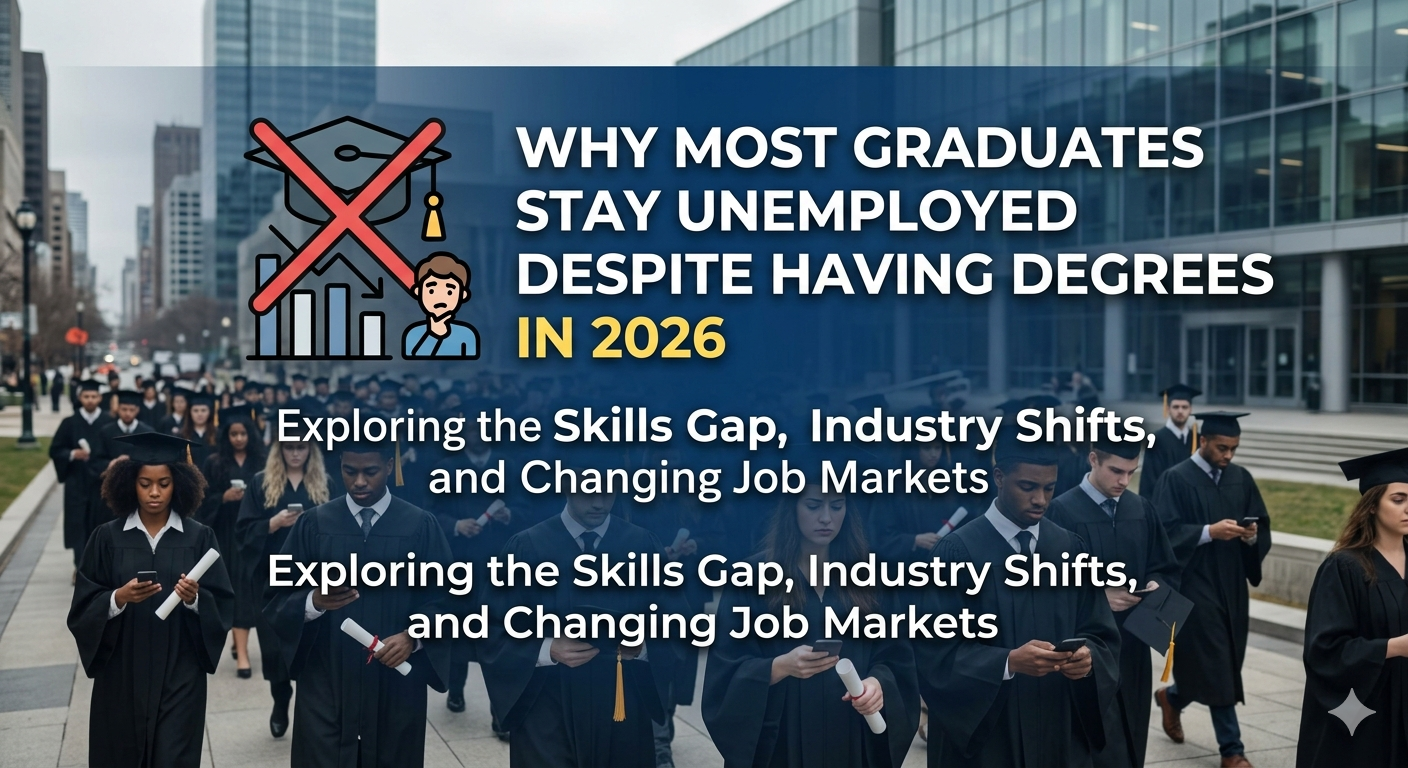
Why Most Graduates Stay Unemployed Despite Having Degrees in 2026
For years, students were told a simple formula for building a successful career:
Study hard → Get a degree → Find a good job.
But the employment market in 2026 is showing that the formula is no longer that simple.
A degree still matters. It can provide knowledge, professional eligibility and access to opportunities. But for many graduates, it is no longer enough to stand out in a competitive job market.
This is why a common question among students and parents today is:
“If I have a degree, why am I still struggling to find a job?”
The answer is not that graduates are lazy, degrees are useless, or companies have stopped hiring.
The real situation is more complicated.
There is a growing gap between academic qualifications, practical skills, employer expectations and the availability of suitable jobs.
According to reporting on the India Skills Report 2026, India’s graduate employability was estimated at 56.35%. Importantly, this figure should not be interpreted as an unemployment rate. Employability and unemployment measure different things.
So what is actually happening?
Let’s look at the major reasons graduates struggle to move from college into employment.

1. A Degree Provides Qualification, Not Guaranteed Employability
A university degree can demonstrate that a student has completed formal education in a particular field.
But employers have a different question:
“Can this candidate actually do the job?”
Imagine a company hiring a digital marketing executive.
A candidate may have a BBA or MBA, but the employer may also expect knowledge of:
- SEO
- Social media marketing
- Content creation
- Analytics
- Advertising platforms
- Basic design tools
- AI-assisted marketing
The same situation exists in almost every industry.
A computer science graduate may need practical programming experience.
A commerce graduate may need accounting software and analytical skills.
A media graduate may need video editing and content-production experience.
A business graduate may need sales, communication and digital marketing skills.
The degree gets the candidate into the conversation.
Practical ability helps them compete.
2. The Skills Students Learn Are Not Always the Skills Employers Need
One of the biggest challenges facing graduates is the skills gap.
Education naturally focuses on concepts, theories and academic learning. Businesses, however, need employees who can solve real problems.
There is nothing wrong with theoretical knowledge.
In fact, strong fundamentals are extremely important.
The problem occurs when theory is not combined with application.
A student might understand what SEO means but have never optimised a real website.
Someone might study graphic design but have never created work for a real client.
A marketing student might understand advertising theory but never run or analyse a campaign.
This creates a gap between:
“I know about it”
and
“I can do it.”
Employers generally need the second one.
3. Fresh Graduates Often Lack Practical Experience
This is one of the biggest difficulties faced by fresh graduates.
Many job descriptions ask for experience even for relatively junior positions.
That creates a frustrating situation:
You need experience to get a job, but you need a job to get experience.
The solution is to start building practical experience before graduation whenever possible.
Students can gain exposure through:
- Internships
- Freelancing
- College projects
- Volunteer work
- Personal projects
- Small business assignments
- Portfolio projects
For example, a student interested in digital marketing could create a small website, optimise its pages, publish content, analyse traffic and document the results.
It may not replace professional employment, but it gives the student something important:
proof of practical effort.
4. Employers Look Beyond Academic Marks
Good marks are valuable, but marks alone cannot demonstrate every skill required in a workplace.
An employer may want to know:
- Can you solve problems?
- Can you communicate clearly?
- Can you work with a team?
- Can you learn new software?
- Can you handle deadlines?
- Can you accept feedback?
- Can you work independently?
- Can you apply your knowledge?
This is why a student with average academic performance but strong practical skills can sometimes compete effectively with someone who has excellent marks but little practical exposure.
The lesson is not to ignore academics.
It is to build beyond academics.
5. Communication Skills Can Become a Career Barrier
Technical skills can help you get noticed.
Communication skills can help you work effectively once you are hired.
Many graduates struggle during interviews because they cannot clearly explain their:
- Skills
- Projects
- Career goals
- Strengths
- Previous experiences
Good communication does not mean speaking sophisticated English.
It means communicating ideas clearly and confidently.
A graduate who knows how to listen, ask questions, explain problems and communicate professionally has an advantage in many workplaces.
That is why communication should be treated as a career skill, not merely a personality trait.
6. Certificates Are Increasing, But Proof of Work Is More Valuable
The internet has made professional learning easier than ever.
Students can complete courses from universities, companies and online learning platforms without leaving home.
That is a positive development.
But there is another problem.
Some students collect certificates without developing the underlying skill.
A resume might contain ten or twenty certificates, but an interviewer may still ask:
“What have you actually done?”
This is where portfolios become powerful.
Instead of simply saying:
“I know SEO.”
A candidate can say:
“I worked on this website, improved its on-page SEO, created content and analysed its performance.”
Instead of saying:
“I know video editing.”
A candidate can show actual videos.
Instead of saying:
“I know graphic design.”
A candidate can present a portfolio.
Skills become much more credible when they can be demonstrated.
7. AI Is Changing the Definition of Job-Ready Skills
Artificial intelligence has become an important part of the employment conversation in 2026.
But saying “AI is taking all the jobs” is an oversimplification.
The more realistic change is that AI is altering how many jobs are performed.
Businesses can now use AI for tasks such as:
- Research assistance
- Content ideation
- Data processing
- Automation
- Customer support
- Coding assistance
- Marketing workflows
As a result, graduates increasingly need to understand how technology can improve their productivity.
But AI does not eliminate the importance of human capabilities.
Skills such as:
Critical thinking
Creativity
Communication
Leadership
Decision-making
Problem-solving
Understanding customers
remain important.
The better strategy for students is not to compete against technology blindly.
It is to learn how to work effectively with technology.
8. Students Often Wait Until Graduation to Prepare for Careers
Another common mistake is starting career preparation too late.
A student spends three or four years completing a degree and only starts thinking about employment during the final semester.
Suddenly, they need to develop:
- Technical skills
- Communication
- Resume writing
- Interview preparation
- Portfolio projects
- Industry knowledge
- Job-search strategies
Trying to build everything within a few months can be difficult.
A better approach is to start early.
Even during college, students can choose one area of interest and gradually develop it.
For example:
First year: Explore career options.
Second year: Develop one practical skill.
Third year: Build projects and gain experience.
Final year: Build a portfolio, improve the resume and apply for relevant positions.
This creates a much smoother transition from education to employment.
9. There Is Also a Shortage of Suitable Jobs
It is important not to place the entire responsibility on graduates.
Sometimes the problem genuinely comes from the labour market.
A graduate may have the right qualification and skills but still struggle because there are fewer suitable vacancies than applicants.
Competition can be particularly intense for jobs that offer:
- High salaries
- Government positions
- Remote work
- Major-city opportunities
- Fast career growth
- Strong job security
Therefore, graduate unemployment cannot be explained only by saying:
“Students don’t have enough skills.”
The economy, industry demand, hiring practices, location and number of available jobs all matter.
This is why the issue requires attention from educational institutions, employers, policymakers and students—not students alone.
10. Salary Expectations Can Also Affect the First Job
Starting a career is different from building a career.
A graduate may expect a high salary immediately after completing college.
But companies generally determine salaries according to factors such as:
- Skill level
- Experience
- Industry
- Location
- Job responsibilities
- Demand for the skill
- Candidate’s demonstrated value
This does not mean graduates should accept unfair salaries.
It means they should understand the difference between starting salary and long-term earning potential.
A first job can provide valuable experience, professional networks and industry exposure that may contribute to future opportunities.
The focus should be on building a career, not simply obtaining the highest possible first salary.
What Can Graduates Do Differently?
The solution is not to abandon college education.
The smarter approach is to combine a degree with practical preparation.
A strong graduate profile increasingly looks like:
Degree + Skills + Experience + Portfolio + Communication + Adaptability
For students, this means:
Choose one career direction
You don’t need to master every skill.
Start with one field that interests you.
Learn practical skills
Go beyond textbooks and learn the tools actually used in your target industry.
Build real projects
Create something that demonstrates your ability.
Get experience early
Internships, freelance assignments and practical projects can help.
Create a portfolio
Give employers something they can see rather than simply telling them what you know.
Improve communication
Learn to explain your ideas, projects and achievements clearly.
Learn continuously
Industries change quickly. The ability to learn new tools and methods can become a major career advantage.
Degree vs Skills: What Matters More?
The answer is both.
It is a mistake to say:
“Degrees are useless now.”
They are not.
It is equally incorrect to say:
“A degree is all you need.”
It isn’t.
A degree can provide the foundation.
Skills help you perform.
Experience helps you understand the workplace.
A portfolio provides evidence.
Communication helps you present your value.
Continuous learning helps you remain relevant.
Think of it this way:
A degree can open the door.
Skills can help you get through it.
Experience can help you perform once you’re inside.
Final Thoughts
The graduate employment problem in 2026 cannot be reduced to one simple reason.
Some graduates lack practical skills.
Some lack experience.
Some struggle with communication.
Some have qualifications that do not match current industry requirements.
Some are competing for a limited number of desirable jobs.
And some simply enter the job market during a difficult hiring period.
The important lesson is that a degree should be the beginning of career development, not the end of it.
Students who combine formal education with practical skills, real projects, communication abilities and continuous learning are better positioned to compete in a changing employment market.
So, instead of asking:
“Is my degree enough to get me a job?”
A better question is:
“What can I do with my degree that makes an employer want to hire me?”
That shift in mindset can make a significant difference.
Learn. Create. Grow.
Sikheya Digital Hub is a digital marketing institute and agency helping students, entrepreneurs and businesses learn and implement digital marketing, AI, social media marketing, SEO and online growth strategies.
Expertise
Digital Marketing
SEO
Social Media Marketing
Meta Ads
Google Ads
AI & Automation
Content Marketing
One Comment