Meta Ads vs Google Ads: Which Is Better for Your Business
If you’re planning to spend money on online advertising, one question usually comes first: Should you invest in Meta Ads or Google Ads?
The answer isn’t the same for every business. Google Ads can be powerful when people are already searching for a product or service, while Meta Ads can be excellent for creating demand, reaching new audiences, and visually showcasing an offer.
The right choice depends on your business model, customer journey, budget, offer, creative assets, and conversion goal. This guide explains the differences between Meta Ads and Google Ads, when to use each platform, how their advertising systems work, and how to decide where your next advertising rupee should go.
Table of Contents
- Meta Ads vs Google Ads: Quick Answer
- What Are Meta Ads?
- What Are Google Ads?
- Meta Ads vs Google Ads: Key Differences
- Search Intent vs Audience Discovery
- Which Platform Is Better for Leads?
- Which Is Better for E-commerce?
- Which Is Better for Local Businesses?
- Cost Comparison
- Targeting Comparison
- Creative Comparison
- Google Ads Campaign Types
- Meta Ads Campaign Objectives
- When to Choose Meta Ads
- When to Choose Google Ads
- When You Should Use Both
- Common Mistakes
- Decision Framework
- Practical Advertising Strategy
- FAQs
- Conclusion
Meta Ads vs Google Ads
Google Ads is often the better starting point when customers already search for your product or service, while Meta Ads can be better when you need to create awareness, generate demand, showcase visual content, or reach specific audiences. Many businesses can benefit from using both, with each platform serving a different stage of the customer journey.
The important point is this:
Don’t choose an advertising platform because it is popular. Choose it because your customers behave in a way that matches the platform.
For example:
A person searching “Google Ads agency in Jalandhar” has already expressed a specific need.
A person scrolling Instagram may not be actively looking for a Google Ads agency, but an engaging advertisement explaining a common advertising problem could create interest.
That’s the fundamental difference.
Simple rule
| Situation | Better Starting Point |
| Customer is actively searching | Google Ads |
| New product needs awareness | Meta Ads |
| Visual product | Meta Ads |
| High-intent service | Google Ads |
| Local service | Google Ads + Meta Ads |
| E-commerce | Usually test both |
| Retargeting | Meta Ads + Google Ads |
| Brand building | Meta Ads |
| Immediate search demand | Google Ads |
| Course or training business | Often both |
What Are Meta Ads?
Meta Ads are paid advertisements distributed across Meta’s advertising ecosystem, including Facebook and Instagram, with placements that can also include other Meta surfaces depending on the campaign setup.
Meta’s advertising system uses an auction to determine which ads are shown. Meta explains that the auction considers factors including the objective, audience, budget, duration and creative
Meta Ads are particularly useful when you want to reach people based on audience characteristics and behavior rather than waiting for them to search for your exact service.
Common Meta Ads formats include:
- Image ads
- Video ads
- Reels ads
- Stories ads
- Carousel ads
- Lead ads
- Click-to-message ads
- Product/Cataloug-based ads
Meta also provides automation features such as Advantage+ for audience, placements, budget and campaign optimization.
Example
Suppose you run a digital marketing course in Jalandhar.
You could create a short video showing:
A student learning Google Ads → creating a campaign → analyzing results → building a portfolio.
The person may not have searched for a course.
But the advertisement can introduce the opportunity while they are browsing Instagram or Facebook.
Key Takeaway
Meta Ads are strong at reaching potential customers before they actively search for your product or service.
What Are Google Ads?
Google Ads allows businesses to advertise across Google’s advertising ecosystem, including Search and other campaign types such as Performance Max and Demand Gen. Search campaigns are particularly valuable because they can reach people while they are actively searching for products or services.
This makes Google Ads especially interesting for businesses with existing search demand.
For example:
- “Digital marketing course near me”
- “Google Ads agency in Jalandhar”
- “best dentist near me”
- “website development company Jalandhar”
- “buy running shoes online”
These searches reveal intent.
Someone typing “Google Ads Training in Jalandhar” is potentially much closer to taking action than someone who simply sees a digital marketing course while scrolling through Instagram.
Google’s Search advertising system uses an auction for eligible searches, with factors including bid, ad quality, Ad Rank thresholds, search context and expected impact of ad formats.
Key Takeaway
Google Ads is especially powerful when there is existing demand and people are actively searching for what you sell.
Meta Ads vs Google Ads: Key Differences
| Factor | Meta Ads | Google Ads |
| Main strength | Demand generation | Capturing existing demand |
| Major platforms | Facebook, Instagram and other Meta placements | Google Search, YouTube and other Google surfaces |
| User mindset | Browsing/discovering | Searching/researching |
| Creative importance | Very high | High, but depends on campaign type |
| Visual content | Extremely important | Important, especially beyond Search |
| Keyword intent | Less central | Very important for Search |
| Audience targeting | Strong | Strong, with different mechanisms |
| Local businesses | Strong | Often excellent for high-intent searches |
| Brand awareness | Strong | Can be strong with suitable campaign types |
| Immediate purchase intent | Variable | Often strong on Search |
| Retargeting | Strong | Strong |
| Video | Strong | Strong through YouTube and relevant campaign types |
| Best for visual products | Often excellent | Can also work well |
| Best for high-intent services | Can work | Often excellent |
| Creative testing | Very important | Important |
| AI automation | Extensive | Extensive |
Search Intent vs Audience Discovery
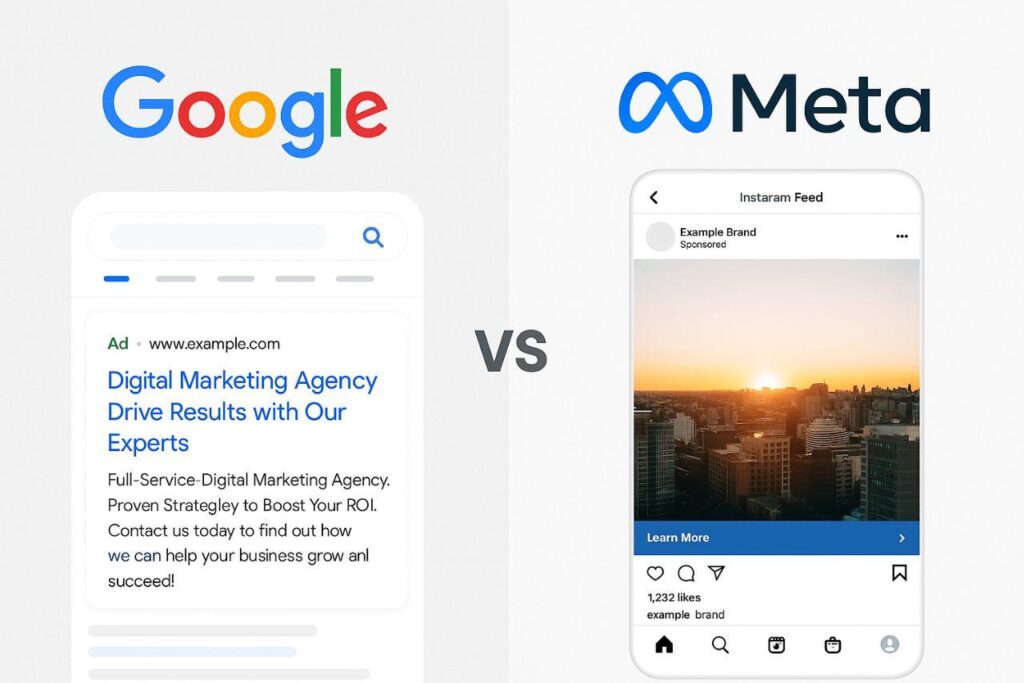
This is perhaps the most important concept to understand before choosing between the two platforms.
Google Ads Captures Intent
Imagine someone searches:
“Best digital marketing course in Jalandhar“
They already have a problem and are looking for a solution.
Your Google advertisement can appear when that search happens, subject to eligibility, auction and campaign settings.
The person has effectively told Google:
“I am looking for this.”
That’s why search advertising can be powerful for services with strong commercial intent
Meta Ads Creates or Develops Demand
Now imagine someone is scrolling Instagram.
They aren’t searching for a digital marketing course.
They see a short video:
A student learns content creation, Google Ads, SEO and social media marketing and builds a practical portfolio.
The advertisement creates curiosity.
The person might then:
- Watch the video.
- Visit the profile.
- Click the website.
- Send a WhatsApp message.
- Search for the business later.
- Register for a consultation.
This is a different customer journey.
The simplest way to remember it:
Google Ads:
“I need something. Let me search for it.”
Meta Ads:
“I wasn’t necessarily looking for it, but this caught my attention.”
Which Platform Is Better for Leads?
There is no universal winner.
Google Ads can be highly effective for lead generation when potential customers are actively searching for a service. Meta Ads can be highly effective when compelling creative and audience targeting can generate interest and encourage people to submit a form or start a conversation.
Meta officially supports lead-generation campaigns and automation through Advantage+ leads campaigns.
Example: Digital Marketing Training
Suppose you want students in Jalandhar to enquire about your course.
Google Ads approach
Target searches such as:
- digital marketing course Jalandhar
- digital marketing training Jalandhar
- Google Ads course Jalandhar
- SEO course Jalandhar
- content creation course Jalandhar
The user has demonstrated search intent.
Meta Ads approach
Create short videos such as:
Video 1:
“5 digital skills students should learn before graduating.”
Video 2:
“Can you get a digital marketing job without a technical degree?”
Video 3:
“3 skills you can learn to start freelancing.”
Then use lead forms, messages or website conversion paths.
Which approach is better?
Rather than guessing, test both and measure:
- Cost per lead
- Qualified leads
- Lead-to-customer rate
- Customer acquisition cost
- Revenue generated
- Return on ad spend where applicable
A cheap lead isn’t necessarily a good lead.
Which Is Better for E-commerce?
E-commerce businesses should usually avoid assuming that one platform will automatically outperform the other.
Meta Ads can be useful for:
- Product discovery
- Visual demonstrations
- Lifestyle products
- New product launches
- Retargeting
- Creative testing
- Building demand
Google Ads can be useful for
- Product searches
- High-intent shoppers
- Brand searches
- Product comparison journeys
- Shopping-related discovery
- Capturing people closer to purchase
Google’s Performance Max campaigns can access Google’s inventory across multiple channels from a single campaign and use AI-based optimization around specified conversion goals.
Example
Imagine you sell premium skincare.
A Meta video could show:
Problem → product demonstration → result → offer
Google can capture searches such as:
“best vitamin C serum for oily skin”
These platforms can therefore work together rather than compete.
Which Is Better for Local Businesses?
For local businesses, the answer depends heavily on how customers find that type of business.
Consider these two examples.
Example 1: Emergency plumber
Someone has a leaking pipe.
They probably search:
“plumber near me”
Google Search may be a natural fit because the customer already needs the service.
Example 2: New café
A new café wants people to discover its atmosphere, food and location.
Instagram and Facebook can be useful because photos, Reels and videos can communicate the experience visually.
Example 3: Digital Marketing Agency
A digital marketing agency could use:
Google Ads to capture searches for services.
Meta Ads to demonstrate expertise through educational videos and case-study-style creative.
Remarketing to reconnect with people who previously interacted with the business.
Key Takeaway
Local businesses should ask:
Do customers search for my service when they need it, or do they discover businesses visually and socially? That answer should influence the advertising strategy
Cost Comparison: Meta Ads vs Google Ads
One of the biggest mistakes beginners make is asking:
“Which platform is cheaper?”
That’s not enough.
Advertising costs vary based on:
- Industry
- Location
- Competition
- Audience
- Offer
- Ad quality
- Landing page
- Conversion rate
- Campaign objective
- Seasonality
- Budget
- Customer value
There is no universal Meta Ads CPC or Google Ads CPC that can be responsibly applied to every business.
More useful question
Instead of asking:
“Which platform has cheaper clicks?”
Ask:
“Which platform produces more qualified customers at an acceptable acquisition cost?”
For example:
| Metric | Campaign A | Campaign B |
| Ad spend | ₹10,000 | ₹10,000 |
| Leads | 100 | 50 |
| Cost per lead | ₹100 | ₹200 |
| Qualified leads | 10 | 25 |
| Customers | 2 | 8 |
| Customer acquisition cost | ₹5,000 | ₹1,250 |
Campaign A appears cheaper if you only look at cost per lead.
But Campaign B generates more customers.
This is why optimizing only for cheap clicks or cheap leads can produce misleading conclusions.
Targeting: Meta Ads vs Google Ads
Meta Ads Targeting
Meta provides tools that allow advertisers to define or guide audiences and use its optimization systems to find people likely to take the desired action.
Depending on the campaign and account setup, advertisers can work with:
- Location
- Demographic information
- Custom audiences
- First-party customer data
- Website activity
- Engagement
- Lookalike-style audience solutions
- Automated audience expansion
Meta’s current Advantage+ approach increasingly uses automation to help determine where and to whom ads should be delivered.
Google Ads Targeting
Google Search advertising has a different foundation.
Keywords can help connect ads with search queries, with match types determining how closely a keyword needs to relate to the user’s search for the ad to be considered.
Google also has audience and automation capabilities across its wider advertising ecosystem.
Example
Meta:
“Find people who may be interested in digital marketing training.”
Google Search:
“Show my ad when someone searches for digital marketing training.”
That’s a simplified explanation, but it captures the strategic difference.
Creative: Meta Ads vs Google Ads
Creative requirements differ significantly.
Meta Ads
Your creative has to stop the scroll.
Strong formats may include:
- Reels
- Short videos
- Before/after demonstrations
- Customer stories
- Product demonstrations
- UGC-style videos
- Carousels
- Problem/solution videos
A simple Meta creative structure
Hook → Problem → Solution → Proof → CTA
Example:
“Getting views but no customers?”
Then:
“Here are three reasons your content isn’t converting.”
Then show the solution.
Finally:
“Want help creating a better content strategy? Send us a message.”
Google Search Ads
Search ads have less visual space, so the message has to align closely with what the person searched.
For example:
Search:
Google Ads Training in Jalandhar
A relevant advertisement might communicate:
- Practical training
- Google Ads
- Beginner-friendly learning
- Local/online options
- Consultation or enrolment CTA
The landing page should then continue the same message.
Google’s auction considers ad and landing-page quality alongside other factors, so relevance shouldn’t be treated as an afterthought.
Google Ads Campaign Types You Should Know
Google Ads is no longer simply “Search Ads.”
Its campaign ecosystem includes several campaign types.
1. Search Campaigns
Search campaigns can place text ads in Google Search results and are particularly suited to reaching people actively searching for products and services.
Best for:
- Leads
- Services
- High-intent searches
- Local businesses
- Direct response
2. Performance Max
Performance Max is a goal-based campaign type designed to access Google’s advertising inventory from a single campaign and use AI optimization around conversion goals.
Best considered for:
- Sales
- Leads
- E-commerce
- Businesses with useful conversion data
- Cross-channel Google reach
Read This : SEO Course in Jalandhar: Fees, Syllabus, Career Opportunities & Placements
3. Demand Gen
Demand Gen focuses on visually engaging Google surfaces such as YouTube, Discover and Gmail, with additional inventory and controls depending on the current campaign setup.
This makes it especially relevant when you want to create demand rather than rely entirely on active search intent.
Important 2026 update
Google says Display campaigns are moving to Demand Gen, with eligible advertisers able to begin voluntary migration in June 2026 and further migration planned.
This is important when following older Google Ads tutorials because some interface and campaign-type recommendations may now be outdated.
Meta Ads Campaign Objectives
Meta’s advertising system is objective-driven. The objective tells the system what business outcome you want it to optimize toward.
Depending on the campaign setup, businesses can work toward goals such as:
- Awareness
- Traffic
- Engagement
- Leads
- Sales
For example, Meta’s Traffic objective is designed to send people to destinations such as a website or landing page, while Meta recommends considering lead, messaging or conversion-focused approaches when the actual business goal is leads, messages or sales.
Practical lesson
Don’t choose:
“Traffic”
simply because you want customers.
Choose the campaign objective that most closely represents the actual business result you’re trying to achieve.
When Should You Choose Meta Ads?
Meta Ads may be a strong choice when:
1. Your product is visual
Examples:
- Fashion
- Beauty
- Food
- Fitness
- Home décor
- Travel
- Events
2. You need to create awareness
If customers don’t know your brand exists, social advertising can introduce it to new audiences.
3. You have strong creative
If you can consistently produce:
- Reels
- Product demonstrations
- Testimonials
- Educational videos
- UGC-style content
Meta can give those assets a strong distribution environment.
4. You want to retarget visitors and engaged users
People who have interacted with your content or website can become valuable audiences for follow-up advertising, depending on your tracking setup and eligibility.
5. Your audience spends significant time on social platforms
This is especially relevant for consumer-focused businesses.
Key Takeaway
Choose Meta when attention, discovery, visual storytelling and audience-based targeting are central to your marketing strategy.
Read This: How to Choose the Right Digital Marketing Institute
When Should You Choose Google Ads?
Google Ads may be a strong choice when:
1. Customers actively search for your service
For example:
- “SEO company in Jalandhar”
- “Google Ads agency near me”
- “dentist near me”
- “best wedding photographer Jalandhar”
2. The customer has urgent intent
Search can be particularly useful when customers need a solution immediately.
3. Your service has strong commercial keywords
If people frequently search for the exact problem you solve, Search Ads deserve consideration.
4. You have a strong landing page
Sending paid traffic to a weak page can waste advertising budget.
5. You can measure conversions properly
You should know what happens after the click.
Key Takeaway
Choose Google Search when customers are already expressing demand through searches and your business can convert that intent effectively.
When Should You Use Both?
For many businesses, the best answer isn’t:
Meta OR Google.
It is:
Meta AND Google — with different jobs.
A simple customer journey might look like this:
Meta Ad → Website → Remarketing → Google Search → Lead → Customer
Or:
Google Search → Website → Meta Remarketing → Purchase
Example: Digital Marketing Course
Stage 1 — Awareness
Run Meta video campaigns introducing:
- Digital marketing careers
- SEO
- Google Ads
- Content creation
- Freelancing
Stage 2 — Consideration
Retarget people who engaged with content or visited important pages, where appropriate.
Show:
- Course curriculum
- Student-focused content
- Training environment
- Practical projects
- FAQs
Stage 3 — High Intent
Use Google Search Ads for searches such as:
Digital Marketing Course in Jalandhar
Google Ads Course in Jalandhar
Content Creation Course in Jalandhar
Stage 4 — Conversion
Send users to a focused landing page with:
- Course information
- Curriculum
- Trainer information
- Practical learning details
- Contact options
- Clear CTA
A Simple Decision Framework
Before spending your budget, answer these 7 questions.
Question 1: Are people already searching for what I sell?
Yes → Google deserves serious consideration.
No → Meta may be useful for demand creation.
Question 2: Is my product highly visual?
Yes → Test Meta.
Question 3: Is my service urgent?
Yes → Search may be particularly valuable.
Question 4: Do I have strong video/content assets?
Yes → Meta becomes more attractive.
Question 5: Is my average customer value high?
If one customer is worth significantly more than your acquisition cost, you may have more room to test paid acquisition.
Question 6: Can I track conversions?
If you cannot distinguish clicks from genuine business outcomes, optimization becomes much harder.
Question 7: What happens after the lead arrives?
This is often overlooked.
A campaign can generate leads successfully while the business still loses money because:
- Leads aren’t contacted quickly.
- Sales follow-up is weak.
- The offer isn’t clear.
- The landing page attracts the wrong audience.
- The sales process is inconsistent.
Advertising is only one part of the customer acquisition system.
Meta Ads vs Google Ads: Pros and Cons
| Platform | Advantages | Limitations |
| Meta Ads | Strong visual storytelling | Users may not have immediate intent |
| Meta Ads | Audience discovery | Creative fatigue can become a problem |
| Meta Ads | Strong social formats | Results depend heavily on creative quality |
| Meta Ads | Good retargeting opportunities | Attribution can be complicated |
| Google Ads | Captures search intent | Competitive keywords can be expensive |
| Google Ads | Strong for high-intent services | Search volume may be limited |
| Google Ads | Excellent for local searches | Requires careful keyword/search-term management |
| Google Ads | Multiple campaign types | Automation can make campaigns more complex |
Common Mistakes Businesses Make
Mistake 1: Choosing a Platform Because a Competitor Uses It
Your competitor’s strategy may not fit your business.
Study your customers first.
Mistake 2: Optimizing Only for Clicks
A click is not a customer.
Track:
Click → Lead → Qualified Lead → Sale → Revenue
Mistake 3: Using the Same Creative Everywhere
A Google Search ad and Instagram Reel have completely different user experiences.
Adapt the message to the platform.
Mistake 4: Sending Everyone to the Homepage
A dedicated landing page often gives visitors a clearer next step.
For example:
Google Ad:
“Google Ads Training in Jalandhar”
Landing Page:
Google Ads Training → curriculum → practical learning → enquiry CTA.
The message should feel connected.
Mistake 5: Changing Campaigns Too Frequently
Constantly changing targeting, budgets, creatives and settings makes it difficult to understand what actually worked.
Test systematically.
Mistake 6: Measuring Only CPL
Cost per lead can be misleading.
A ₹100 lead isn’t automatically better than a ₹300 lead.
If the ₹300 lead produces customers and the ₹100 lead doesn’t, the cheaper campaign may actually be the more expensive business decision.
A Practical 30-Day Testing Strategy
If you’re unsure whether Meta or Google Ads will work better, don’t rely on assumptions.
Build a controlled test.
Week 1: Preparation
Set up:
- Conversion tracking
- Landing page
- Analytics
- CRM or lead tracking
- Meta/Google tracking where appropriate
- Clear offer
- Audience/customer research
Week 2: Launch
Start with a limited budget that your business can afford to test.
Avoid launching ten different campaigns without enough budget or data.
Test:
- Different messages
- Different creatives
- Different offers
- Relevant audiences/search themes
Week 3: Analyze
Don’t look only at impressions and clicks.
Review:
- CTR
- CPC
- Leads
- Cost per lead
- Qualified leads
- Conversion rate
- Sales
- Customer acquisition cost
Week 4: Optimize
Identify:
What attracted attention?
What generated leads?
What generated qualified leads?
What generated customers?
Then allocate more budget toward what is producing the business outcome you actually care about.
The Best Platform Depends on Your Customer Journey
A useful way to think about paid advertising is:
Discovery
Meta Ads
↓
Interest
Meta content + website
↓
Research
Google Search
↓
Conversion
Landing page + sales process
↓
Retention
Email, WhatsApp, remarketing and customer experience
This isn’t a fixed rule. Customers can enter at any stage.
The point is that Meta and Google don’t necessarily need to compete for the same job.
Meta Ads vs Google Ads: Final Decision Table
| Your Business Situation | Recommended Starting Point |
| People search for your exact service | Google Ads |
| New product with little search demand | Meta Ads |
| Fashion brand | Meta + Google |
| Local emergency service | Google Search |
| Restaurant launching locally | Meta + Google |
| Digital marketing agency | Google + Meta |
| Training institute | Google + Meta |
| B2B high-intent service | Google often deserves priority |
| Highly visual consumer brand | Meta often deserves priority |
| E-commerce | Test both |
| Brand awareness campaign | Meta |
| Search-driven lead generation | |
| Retargeting | Potentially both |
FAQs
1. Is Meta Ads better than Google Ads?
Neither platform is universally better. Google Ads can be stronger for capturing existing search demand, while Meta Ads can be stronger for visual discovery and audience-based demand generation. Your business model and customer journey should determine the choice.
2. Which is cheaper, Meta Ads or Google Ads?
There is no universal answer. Costs vary by industry, location, competition, audience, creative, objective and conversion rate. Compare the platforms using qualified leads, customers and revenue—not just CPC.
3. Which is better for lead generation?
Google Ads can be effective when people actively search for your service. Meta can be effective when strong creative and targeting can generate interest and leads. For many businesses, testing both provides better evidence than choosing based on assumptions.
4. Which is better for e-commerce?
Both can be valuable. Meta is often useful for product discovery and creative storytelling, while Google can capture shoppers with active product-related intent. Test both according to your product and customer journey.
5. Are Google Ads good for local businesses?
Yes, particularly when customers actively search for local services. Search intent can make Google Ads a useful acquisition channel for many local businesses.
6. Are Meta Ads good for local businesses?
Yes. Meta can help local businesses build awareness, showcase products or services and reach audiences in specific geographic areas.
7. Should I run Meta Ads and Google Ads together?
You can. They can serve different roles in the customer journey. For example, Meta can introduce your business while Google Search captures people who later search for your service.
8. Do I need a large budget to start?
You don’t necessarily need a huge budget to begin testing, but your budget needs to be sufficient to generate useful data for your specific market. A very small budget may take longer to produce meaningful conclusions.
9. Is Google Ads better for high-intent customers?
Google Search can be particularly useful for high-intent searches because the user is actively expressing a need. However, intent does not automatically guarantee conversion.
10. Is Meta Ads better for brand awareness?
Meta can be a strong option for awareness because its advertising environment supports visual formats and audience-based distribution. Meta’s Awareness objective is specifically designed around goals such as reach, impressions and ad recall.
11. Which platform is better for a digital marketing agency?
A combination can work well. Google Search can capture people searching for marketing services, while Meta can be used to demonstrate expertise through educational videos, case studies and creative content.
12. Should beginners learn Meta Ads or Google Ads first?
Start with the platform that matches your business or career goal. If you want to work with search-driven lead generation, Google Ads is a strong starting point. If you’re interested in social media advertising, content and audience-based campaigns, Meta Ads may be more suitable.
13. Can AI manage Meta Ads and Google Ads automatically?
Both platforms use increasingly sophisticated automation and AI features. However, automation does not remove the need for good strategy, accurate conversion data, strong creative, useful offers and proper measurement.
14. Which one gives faster results?
Neither platform guarantees fast results. Google Search can capture existing demand immediately when relevant searches are available, while Meta can generate awareness and demand through creative distribution. Actual results depend on the campaign and business.
15. Can I run ads without learning digital marketing?
You can launch campaigns without deep expertise, but understanding fundamentals such as targeting, objectives, creative, conversion tracking, landing pages and measurement can help you make better decisions and avoid wasting budget.
Key Takeaways
- Google Ads and Meta Ads solve different marketing problems.
- Google Search is especially useful for capturing existing demand.
- Meta is particularly useful for discovery, awareness and visual storytelling.
- Neither platform is automatically cheaper or better.
- Measure customers and revenue, not just clicks.
- Strong landing pages matter on both platforms.
- Good creative is essential for Meta.
- Search intent and keyword strategy are especially important for Google Search.
- AI automation is becoming increasingly important on both platforms, but strategy still matters.
- Many businesses should consider using both platforms as part of one customer journey.
Suggested External References
For factual and platform-specific information, prioritize official documentation:
- Google Ads Help — Choose the right campaign type
- Google Ads Help — How the Google Ads auction works
- Google Ads Help — Demand Gen campaigns
- Meta for Business — Ad objectives
- Meta for Business — Ad auction
- Meta for Business — Advantage+ placements
Not Sure Whether Meta Ads or Google Ads Is Right for Your Business?
Choosing an advertising platform is only the first step.
A successful campaign also needs:
The right audience + the right offer + strong creative + proper tracking + a conversion-focused landing page.
If you’re a business owner in Jalandhar and want to understand whether Google Ads, Meta Ads, or a combination of both makes sense for your business, start with a proper strategy instead of spending blindly.
If you’re a student or beginner looking to build practical advertising skills, learning both Google Ads and Meta Ads can give you a broader understanding of paid digital marketing.
Learn the strategy. Practice with real campaigns. Analyze the data. Then optimize.
Meta Ads vs Google Ads: Which One Should You Choose?
There is no universal winner.
Choose Google Ads when your customers are actively searching for the products or services you offer. Choose Meta Ads when discovery, visual content, audience targeting and demand generation are central to your strategy. And if your customer journey involves both discovery and search, using both platforms can be more effective than forcing yourself to choose only one.
The biggest mistake is treating advertising as a platform decision alone.
The better approach is to start with your customer:
What problem do they have?
When do they recognize that problem?
Do they search for a solution?
Where do they spend their time?
What makes them trust a business?
What action do you want them to take?
Once you understand those questions, choosing between Meta Ads and Google Ads becomes much easier.
And remember:
The best advertising platform isn’t the one with the most features. It’s the one that can connect your business with the right customer at the right stage of their decision-making process.
Because Google and Meta frequently change campaign interfaces, automation features and campaign structures, update this article periodically and link to official platform documentation when describing current features. For example, Google’s 2026 documentation reflects ongoing changes around Demand Gen and Display campaigns.
Sikheya Digital Hub is a digital marketing institute and agency helping students, entrepreneurs and businesses learn and implement digital marketing, AI, social media marketing, SEO and online growth strategies.
Expertise
Digital Marketing
SEO
Social Media Marketing
Meta Ads
Google Ads
AI & Automation
Content Marketing


2 Comments