The Future of Digital Marketing in the AI Era: How Search, Content & Advertising Are Changing
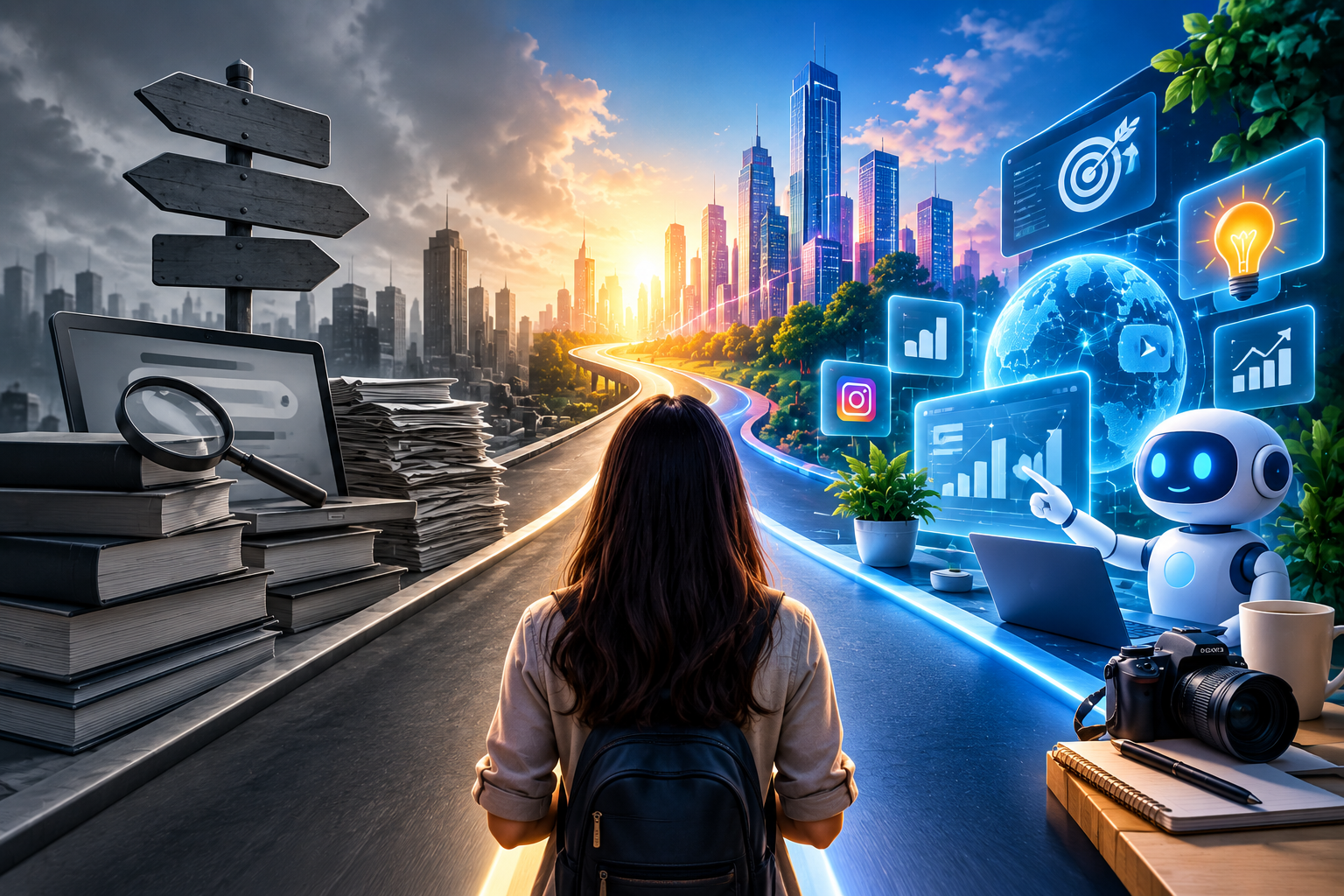
Artificial intelligence is not simply adding another tool to digital marketing. It is changing how people search, how content is discovered, how advertisements are created, and how marketers make decisions.
Search is becoming more conversational. AI systems can summarise information before users visit websites. Advertising platforms are increasingly using AI to match queries, audiences and creative assets. Content production is becoming faster, but generic content is also becoming easier to produce.
That creates a new challenge:
If everyone can create content and advertising with AI, what will actually make a marketer valuable?
The answer is not simply “learn AI.”
The future belongs to marketers who can combine AI tools with strategy, creativity, data, customer understanding, original expertise and strong judgement.
Google itself says its AI Search features still rely on the fundamentals of SEO and that there are no special technical requirements specifically needed to appear in AI Overviews or AI Mode. At the same time, Google is encouraging publishers to create unique, valuable, non-commodity content.
This means the future of digital marketing is not:
Human marketers vs AI.
It is increasingly:
Human expertise + AI capabilities.
Table of Contents
- Key Takeaways
- What Is Changing in Digital Marketing?
- Why AI Is Such a Big Shift
- How Search Is Changing
- What AI Search Means for SEO
- Is SEO Dead Because of AI?
- How Content Marketing Is Changing
- The Problem With Mass AI Content
- What Makes Content Valuable in the AI Era?
- How AI Is Changing Digital Advertising
- Google Ads and AI
- Social Media Advertising and AI
- AI and Social Media Marketing
- What Happens to Digital Marketing Jobs?
- Skills Digital Marketers Need
- Beginner vs Advanced Marketer
- AI Tools vs Human Skills
- What Businesses Should Do
- What Students Should Learn
- 30-Day AI-Era Digital Marketing Roadmap
- Common Myths
- Common Mistakes
- Future Trends
- FAQs
- Conclusion
Key Takeaways
- AI is changing how digital marketing work is performed, not simply eliminating the profession.
- Search is moving from traditional keyword-result pages toward more conversational and AI-assisted experiences.
- Google AI Overviews and AI Mode are changing how users discover information while continuing to surface links to websites.
- SEO is not dead. However, focusing only on keywords and rankings is becoming a weaker strategy.
- Original information, first-hand experience, useful explanations and trustworthy content are becoming more important.
- AI can speed up content production, but it cannot replace strategic judgement.
- Advertising platforms are increasingly automating targeting and creative optimisation.
- Google Ads’ AI Max, for example, uses AI for search-term matching and asset optimisation within Search campaigns.
- Digital marketers need to learn AI alongside marketing fundamentals.
- Analytical thinking, creativity, adaptability and continuous learning remain important as technology changes.
- Businesses should measure outcomes rather than simply increasing the amount of AI-generated content.
- Students should build projects and practical skills instead of collecting certificates alone.
What Is Changing in Digital Marketing?
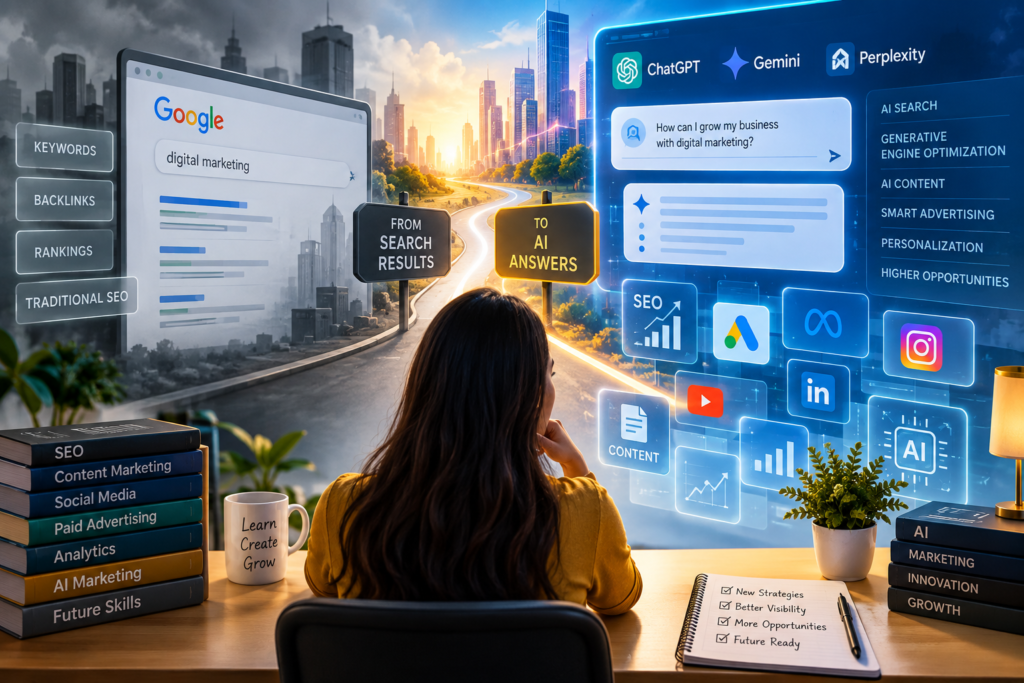
Digital marketing is moving from a largely manual, keyword-and-platform-driven discipline toward an AI-assisted, data-driven and increasingly conversational discipline.
Traditional digital marketing often looked like this:
Keyword → Content → Search Ranking → Click → Website → Conversion
The emerging model is more complicated:
Question → AI/Search Discovery → Multiple Sources → Content/Brand Exposure → Website/Social/Marketplace → Conversion
And sometimes:
Customer Need → AI Assistant → Recommendation → Action
This does not mean the traditional model disappears.
Instead, more paths are being added.
Google’s AI Search experiences are designed to help users ask longer and more complex questions while still providing links that allow them to explore the web.
For marketers, this creates both a challenge and an opportunity.
What Is Changing in Digital Marketing?
Digital marketing is moving from a largely manual, keyword-and-platform-driven discipline toward an AI-assisted, data-driven and increasingly conversational discipline.
Traditional digital marketing often looked like this:
Keyword → Content → Search Ranking → Click → Website → Conversion
The emerging model is more complicated:
Question → AI/Search Discovery → Multiple Sources → Content/Brand Exposure → Website/Social/Marketplace → Conversion
And sometimes:
Customer Need → AI Assistant → Recommendation → Action
This does not mean the traditional model disappears.
Instead, more paths are being added.
Google’s AI Search experiences are designed to help users ask longer and more complex questions while still providing links that allow them to explore the web.
For marketers, this creates both a challenge and an opportunity.
Why AI Is Such a Big Shift
AI is different from many previous marketing technologies because it can participate in multiple parts of the workflow.
For example, AI can assist with:
- research;
- brainstorming;
- content outlines;
- copy variations;
- audience analysis;
- campaign ideas;
- image creation;
- video concepts;
- reporting;
- data analysis;
- workflow automation;
- customer communication.
Previously, a marketer might spend hours completing repetitive tasks.
Now some of those tasks can be accelerated significantly.
But faster execution creates another problem:
When everyone can produce more, production itself becomes less valuable.
If 1,000 businesses can generate ten blog posts a day, producing ten blog posts is no longer a meaningful competitive advantage.
The competitive advantage moves toward:
- better ideas;
- better data;
- better customer understanding;
- original insights;
- stronger brand positioning;
- better execution;
- better measurement.
How Search Is Changing
Search is becoming more conversational, multimodal and AI-assisted, which means marketers need to optimise for useful answers and discovery rather than only traditional blue-link rankings.
Google introduced AI Mode in India in 2025 and has continued expanding AI-powered Search experiences. Google reported in 2026 that AI Overviews had more than 2.5 billion monthly active users globally and AI Mode had surpassed one billion monthly users.
That scale matters because user behaviour changes when the interface changes.
A traditional search might be:
“best digital marketing course”
An AI-assisted search might be:
“I am a B.Com graduate in Jalandhar with no marketing experience. Which digital marketing skills should I learn first, how long might it take, and what should I put in my portfolio?”
The second query contains:
- personal context;
- multiple questions;
- comparison;
- decision-making;
- career intent.
That is a much richer marketing opportunity.
What Does This Mean for Marketers?
Marketers need to understand search intent at a deeper level.
Instead of creating one article for:
“digital marketing course”
you may need content addressing different stages:
Awareness
What is digital marketing?
Problem
Why can’t I get a digital marketing job after graduation?
Education
What digital marketing skills should a beginner learn?
Comparison
Online digital marketing course vs classroom training
Decision
What should I check before choosing a digital marketing course?
Local Intent
Digital marketing course in Jalandhar
The more clearly a business understands its audience’s questions, the easier it becomes to create useful content.
What AI Search Means for SEO
AI Search does not eliminate SEO; it makes the quality and usefulness of SEO more important.
Google’s current guidance is particularly important here.
Google says the same SEO fundamentals remain relevant for AI Overviews and AI Mode, and that there are no additional special optimisation requirements for appearing in those AI features.
Google’s 2026 guidance also emphasises valuable, unique, non-commodity content and provides recommendations around local, shopping, image and video content.
So businesses should not assume they need a completely separate “AI SEO” system.
A better approach is:
Strong SEO foundation + unique content + clear information + first-hand expertise + useful media + strong technical health
Is SEO Dead Because of AI?
No. SEO is not dead, but the definition of successful SEO is changing.
Old-style SEO often focused heavily on:
- exact-match keywords;
- keyword density;
- backlinks;
- ranking positions;
- publishing volume.
Modern SEO requires a broader approach.
Consider two websites.
Website A
Publishes 50 AI-generated articles.
Most repeat information already available elsewhere.
Website B
Publishes 10 detailed articles containing:
- original examples;
- first-hand experience;
- screenshots;
- practical processes;
- expert explanations;
- unique data;
- useful comparisons.
Website B has fewer articles.
But it may offer significantly more value.
This is why information gain matters.
A Better SEO Framework for the AI Era
Use this model:
1. Understand the Query
What is the user really trying to accomplish?
2. Identify the Decision
What decision will they make after reading?
3. Find the Missing Information
What do existing articles fail to explain?
4. Add First-Hand Insight
What can your business explain from actual experience?
5. Make the Answer Easy to Extract
Use:
- clear headings;
- concise definitions;
- lists;
- tables;
- examples.
6. Go Beyond the Basic Answer
Explain:
- limitations;
- alternatives;
- mistakes;
- implementation;
- edge cases.
7. Give the Reader a Next Step
Help them act on the information.
How Content Marketing Is Changing
AI is making content production cheaper and faster, which means content quality, originality, expertise and distribution are becoming more important differentiators.
Before generative AI, producing a large amount of content required significant human effort.
Now marketers can create:
- outlines;
- drafts;
- social posts;
- ad variations;
- email ideas;
- video scripts;
- image concepts;
much faster.
This is useful.
But it creates a content-supply problem.
More content does not automatically mean more attention.
The internet already contains huge amounts of repetitive content.
AI can increase that supply.
Therefore, businesses need to ask:
“Why should someone read our content instead of the hundreds of similar pages already available?”
That is the strategic question.
The Problem With Mass AI Content
AI-generated content becomes weak when the workflow looks like:
Keyword → Prompt → Article → Publish
There is almost no original thinking.
A stronger workflow looks like:
Audience Research → Search Intent → Expert Input → Original Data/Examples → AI Assistance → Human Editing → Fact Checking → Publication → Measurement
The difference is enormous.
AI becomes an assistant rather than the author of the strategy.
What Makes Content Valuable in the AI Era?
1. First-Hand Experience
Explain what you have actually done.
For example:
Instead of:
“SEO is important for businesses.”
Explain:
“When auditing a local business website, check whether its service pages clearly target the areas it serves, whether Google Business Profile information is consistent, and whether location-specific pages provide genuinely useful information.”
That is more practical.
2. Original Examples
Show examples from realistic business situations.
For example:
Restaurant
Search intent:
“best family restaurant near me”
Potential content:
- menu;
- location;
- opening hours;
- photos;
- reviews;
- parking;
- reservation information.
3. Data
If you have legitimate first-party data, use it.
This could include:
- campaign performance;
- customer surveys;
- website analytics;
- content performance;
- conversion patterns.
Never invent statistics.
4. Expert Commentary
Tell readers why you recommend something.
Not just:
“Use short videos.”
Instead:
“Short-form video can be useful when the product is easier to understand visually, but businesses should choose the format based on customer behaviour rather than following every social-media trend.”
AI Content vs Human-Led Content
| AI-Heavy Workflow | Human-Led AI Workflow |
|---|---|
| Prompt → Publish | Research → Strategy → AI → Human Review |
| Generic | Specific |
| High volume | Purposeful volume |
| Repetitive | Original |
| Keyword-focused | Intent-focused |
| Little experience | First-hand expertise |
| Minimal editing | Strong editorial review |
| Automation-first | Customer-first |
The goal is not to avoid AI.
The goal is to avoid producing content that has no reason to exist.
How AI Is Changing Digital Advertising
AI is increasingly automating parts of audience targeting, search-term matching, creative generation and optimisation, shifting marketers toward strategy, measurement and oversight.
Google’s AI Max for Search campaigns is a good example.
Google describes AI Max as an optimisation layer for Search campaigns that includes features such as search-term matching and asset optimisation.
That changes the role of the advertiser.
Previously, marketers spent substantial time manually managing:
- keywords
- targeting
- ad variations
- creative combinations
Automation can now handle more of these decisions.
But the marketer still needs to determine:
- campaign objective
- offer
- budget
- landing page
- brand positioning
- conversion event
- acceptable acquisition cost
- business constraints
Google Ads and AI
Google’s AI Max can expand search matching and optimise creative assets using AI. Google also describes controls around location, brand and campaign settings.
This means paid-search professionals need to develop a new skill:
Managing automation rather than manually controlling every variable.
A future-focused Google Ads professional should understand:
Business Goal → Tracking → Audience → Offer → Creative → Landing Page → AI Automation → Measurement
The human’s job increasingly becomes deciding:
What should the system optimise for?
rather than:
How do I manually change every setting?
Social Media Advertising and AI
Social platforms are also moving toward increasingly automated advertising systems.
The general direction is similar:
More machine learning → more automated targeting and creative optimisation → more importance on strategy and quality inputs.
For marketers, this means creative strategy becomes increasingly important.
Why?
Because when platforms automate more of the delivery process, the quality of the assets you give them matters.
That means marketers need to understand:
- hooks
- creative angles
- offers
- customer pain points
- formats
- messaging
- brand identity
- testing
AI and Social Media Marketing
AI can help social media teams with:
- content ideas
- caption variations
- content calendars
- script drafts
- repurposing
- comment classification
- trend research
- creative brainstorming
But there is a major limitation.
AI can generate ten captions.
It cannot automatically know which caption fits your brand, customer and local context unless you provide the right information and evaluate the output.
That is why brand knowledge remains important.
The Future of Content Creation
The content creator of the future may not simply be someone who can write.
They may need to combine:
Research + Writing + Video + Design + AI + Analytics + Distribution
A creator who can turn one idea into:
- a blog
- Instagram Reel
- YouTube Short
- LinkedIn post
- Pinterest graphic
- infographic
has more leverage than someone who creates one format only.
AI can help with repurposing.
The creator still needs the original idea.
What Happens to Digital Marketing Jobs?
AI is likely to change many digital marketing tasks rather than simply remove the need for digital marketers.
The World Economic Forum’s Future of Jobs Report 2025 identifies AI and big data among the fastest-growing skill areas while also highlighting creative thinking, resilience, flexibility, agility, curiosity and lifelong learning.
This is important.
The future marketer may need more skills, not fewer.
For example:
SEO Executive
May increasingly need:
- SEO
- analytics
- content strategy
- AI Search understanding
- technical knowledge
- content quality evaluation
Content Marketer
May need:
- writing
- research
- AI tools
- video
- analytics
- distribution
Paid Media Specialist
May need:
- campaign strategy
- creative testing
- conversion tracking
- AI automation
- data analysis
Social Media Manager
May need:
- strategy;
- creative production;
- community management;
- AI tools;
- analytics.
Skills Digital Marketers Need in the AI Era
Here is the practical skill stack I would recommend.
Core Marketing Skills
- customer research;
- positioning;
- marketing funnels;
- offers;
- copywriting;
- conversion principles.
Digital Skills
- SEO;
- content marketing;
- social media;
- paid advertising;
- analytics;
- email marketing.
AI Skills
- prompt design;
- AI-assisted research;
- workflow automation;
- content ideation;
- data analysis;
- AI quality control.
Human Skills
- communication;
- creativity;
- analytical thinking;
- problem solving;
- adaptability;
- strategic judgement.
Beginner vs Advanced Digital Marketer
| Beginner | Advanced |
|---|---|
| Learns tools | Understands systems |
| Follows tutorials | Solves problems |
| Writes posts | Builds content strategy |
| Runs basic campaigns | Designs acquisition strategy |
| Reads metrics | Interprets business impact |
| Uses AI for output | Uses AI for workflow leverage |
| Focuses on tasks | Focuses on outcomes |
| Copies examples | Develops original approaches |
The goal should not be to remain a tool operator.
The goal is to become a problem solver who knows how to use tools.
AI Tools vs Human Skills
| AI Is Good At | Humans Are Still Needed For |
|---|---|
| Generating variations | Choosing the right direction |
| Summarising | Judging importance |
| Brainstorming | Understanding business context |
| Pattern recognition | Strategic decisions |
| Repetitive tasks | Relationship building |
| Drafting | Brand voice |
| Data processing | Business interpretation |
| Scaling workflows | Accountability |
The best workflow combines both.
A Practical AI-Era Marketing Workflow
Imagine a local business wants more leads.
Step 1 — Human Research
Understand:
- customers;
- competitors;
- location;
- product;
- pricing;
- objections.
Step 2 — AI-Assisted Research
Use AI to organise:
- customer questions;
- content ideas;
- competitor themes;
- keyword clusters.
Step 3 — Human Strategy
Choose:
- positioning;
- content priorities;
- campaign objective;
- offer.
Step 4 — AI Production
Generate:
- initial drafts;
- creative variations;
- scripts;
- headlines.
Step 5 — Human Review
Check:
- accuracy;
- brand voice;
- claims;
- originality;
- usefulness.
Step 6 — Publish
Distribute through:
- website
- search
- social media
- advertising
Step 7 — Measure
Evaluate:
- traffic
- leads
- conversions
- engagement
- customer quality
Step 8 — Improve
Use performance data to refine the strategy.
This is much more powerful than simply asking AI:
“Write me a marketing campaign.”
What Businesses Should Do
Businesses should not respond to AI by publishing more content simply because content is cheap.
Instead, build an AI-assisted marketing system.
Priority 1: Strengthen Your Website
Make sure the website clearly communicates:
- what you offer
- who you help
- where you operate
- why customers should trust you
- how customers can contact you
Priority 2: Build Topic Authority
Instead of publishing random articles, create connected content around important customer problems.
For example, a digital marketing training business could cover:
Pillar:
Digital Marketing Career
Supporting topics:
- digital marketing skills;
- SEO career;
- Google Ads;
- content marketing;
- AI in digital marketing;
- digital marketing courses;
- digital marketing jobs.
Priority 3: Add Original Information
Use:
- expert commentary;
- practical examples;
- screenshots;
- case studies;
- original research;
- customer questions.
Google’s recent guidance specifically encourages unique, valuable content rather than commodity information.
What Students Should Learn
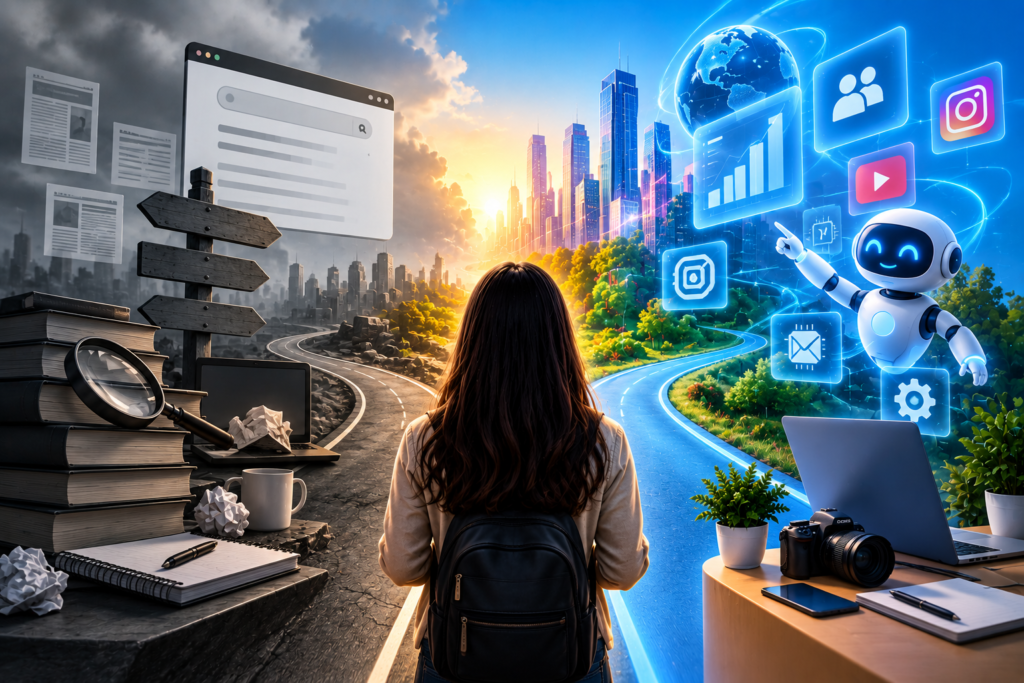
Students should learn marketing fundamentals first, then build practical digital and AI skills around a specific career direction.
Do not begin with:
“Which AI tool is trending?”
Start with:
“What problem do I want to solve professionally?”
For example:
If You Want SEO
Learn:
- search intent;
- keyword research;
- on-page SEO;
- technical SEO;
- analytics;
- content strategy;
- AI Search concepts.
If You Want Paid Advertising
Learn:
- campaign objectives;
- audience;
- creative;
- landing pages;
- tracking;
- analytics;
- AI optimisation.
If You Want Content Creation
Learn:
- storytelling;
- research;
- scripting;
- design;
- video;
- editing;
- social platforms;
- AI-assisted production.
Are Digital Marketing Courses Still Worth It?
Yes, structured digital marketing training can still be valuable, but the course should teach transferable marketing concepts and practical application—not just software interfaces.
A tool can change.
The underlying marketing principle may remain useful.
For example:
A platform interface may change.
But understanding:
Audience → Offer → Message → Distribution → Conversion → Measurement
remains valuable.
Before choosing an online marketing course, check whether it teaches:
- fundamentals;
- practical projects;
- current tools;
- analytics;
- AI workflows;
- real examples;
- portfolio development
Certification vs Practical Skill
| Certification | Practical Skill |
|---|---|
| Shows structured learning | Shows application |
| Useful for résumé | Useful in interviews |
| Easier to obtain | Requires practice |
| Limited evidence alone | Stronger with portfolio |
| Good starting point | Essential for competence |
A digital marketing certificate can support your learning journey.
But don’t make certification the final goal.
Make capability the goal.
Free vs Paid Digital Marketing Learning
| Free Resources | Paid Training |
|---|---|
| Low cost | Structured curriculum |
| Self-paced | Guided learning |
| Huge volume | Curated content |
| Quality varies | Quality depends on provider |
| Requires discipline | May provide accountability |
| Good for exploration | Useful for structured progression |
Use free resources when:
- you are exploring digital marketing;
- you want to learn fundamentals;
- you are comfortable learning independently.
Consider paid training when:
- you need structure;
- you want mentor feedback;
- you need practical assignments;
- you want accountability;
- you need help building projects.
The question should not be:
“Which course has the most modules?”
Ask:
“What can I actually do after completing this course?”
How to Choose a Future-Proof Digital Marketing Skill
No digital skill is completely future-proof.
Instead, choose skills with transferable principles.
A useful decision framework is:
High Transferability
Does the skill work across platforms?
Measurability
Can you connect your work to outcomes?
Strategic Value
Does the skill require judgement?
AI Compatibility
Can AI make you faster without completely replacing your role?
Business Value
Does the skill help generate revenue, reduce costs, improve customer experience or strengthen the brand?
The more “yes” answers you have, the more attractive the skill is as a long-term foundation.
Common Myths About AI and Digital Marketing
Myth 1: AI Will Replace Every Digital Marketer
Reality: AI is automating many tasks, but strategy, judgement, communication and customer understanding remain important.
Myth 2: SEO Is Finished
Reality: Search is changing, but websites and search visibility remain important. Google continues to state that foundational SEO best practices remain relevant to its AI Search experiences.
Myth 3: Publishing More AI Content Means More Traffic
Reality: More content does not automatically create more value.
Myth 4: Prompt Engineering Alone Is a Career
Reality: Prompting becomes more useful when combined with a domain skill.
Marketing + AI is more meaningful than simply saying:
“I know prompts.”
Myth 5: Keywords Don’t Matter Anymore
Reality: Understanding what users search for and what they need remains valuable. But keyword research should be connected to intent, topics and business goals.
Myth 6: Every Business Needs AI
Reality: Businesses need useful outcomes.
AI is a means, not the objective.
Common Mistakes Marketers Should Avoid
1. Chasing Every AI Tool
New tools appear constantly.
You do not need all of them.
2. Removing Human Review
AI can produce confident but incorrect information.
3. Publishing Without Strategy
AI makes content creation easy.
That makes strategy more important.
4. Measuring Vanity Metrics
Followers and impressions are not always business outcomes.
5. Ignoring First-Party Data
Your customer data can be more useful than generic industry assumptions.
6. Treating AI Search Like Traditional Search
AI Search requires thinking about how information is understood, cited, linked and discovered—not only where a page ranks.
7. Forgetting the Website
Social media can create attention.
A strong website can help turn that attention into a business relationship.
Future Trends in Digital Marketing
1. Conversational Search
Users will increasingly ask longer, more detailed questions.
Google says people are asking more complex questions through AI Search experiences.
2. AI-Assisted SEO
SEO professionals will increasingly evaluate:
- AI visibility;
- citations;
- content quality;
- entity relationships;
- topical authority;
- user intent.
Google has also begun introducing dedicated Search Console reporting for visibility in generative AI features, including AI Overviews and AI Mode, although the initial rollout was limited.
3. More Automated Advertising
Platforms will handle more optimisation automatically.
Marketers will increasingly manage:
- goals;
- inputs;
- creative;
- constraints;
- measurement.
Google’s AI Max is an example of this direction in Search advertising.
4. Original Content Will Matter More
When generic content becomes cheap, original content becomes more valuable.
That means:
Experience > repetition
Insight > volume
Evidence > claims
5. More Multimodal Marketing
People do not only search through text.
They use:
- images;
- video;
- voice;
- screenshots;
- conversational interfaces.
Marketers therefore need to think beyond blog posts.
6. AI Agents and Marketing
Search is also moving toward more agentic experiences.
Google’s 2026 announcements describe AI agents that can work on tasks and personalised experiences within Search.
That raises an interesting future question:
What happens when a consumer asks an AI to research, compare and help complete a purchase?
Marketing may increasingly involve influencing AI-mediated discovery, not only human attention.
The Future Marketing Funnel May Look Different
Traditional:
Awareness → Interest → Consideration → Conversion
AI-assisted:
Question → AI Discovery → Brand/Content Exposure → Evaluation → Recommendation → Action
This does not mean traditional funnels disappear.
It means there can be additional AI-driven touchpoints between the customer and the business.
A 30-Day AI-Era Digital Marketing Roadmap
Days 1–5: Understand Marketing
Learn:
- customer journey;
- positioning;
- audience;
- offers;
- funnels.
Days 6–10: Choose One Specialisation
Select:
- SEO;
- content;
- social media;
- Google Ads;
- Meta Ads;
- analytics.
Do not select everything.
Days 11–15: Add AI
Learn how AI can assist with:
- research;
- ideation;
- analysis;
- content;
- workflows.
Days 16–22: Build a Project
Choose a real or hypothetical business.
Create:
- audience profile;
- content strategy;
- campaign plan;
- SEO plan;
- creative strategy.
Days 23–26: Build Your Portfolio
Document:
- problem;
- research;
- strategy;
- execution;
- result;
- lessons.
Days 27–30: Publish and Improve
Publish your project.
Ask for feedback.
Improve it.
Then begin a second project.
AI-Era Digital Marketing Checklist
Before calling yourself “AI-ready,” ask:
- Do I understand marketing fundamentals?
- Can I identify search intent?
- Can I create a content strategy?
- Do I understand SEO fundamentals?
- Can I analyse basic marketing data?
- Can I use AI responsibly?
- Can I fact-check AI output?
- Can I create and evaluate marketing creatives?
- Can I explain campaign performance?
- Can I build a practical project?
- Can I communicate my decisions?
- Am I continuously learning?
If you can only tick the AI-tool boxes, you are not yet an AI-era marketer.
The Most Important Skill: Learning How to Learn
Technology changes too quickly for a marketer to depend on one tool forever.
Today’s platform may change.
Tomorrow’s AI model may be different.
A new advertising interface may appear.
A search experience may be redesigned.
Therefore, one of the most valuable professional skills is:
The ability to learn a new tool without losing your understanding of the underlying marketing principle.
That is much more durable.
A Simple Future-of-Marketing Framework
Remember this:
STRATEGY + DATA + CREATIVITY + AI + HUMAN JUDGEMENT
Strategy
Know what you are trying to achieve.
Data
Measure what actually happens.
Creativity
Create something people notice and remember.
AI
Use technology to increase speed and scale.
Human Judgement
Decide what is right, useful and appropriate.
Remove any one of these and the system becomes weaker.
Frequently Asked Questions
1. What is the future of digital marketing in the AI era?
The future of digital marketing is likely to be more AI-assisted, conversational, automated and data-driven, while human strategy, creativity, expertise and judgement remain important.
AI is changing how marketers execute tasks, but businesses still need people who understand customers and business objectives.
2. Will AI replace digital marketers?
AI is more likely to automate specific marketing tasks than eliminate every digital marketing role.
Marketers who learn to work effectively with AI may become more productive, while purely repetitive roles may face greater automation pressure.
3. Is SEO still important with AI Search?
Yes.
Google says its AI Search features continue to rely on foundational SEO practices. The bigger change is that marketers need to think beyond traditional rankings and focus on useful, original content and broader discovery.
4. Will AI-generated content rank on Google?
AI assistance itself is not the main issue; quality and usefulness matter.
Google’s guidance focuses on creating valuable content for people and warns against approaches that exist primarily to manipulate search rankings.
Use AI as part of a quality-controlled workflow rather than a shortcut to mass publishing.
5. How is AI changing content marketing?
AI is making content production faster, but originality and expertise are becoming more important.
Marketers can use AI for research, ideation and drafting while humans provide strategy, experience, fact-checking and editorial judgement.
6. How is AI changing Google Ads?
AI is increasingly helping with search-term matching, targeting and creative optimisation.
Google’s AI Max for Search campaigns is an example of this development.
Marketers therefore need to understand campaign strategy and measurement rather than relying entirely on manual optimisation.
7. Should students learn digital marketing in the AI era?
Yes, but they should learn digital marketing alongside AI rather than treating AI as a replacement for marketing knowledge.
Students should understand fundamentals first and then learn how AI can improve research, content, analytics and workflows.
8. Is a digital marketing certificate still useful?
Yes, a certificate can demonstrate structured learning, but it is not a substitute for practical ability.
A strong combination is:
Training + Certificate + Projects + Portfolio + Experience
9. What digital marketing skills will be important in the future?
Useful areas include:
- SEO;
- analytics;
- content strategy;
- paid advertising;
- social media;
- AI literacy;
- creativity;
- analytical thinking;
- communication;
- adaptability.
The exact skill mix will vary by role.
10. What is more important: AI skills or marketing skills?
Marketing skills come first; AI makes them more scalable.
Knowing how to use AI without understanding customers, positioning, messaging and measurement can produce faster but ineffective marketing.
11. Will keywords become irrelevant?
No, but keyword research should not be treated as the entire SEO strategy.
Marketers should understand the underlying questions, intent, topics, entities and problems represented by search behaviour.
12. Should businesses use AI to create all their content?
No.
AI can help with production, but businesses should maintain human oversight and add original information, expertise, brand context and fact-checking.
13. What is the biggest digital marketing trend right now?
The biggest structural shift is the integration of AI into search, advertising, content workflows and marketing analytics.
The important point is not to chase a single trend but to understand how these changes affect customer discovery and decision-making.
14. Is an online digital marketing course worth taking in the AI era?
It can be, especially if it teaches fundamentals, practical projects and current AI-assisted workflows.
Avoid courses that only teach button-clicking on tools without explaining the underlying strategy.
15. What should a beginner learn first?
Start with marketing fundamentals and one specialised digital skill.
For example:
Marketing fundamentals → SEO → Analytics → AI-assisted SEO
or:
Marketing fundamentals → Paid Ads → Tracking → AI-assisted optimisation
This is better than trying to learn every tool simultaneously.
Conclusion
The future of digital marketing will not be defined by who uses the most AI tools.
It will be defined by who can use AI to solve real marketing problems better.
Search is becoming more conversational.
Content creation is becoming faster.
Advertising platforms are becoming more automated.
Analytics is becoming increasingly important.
And businesses have more technology available than ever before.
But one thing has not changed:
Customers still need useful information, relevant solutions and reasons to trust a business.
AI can help marketers produce, analyse and optimise faster.
It cannot remove the need to understand:
- people;
- markets;
- businesses;
- positioning;
- creativity;
- trust;
- strategy.
Google’s own guidance around AI Search reinforces an important principle: foundational SEO remains relevant, while unique and valuable content continues to matter.
So don’t prepare for the future by learning AI alone.
Build the complete skill stack:
Marketing knowledge + Digital skills + AI literacy + Data + Creativity + Human judgement
That is the direction in which digital marketing is moving.
And for students and professionals, the smartest strategy is not to ask:
“Will AI replace my job?”
Ask:
“Which parts of my work can AI improve, and which human skills can I become exceptionally good at?”
Sikheya Digital Hub is a digital marketing institute and agency helping students, entrepreneurs and businesses learn and implement digital marketing, AI, social media marketing, SEO and online growth strategies.
Expertise
Digital Marketing
SEO
Social Media Marketing
Meta Ads
Google Ads
AI & Automation
Content Marketing



One Comment