ChatGPT Ads & GEO: A Roundtable With Go Fish Digital & OpenAI — What Marketers Need to Know
Artificial intelligence is changing the way people discover information, research products, compare services, and make buying decisions.
For years, businesses focused heavily on Google Search, SEO, social media marketing, and paid advertising. But the rise of conversational AI is creating another important digital discovery channel: ChatGPT and other AI-powered search and answer platforms.
Now, marketers have to think about two different opportunities inside ChatGPT:
- Paid visibility through ChatGPT Ads
- Organic visibility through Generative Engine Optimization (GEO)
This shift is the focus of an upcoming “ChatGPT Ads & GEO: A Roundtable With Go Fish Digital & OpenAI” hosted by Search Engine Journal. The roundtable is scheduled for September 22, 2026, at 2 PM ET, and brings together OpenAI’s SMB monetization leadership and GEO specialists from Go Fish Digital.
For digital marketers, SEO professionals, business owners, content creators, and agencies, the discussion represents a much larger change than simply “another advertising platform.”
The real question is:
How should businesses become visible when customers stop searching only through traditional search engines and start asking AI systems for answers, recommendations, comparisons, and solutions?
This article explains what ChatGPT Ads are, what GEO means, how paid and organic AI visibility differ, what marketers should prepare for, and what this development could mean for businesses in India.
What Is the ChatGPT Ads & GEO Roundtable?
The upcoming roundtable brings together experts from OpenAI and Go Fish Digital to discuss the two major ways businesses can gain visibility inside ChatGPT: paid advertising and organic AI visibility.
According to the event information, Abhilash Edathil, Head of SMB Monetization at OpenAI, will discuss the advertising side, while Patrick Algrim, VP of GEO, and Ashish Jacob, GEO Search Manager, from Go Fish Digital will discuss the organic visibility side. The session will be hosted by Search Engine Journal founder Loren Baker.
The event is particularly relevant because ChatGPT is not simply another version of Google Search.
A traditional search journey might look like this:
User → Google → Search Results → Website → Product/Service
A conversational AI journey can look more like:
User → Question → Conversation → AI-generated answer → Sources/recommendations → Decision
The user may explain their budget, preferences, location, problems, previous choices, and requirements in a single conversation.
That creates a completely different environment for marketers.
OpenAI itself describes ChatGPT Ads as a way for businesses to reach people while they explore options, compare alternatives, and make decisions.
What Are ChatGPT Ads?
ChatGPT Ads are paid advertising placements that appear within the ChatGPT experience.
OpenAI’s current advertising system allows businesses to create campaigns and reach users in conversational contexts. Ads are clearly labeled and appear separately from ChatGPT’s organic responses.
This distinction is extremely important.
An advertiser does not simply pay OpenAI to make ChatGPT recommend its product organically.
According to OpenAI, advertising and ChatGPT’s answers operate separately. Advertisers cannot pay to influence, rank, or change ChatGPT’s organic answers.
For example, imagine someone asks:
“I want to buy a laptop for video editing under ₹1 lakh. What should I look for?”
ChatGPT may provide an organic answer based on the information and sources available to it.
Separately, an eligible advertisement could potentially appear below the response if the advertiser’s offering is relevant to the conversation.
This creates a new form of advertising:
Conversation + Context + Commercial Intent + Advertisement
Why ChatGPT Ads Are Different From Google Ads
One of the biggest mistakes marketers could make is assuming that ChatGPT Ads are simply “Google Ads inside ChatGPT.”
They aren’t identical.
Traditional search advertising often begins with a relatively short query.
For example:
“best digital marketing course”
But a ChatGPT conversation could be much richer:
“I’m a college graduate from Punjab. I want to learn digital marketing, but I don’t know coding. I want a course that teaches SEO, social media, Google Ads, AI tools and practical projects, and I want to start freelancing after completing it.”
The second example contains much more context.
It tells the system about:
- The user’s background
- Location
- Goals
- Skill level
- Learning requirements
- Career objective
- Specific subjects
- Expected outcome
OpenAI says ChatGPT advertising can use multiple relevance signals, including conversational context and intent, the landing page, ad title and copy, advertiser-provided context hints, and, when personalization is enabled, selected signals from a user’s broader ChatGPT experience.
That means marketers need to think beyond keywords.
They need to understand customer situations.
What Are Context Hints in ChatGPT Ads?
One particularly interesting concept in ChatGPT advertising is context hints.
Context hints help advertisers explain when their product or service may be relevant.
OpenAI says context hints are not traditional exact-match keywords. Instead, they provide additional information about the product, customer need, or situation in which an offering could be useful.
Consider a running-shoe company.
A traditional keyword approach might focus on:
- Running shoes
- Sports shoes
- Running shoes online
- Best running shoes
A contextual approach could be:
“Cushioned everyday running shoes for beginners training for their first 5K.”
The second statement describes a customer situation, not just a keyword.
This is an important lesson for marketers.
The future of AI advertising is likely to be increasingly contextual.
Businesses should understand:
What does the customer want?
Why do they want it?
What problem are they trying to solve?
What constraints do they have?
What decision are they trying to make?
These questions can become more useful than simply collecting hundreds of keywords.
What Is GEO?
GEO stands for Generative Engine Optimization.
Traditional SEO is primarily concerned with helping web pages become visible in search engines.
GEO focuses on making a business, website, brand, or content more likely to be understood, surfaced, mentioned, cited, or referenced by generative AI systems.
Instead of asking:
“How do I rank at position #1?”
A GEO-focused marketer may ask:
“How can my business become a reliable source when an AI system answers questions about my industry?”
This represents a significant change in digital marketing.
The objective is no longer only:
Rank → Click → Visit
It can increasingly become:
Understand → Surface → Mention → Cite → Influence the decision
SEO vs GEO: What’s the Difference?
SEO and GEO should not be treated as competitors.
They overlap significantly, but they emphasize different discovery environments.
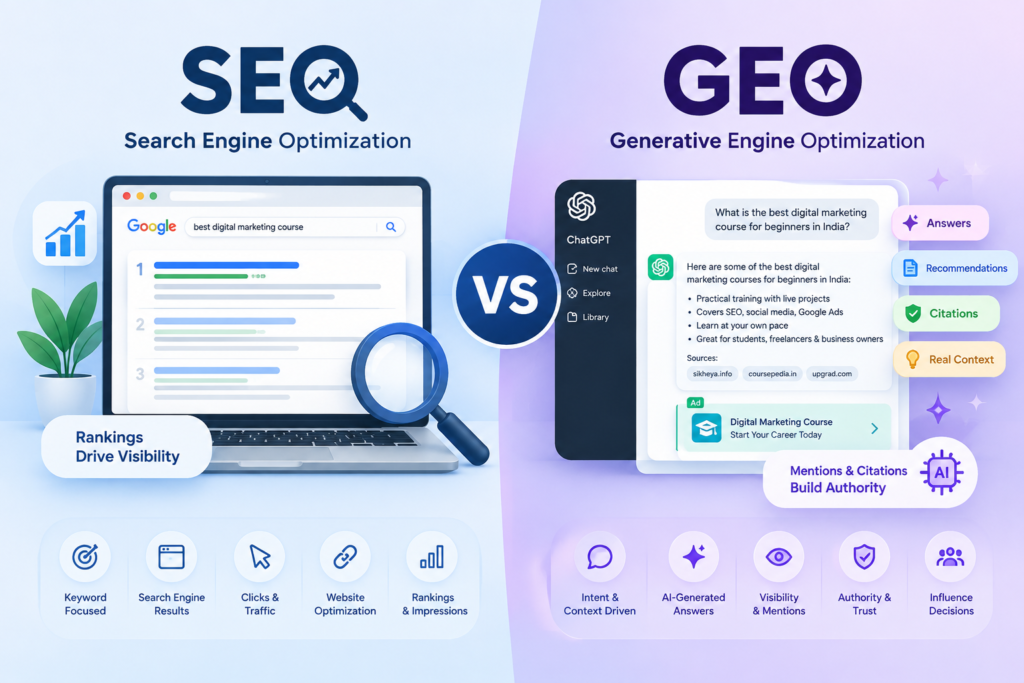
| Traditional SEO | GEO |
|---|---|
| Focuses heavily on search engines | Focuses on generative AI systems |
| Keyword-oriented | Intent and context-oriented |
| Rankings are important | Mentions, citations and inclusion matter |
| SERPs are central | AI-generated answers are central |
| Clicks are a major KPI | Visibility and influence can happen before the click |
| Website optimization | Content + authority + machine readability |
The important point is that GEO does not mean abandoning SEO.
A strong technical SEO foundation can actually support AI visibility.
OpenAI’s publisher guidance says public websites can appear in ChatGPT Search and recommends allowing OAI-SearchBot to crawl content if a site wants its pages to be discovered, surfaced, cited, and linked in ChatGPT search results.
Why Content Structure Matters for GEO
AI systems need to understand what a webpage actually says.
A page filled with vague marketing language may be difficult to interpret.
For example:
“We deliver world-class solutions designed to transform your digital future.”
What exactly does the company do?
A clearer version might say:
“Sikheya Digital Hub provides practical digital marketing training in India covering SEO, social media marketing, Google Ads, content creation, AI marketing tools and website development.”
The second statement is easier to understand.
For GEO, businesses should make important information:
- Clear
- Specific
- Factual
- Well structured
- Consistent
- Easy to extract
- Supported by evidence where appropriate
The Importance of Entity and Brand Information
AI visibility is not only about individual blog posts.
It is also about helping systems understand who your business is.
For example, a business website should clearly communicate:
- Business name
- Products
- Services
- Locations
- Industry
- Expertise
- Contact information
- About information
- Customer segments
- Frequently asked questions
- Author information
- Credentials
- Case studies
- Reviews and testimonials
- Policies
If a company sells digital marketing courses, the website should clearly explain what courses exist and who they are for.
Instead of publishing dozens of disconnected articles, create a strong topical structure.
For example:
Digital Marketing
→ SEO
→ Google Ads
→ Social Media Marketing
→ Content Marketing
→ AI Marketing
→ Email Marketing
→ Local SEO
→ E-commerce Marketing
This creates a more understandable content ecosystem.
ChatGPT Ads and GEO Are Not the Same Thing
This is probably the most important concept marketers should understand.
ChatGPT Ads = Paid visibility
GEO = Organic visibility
If a company runs ChatGPT Ads, it is purchasing advertising exposure.
If ChatGPT organically mentions or cites a company, that is a different mechanism.
OpenAI explicitly states that advertisements do not influence ChatGPT’s answers.
Therefore, marketers should not assume:
“If I advertise, ChatGPT will recommend my brand.”
That’s not how the systems are designed.
A business can potentially have:
- Organic AI visibility without advertising
- Paid visibility without organic mentions
- Both
- Neither
This makes separate measurement extremely important.
Why Businesses May Need Both Paid and Organic AI Strategies
Imagine an e-commerce company selling skincare products.
Its GEO strategy could involve creating useful content around:
- How to choose skincare products
- Ingredients
- Skin types
- Product comparisons
- Common skincare questions
- Product guides
- FAQs
At the same time, the business could test ChatGPT Ads for specific commercial situations.
The two strategies have different roles.
GEO can help build:
- Organic visibility
- Authority
- Brand recognition
- Citations
- Long-term discoverability
ChatGPT Ads can provide:
- Paid exposure
- Controlled campaign objectives
- Audience and geographic targeting options
- Traffic opportunities
- Conversion-focused campaigns
OpenAI’s current Ads Manager supports campaign objectives including Views, Clicks, and Conversions, along with country targeting and other campaign settings.
What Does This Mean for Indian Businesses?
This is where the topic becomes particularly interesting.
India has millions of small and medium-sized businesses competing for attention online.
Businesses include:
- Coaching institutes
- Digital marketing agencies
- Restaurants
- Salons
- Local retailers
- Clothing brands
- Home businesses
- Real estate companies
- Doctors and clinics
- Consultants
- Freelancers
- Manufacturers
- E-commerce brands
- Educational institutes
Traditionally, many of these businesses depended on Google Search and social media.
AI discovery introduces another layer.
Consider someone asking:
“Best digital marketing course in Punjab for beginners?”
Or:
“Which digital marketing skills should I learn in 2027?”
Or:
“I run a small clothing business in India. How can I get customers through Instagram and WhatsApp?”
These are conversational questions.
The business opportunity is to create content that directly addresses the questions customers are asking.
GEO Strategy for a Local Indian Business
Suppose you run a salon in Jalandhar.
Instead of publishing only:
“Welcome to our salon.”
Create useful content such as:
Blog 1
How to Choose the Right Haircut for Your Face Shape
Blog 2
Hair Care Tips for Indian Weather
Blog 3
Keratin vs Hair Spa: What’s the Difference?
Blog 4
How Much Does a Professional Hair Treatment Cost in India?
Blog 5
Questions to Ask Before Booking a Bridal Makeup Artist
The goal is not to stuff these articles with keywords.
The goal is to become a useful information source.
That is much closer to how AI-driven discovery works.
Build Content Around Real Questions
One of the most practical GEO strategies is simple:
Stop creating content only around keywords.
Start creating content around questions and decisions.
Instead of:
“Digital Marketing Course”
Create:
“What Does a Digital Marketing Course Actually Teach?”
Instead of:
“SEO Services”
Create:
“How Long Does SEO Usually Take to Produce Results?”
Instead of:
“Social Media Marketing”
Create:
“How Can a Small Business Get Customers From Instagram?”
Instead of:
“Google Ads”
Create:
“How Much Should a Small Business Spend on Google Ads?”
These topics reflect real customer conversations.
Create Answer-First Content
AI systems are designed to provide answers.
Therefore, your content should make important answers easy to identify.
For example:
What Is GEO?
GEO, or Generative Engine Optimization, is the practice of improving a brand’s visibility and understanding across AI-powered search and generative answer systems.
Then expand:
- How GEO works
- Why GEO matters
- GEO vs SEO
- GEO strategies
- Examples
- FAQs
- Tools
- Measurement
This structure helps human readers and makes the information easier to understand programmatically.
Use FAQs Strategically
Frequently asked questions can be extremely useful for both users and content strategy.
For a digital marketing institute, questions could include:
Is digital marketing difficult to learn?
Digital marketing can be learned by beginners when the learning process is structured around practical skills such as content creation, SEO, social media, advertising, analytics and AI tools.
Is digital marketing useful for business owners?
Yes. Business owners can use digital marketing to build online visibility, generate leads, communicate with customers and promote products or services.
Can beginners learn digital marketing?
Yes. Beginners can start with foundational areas such as content marketing, social media, SEO and basic paid advertising before moving into advanced strategies.
The objective should always be to provide genuinely useful information rather than writing FAQs purely for search engines.
Don’t Ignore Your Website’s Technical Foundation
GEO is not a replacement for technical SEO.
Your website still needs:
- Fast loading
- Mobile responsiveness
- Crawlable pages
- Logical navigation
- Clean URLs
- Good internal linking
- Proper headings
- Structured content
- Accessible pages
- Secure HTTPS
- Accurate metadata
- Useful page titles
For websites that want visibility in ChatGPT Search, OpenAI specifically advises publishers to avoid blocking OAI-SearchBot.
For advertising landing pages, OpenAI also says advertisers need to allow OAI-AdsBot, while recommending OAI-SearchBot as well.
So technical accessibility is becoming relevant to both organic AI discovery and AI advertising.
What Should Marketers Measure?
Traditional SEO reporting often focuses on:
- Rankings
- Impressions
- Clicks
- CTR
- Organic traffic
- Backlinks
AI visibility may require additional measurements.
Businesses can start tracking:
Organic AI visibility
- Brand mentions
- Citations
- AI-generated recommendations
- Inclusion in relevant answers
- Referral traffic from AI platforms
- Branded searches following AI exposure
Paid AI visibility
- Impressions
- Clicks
- CTR
- CPC
- CPM
- Conversions
- Cost per conversion
- Lead quality
- Revenue
- Landing-page engagement
OpenAI’s current advertising platform supports impression, click and conversion-oriented objectives and provides measurement options for advertisers.
The key is not to treat every metric as interchangeable.
A ChatGPT impression and a Google Search impression may represent different user experiences.
Don’t Compare ChatGPT Ads and Google Ads Too Quickly
Marketers naturally want to ask:
“Are ChatGPT Ads better than Google Ads?”
That’s not necessarily the most useful question.
A better question is:
“What role does ChatGPT play in my customer’s decision journey?”
A person searching Google may be looking for a website.
A person using ChatGPT may be asking for:
- Research
- Advice
- Comparisons
- Recommendations
- Explanations
- Planning
- Product discovery
The customer journey can therefore look different.
Go Fish Digital has also highlighted the distinction between ChatGPT and traditional search advertising, noting that OpenAI has positioned ChatGPT as a different environment rather than simply another search channel.
A Practical GEO Framework for 2026
At Sikheya Digital Hub, businesses can think about GEO using a simple framework:
1. Understand
Make it obvious what your company does.
2. Answer
Create content answering customer questions.
3. Structure
Organize content into clear topics and categories.
4. Prove
Use case studies, credentials, reviews, data and first-hand experience where appropriate.
5. Connect
Build relationships between related pages through internal linking.
6. Maintain
Keep prices, services, products, locations and important information updated.
7. Measure
Monitor organic AI visibility and referral traffic where measurable.
This is not about trying to “hack ChatGPT.”
It is about building a website that is genuinely useful and understandable.
What Should Businesses Do Before Running ChatGPT Ads?
If your business is considering ChatGPT Ads, don’t immediately start by creating dozens of advertisements.
Start with research.
Step 1: Identify your best product
Choose a product or service with clear customer intent.
Step 2: Understand customer situations
Ask:
- What problem causes someone to look for this?
- What alternatives do they consider?
- What objections do they have?
- What questions do they ask?
- What budget constraints exist?
- What makes them choose one provider over another?
Step 3: Create relevant landing pages
Don’t automatically send every user to your homepage.
Create pages specifically relevant to the advertised offering.
Step 4: Write useful ad messages
OpenAI recommends clear, specific and benefit-focused advertising copy rather than vague marketing language.
Step 5: Test different messages
Different customers may have different needs.
Your creative should reflect those different situations.
Step 6: Measure conversions
Don’t stop at clicks.
If the campaign objective and setup support it, measure what happens after the click.
Example: ChatGPT Ads Strategy for a Digital Marketing Institute
Let’s take a practical example for an institute like Sikheya Digital Hub.
Potential audience:
Students, freelancers, business owners and professionals interested in digital marketing.
Instead of creating one generic campaign, you could think in terms of different customer needs.
Ad Group 1: Beginners
Context:
People looking for a practical digital marketing course to start from beginner level.
Landing page:
Digital Marketing Course
Ad Group 2: Business Owners
Context:
Business owners looking to learn digital marketing to promote their own business.
Landing page:
Digital Marketing for Business Owners
Ad Group 3: Freelancers
Context:
People wanting to learn digital marketing skills for freelancing and client work.
Landing page:
Digital Marketing Freelancing Course
Ad Group 4: AI Marketing
Context:
Professionals looking to learn how AI tools can improve content, marketing research and business workflows.
Landing page:
Digital Marketing With AI
This approach is more contextual than simply targeting:
“digital marketing course”
The Biggest GEO Mistake: Writing for AI Instead of People
As GEO becomes popular, another problem can emerge.
Businesses may start publishing articles like:
“Best GEO SEO AI optimization ChatGPT ranking strategy 2026”
That’s not useful.
GEO should not become another form of keyword stuffing.
The best content still needs to be:
- Helpful
- Original
- Accurate
- Well researched
- Easy to read
- Relevant
- Updated
- Written for real people
AI visibility should be a result of good digital publishing practices, not an excuse to produce low-quality content at scale.
What the OpenAI + Go Fish Digital Discussion Could Mean for Marketers
The upcoming roundtable is significant because it brings together two sides of the AI marketing equation.
OpenAI → Paid visibility
Go Fish Digital → Organic AI visibility
The event description specifically focuses on questions such as how businesses can maximize their presence in ChatGPT, whether brands should combine ChatGPT Ads with GEO, how businesses can sell products or generate leads through ChatGPT, and where marketers should prioritize paid versus organic efforts.
The answers will matter because businesses need a framework for deciding:
- Where should we invest content resources?
- Should we test ChatGPT advertising?
- How do we measure AI visibility?
- What content should we create?
- How does AI discovery differ from Google?
- How should SEO teams adapt?
- How should paid media teams adapt?
These are no longer purely theoretical questions.
OpenAI has continued expanding ChatGPT advertising, and its current platform includes campaign management, targeting, measurement and conversion-oriented capabilities.
The Future of Digital Marketing May Be AI-Native
The bigger story isn’t simply that ChatGPT has ads.
The bigger story is that the customer journey itself is changing.
Previously:
Search → Browse → Compare → Visit → Decide
Increasingly, an AI-assisted journey can be:
Ask → Explain → Compare → Refine → Decide
That compression has major implications for marketers.
Brands need to become useful before the click.
Content needs to answer questions.
Websites need to communicate clearly.
Brands need credible information.
Advertising needs to be relevant to the context.
And marketing teams need to understand how paid and organic visibility work together without confusing the two.
Final Takeaway
The upcoming ChatGPT Ads & GEO roundtable with Go Fish Digital and OpenAI highlights an important transition in digital marketing.
AI platforms are becoming part of the way people research, compare, discover and make decisions.
For marketers, that creates two separate but connected opportunities:
Paid AI visibility
Use ChatGPT Ads to reach relevant audiences within conversational experiences.
Organic AI visibility
Use GEO and strong content practices to increase the likelihood that your brand and content can be understood, surfaced, cited or mentioned in AI-generated experiences.
The key lesson is not that businesses should abandon Google, SEO, social media or traditional advertising.
Instead, businesses should expand their digital strategy.
The future may not be:
SEO vs GEO
or
Google Ads vs ChatGPT Ads
It may increasingly be:
SEO + GEO + Paid Media + Content + Brand + AI
The businesses that prepare early can use this period to understand how their customers are using AI, what questions they ask, which topics matter most, and where their existing digital presence needs improvement.
For Indian businesses in particular, this creates an opportunity to build strong, useful, structured digital assets before AI-driven discovery becomes an even more important part of the customer journey.
Frequently Asked Questions About ChatGPT Ads & GEO
What are ChatGPT Ads?
ChatGPT Ads are paid advertising placements within the ChatGPT experience. OpenAI says ads are clearly labeled and kept separate from ChatGPT’s organic responses.
Can advertisers pay to influence ChatGPT’s answers?
According to OpenAI, no. Advertisements operate separately from ChatGPT’s answers, and advertisers cannot pay to shape, rank or change organic responses.
What is GEO?
GEO stands for Generative Engine Optimization. It refers broadly to optimizing a brand’s digital presence so that it can be better understood and potentially surfaced, mentioned or cited by generative AI systems.
Is GEO the same as SEO?
No. GEO and SEO overlap, but GEO focuses more heavily on visibility within AI-generated answers and conversational discovery, while SEO traditionally focuses on visibility within search engines.
Should a business invest in GEO or ChatGPT Ads?
They serve different purposes. ChatGPT Ads provide paid visibility, while GEO focuses on organic AI visibility. Businesses can evaluate both based on their goals, customer journey and available data.
Do I need SEO if I am doing GEO?
SEO fundamentals still matter. Website accessibility, crawlability, structure, useful content and strong information architecture can support broader digital discoverability.
Can small businesses use ChatGPT Ads?
OpenAI’s current advertising platform is designed to allow businesses to participate through its Ads Manager, with campaign objectives and targeting capabilities. Availability and eligibility can vary by market and account.
How can I start GEO for my business?
Start by understanding your customers’ questions, creating genuinely useful content, organizing your website clearly, strengthening authority and trust signals, improving technical accessibility, and monitoring how your brand appears across AI-powered discovery platforms.
About Sikheya Digital Hub
Sikheya Digital Hub focuses on practical digital marketing education and skills for students, professionals, freelancers, creators and business owners.
As AI changes how people search, learn and make purchasing decisions, digital marketers need to understand more than traditional SEO and advertising.
The next generation of marketers will need to understand:
SEO + GEO + AI + Content + Paid Advertising + Social Media + Analytics
And that journey starts with learning how the digital ecosystem is changing.
Keep learning. Keep experimenting. Keep adapting.
Sikheya Digital Hub is a digital marketing institute and agency helping students, entrepreneurs and businesses learn and implement digital marketing, AI, social media marketing, SEO and online growth strategies.
Expertise
Digital Marketing
SEO
Social Media Marketing
Meta Ads
Google Ads
AI & Automation
Content Marketing