
Top 10 AI Skills Students Must Learn to Stay Relevant in 2026
Artificial Intelligence is no longer something students need to prepare for “someday.” AI tools are already changing how people research, create content, analyze information, automate tasks, and work across different industries.
For students, this does not mean that everyone needs to become an AI engineer or learn advanced programming. In many careers, the more useful goal is to understand how to work effectively with AI and combine it with human skills such as creativity, communication, critical thinking, and problem-solving.
The good news is that students can start developing these skills without becoming technical experts.
In this guide, we’ll explore 10 AI skills students should learn, why they matter, how they can be used, and where beginners can start.
Why Should Students Learn AI Skills?
AI is becoming part of everyday professional work. Marketing teams use it for content and research, designers use AI-assisted creative tools, businesses use automation, and professionals use AI to organize information and improve productivity.
Students who understand these tools can potentially complete routine tasks faster and spend more time on higher-value work.
However, simply knowing how to use ChatGPT or another AI tool is not enough.
The real advantage comes from knowing what to ask, how to verify the output, how to improve it, and when human judgment is necessary.
That is why students should focus on developing practical AI skills rather than learning tools randomly.
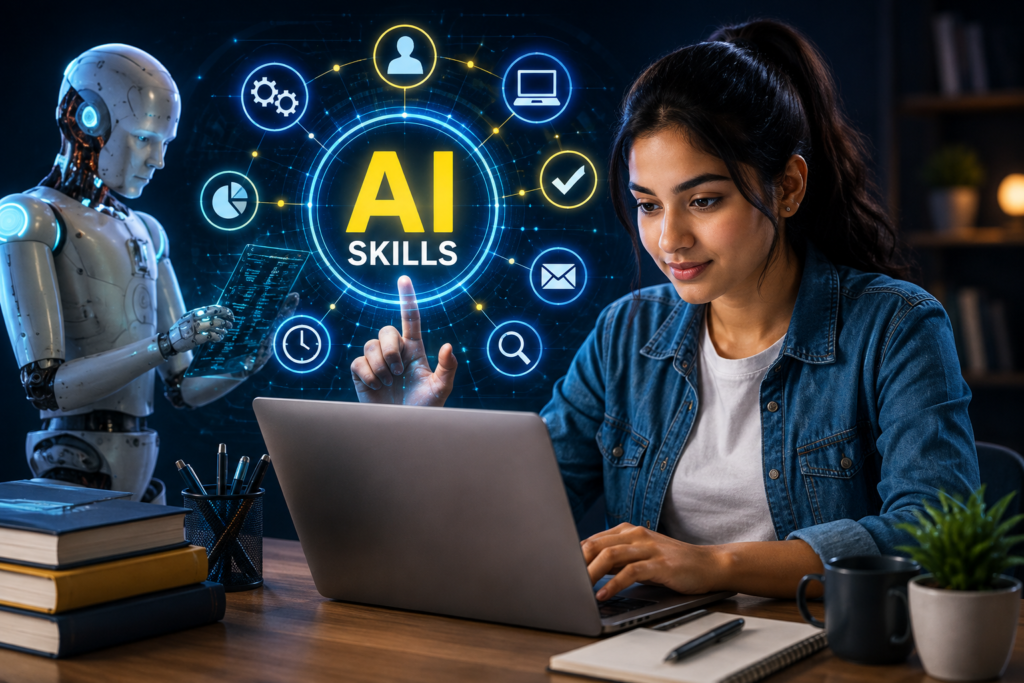
1. Prompt Engineering
Prompt engineering means learning how to give clear and useful instructions to an AI system.
A weak prompt might produce a generic answer, while a well-structured prompt can provide much more relevant results.
For example, instead of asking:
“Write a blog about digital marketing.”
A student could provide the topic, target audience, objective, tone, format, and specific information required.
Good prompting involves understanding:
- What information to provide
- How to describe the desired result
- How to give context
- How to set limitations
- How to review and improve AI responses
Why is prompt engineering useful?
Students can use effective prompting for research, brainstorming, writing, coding assistance, learning difficult subjects, creating presentations, and organizing ideas.
The important skill is not memorizing hundreds of prompts. It is learning how to communicate clearly with AI.
2. AI Research and Information Analysis
AI can help students explore a topic, summarize information, generate questions, compare ideas, and organize research.
But students should not blindly trust every AI-generated answer.
AI can make mistakes, misunderstand context, or provide outdated information. Therefore, students should learn how to:
- Ask focused research questions
- Compare information from different sources
- Verify important claims
- Identify unreliable information
- Separate facts from opinions
- Use original sources when necessary
Why does this matter?
The ability to use AI for research while still thinking critically is much more valuable than simply asking AI for an answer.
Students who combine AI-assisted research + human verification can develop stronger research habits.
3. AI-Assisted Content Creation
Content creation is one of the areas where AI can save significant time.
Students can use AI to brainstorm:
- Blog topics
- Social media ideas
- Video scripts
- Headlines
- Captions
- Email drafts
- Content calendars
- Marketing concepts
However, publishing raw AI-generated content is not a strong strategy.
Students should learn to add their own experiences, examples, opinions, research, creativity, and editing.
The ideal workflow
AI generates ideas → Student evaluates → Student adds expertise → AI assists with refinement → Student edits and verifies.
This approach keeps humans involved in the creative process.
4. AI Image and Creative Generation
AI-powered creative tools are changing how people approach visual content.
Students interested in marketing, graphic design, social media, entrepreneurship, or content creation can learn how to use AI-assisted tools for:
- Concept development
- Image generation
- Creative brainstorming
- Social media graphics
- Advertising concepts
- Visual storytelling
- Design variations
But creating an image is only one part of the skill.
Students should also understand composition, branding, typography, visual hierarchy, audience, and copyright considerations.
AI can help produce visuals faster, but creative judgment still matters.
5. AI-Assisted Video Production
Short-form video has become an important format for businesses, creators, educators, and brands.
AI can assist with different stages of video production, including:
- Script ideas
- Storyboarding
- Captions
- Voice generation
- Editing assistance
- Video concepts
- Content repurposing
Students interested in content creation or digital marketing can combine AI tools with traditional video-production skills.
For example, a student could turn one long educational topic into a series of short videos with AI-assisted scripting and editing.
The goal should be to use AI to speed up production without sacrificing originality and quality.
6. Data Interpretation and AI-Assisted Analysis
Businesses generate large amounts of information every day.
Students do not necessarily need to become data scientists to benefit from learning basic data interpretation.
They can learn how to:
- Understand tables and charts
- Identify patterns
- Compare performance
- Ask useful questions about data
- Summarize findings
- Use AI to assist with analysis
For example, a digital marketing student might use AI to help understand website traffic, campaign performance, engagement data, or customer behavior.
The important skill is not simply generating a report.
It is understanding what the data means and what action should be taken next.
7. Digital Marketing with AI
AI is becoming increasingly useful across digital marketing.
Students interested in marketing can learn how AI can assist with:
SEO: topic research, content planning, search-intent analysis, and optimization ideas.
Social Media: content ideas, captions, creative concepts, and content planning.
Advertising: ad variations, audience research, creative testing ideas, and performance analysis.
Email Marketing: subject-line ideas, segmentation concepts, and draft creation.
Content Marketing: topic research, outlines, repurposing, and editorial planning.
But successful marketing still requires understanding customers, positioning, competition, brand voice, and business goals. AI is a tool. Marketing strategy remains the foundation.
8. Workflow Automation
Automation is another valuable AI-related skill for students.
Many businesses spend time on repetitive tasks such as organizing information, moving data between tools, generating reports, sending routine messages, or managing workflows.
Students can learn to identify repetitive processes and explore how AI and automation tools can simplify them.
For example:
Form submission → information organized → AI-assisted summary → notification sent → record updated.
Learning to think in workflows can be useful in marketing, operations, sales, administration, and entrepreneurship.
The key question is:
“What repetitive task can be simplified without reducing quality or control?”
9. AI-Assisted Problem Solving
One of the most useful AI skills is knowing how to use AI as a thinking assistant.
Students can use AI to:
- Break a large problem into smaller parts
- Generate possible solutions
- Compare different approaches
- Identify potential weaknesses
- Create action plans
- Explore alternative ideas
However, students should not allow AI to replace their own thinking.
A better approach is:
Understand the problem → Ask AI for possibilities → Evaluate the suggestions → Apply human judgment → Test the solution.
This develops both technological confidence and critical thinking.
10. Continuous Learning
AI is changing quickly.
New tools, features, workflows, and applications appear regularly. Because of this, learning one AI tool today does not guarantee that the skill will remain sufficient forever.
Students should develop the habit of continuous learning.
That means:
- Experimenting with new tools
- Following reliable technology resources
- Practicing regularly
- Learning from real projects
- Updating existing skills
- Understanding new AI applications
The most valuable long-term skill may not be knowing one specific AI platform. It may be the ability to learn, adapt, and apply new technology effectively.
AI Skills vs Traditional Skills: What Should Students Learn?
Students should not think of AI skills as a replacement for traditional professional skills.
Instead, they should combine both.
Students should not think of AI skills as a replacement for traditional professional skills.
Instead, they should combine both.
| AI Skills | Human Skills |
| Prompting | Communication |
| AI research | Critical thinking |
| AI content creation | Creativity |
| Automation | Problem-solving |
| AI data analysis | Decision-making |
| AI-assisted design | Visual thinking |
| AI marketing tools | Customer understanding |
The strongest combination is AI capability + human expertise. A student who knows how to use AI but cannot communicate, think critically, or understand customers may still struggle professionally.
How Can Beginners Start Learning AI?
You don’t need to learn everything at once.
Start with one practical area that matches your interests.
If you are interested in digital marketing, begin with AI-assisted research, content creation, SEO, social media, and advertising.
If you are interested in content creation, explore AI-assisted writing, image generation, video production, and creative workflows.
If you are interested in business, focus on automation, research, data interpretation, customer analysis, and productivity.
If you are interested in technology, gradually explore coding assistants, AI APIs, automation, and data-related skills.
A simple learning method
Learn → Practice → Create a Project → Review → Improve
For example, instead of only watching tutorials about AI content creation, create an actual social media campaign or blog project.
Projects give students something practical to discuss in interviews, portfolios, internships, and freelance opportunities.
Will AI Replace Digital Marketing Jobs?
AI will change many digital marketing tasks, but that does not mean every digital marketing professional will be replaced.
The nature of the work is likely to continue evolving.
Tasks that are repetitive and predictable may become increasingly automated, while professionals who can combine strategy, creativity, customer understanding, data interpretation, and AI tools can remain valuable.
For students, the better question is not:
“Will AI take my job?”
A more useful question is:
“How can I learn to work effectively with AI?”
That mindset encourages students to develop skills that complement technology instead of competing with it.
Common Mistakes Students Make While Learning AI
Learning Too Many Tools
Trying dozens of AI tools at once can create confusion. Start with a small number of tools and learn how to use them properly.
Copying AI Output Without Checking It
AI-generated information can contain errors. Always review and verify important information.
Focusing Only on Prompts
Prompting is useful, but it is only one part of AI literacy. Domain knowledge and critical thinking are equally important.
Using AI Without Learning the Basics
Students should understand the fundamentals of the field they are working in. AI works best when the user knows what good output looks like.
Depending Completely on AI
AI should assist your thinking, not replace it. Develop your own ideas, judgment, creativity, and communication skills.
What AI Skills Should Students Learn First?
If you’re completely new to AI, don’t try to learn all ten skills immediately.
A practical starting sequence is:
Step 1: Learn basic AI concepts.
Step 2: Learn effective prompting.
Step 3: Use AI for research and learning.
Step 4: Choose one career-related area such as digital marketing, content creation, design, data, or automation.
Step 5: Build small projects.
Step 6: Create a portfolio showing how you used AI to solve real problems.
This approach is more useful than collecting certificates without practical experience.
Frequently Asked Questions
Which AI skill should students learn first?
For most beginners, effective prompting and AI-assisted research are good starting points. After that, students should choose skills related to their career interests.
Do students need coding skills to learn AI?
No. Many useful AI applications do not require programming. Students can begin with prompting, research, content creation, marketing, design, and automation. Coding becomes more important for technical AI careers.
Is prompt engineering still useful?
Yes, but prompting should not be treated as a standalone career shortcut. It is more valuable when combined with a specific domain skill such as marketing, design, research, business, or programming.
Can AI help students get jobs?
AI skills can improve productivity and help students build projects and portfolios, but learning AI alone does not guarantee employment. Employers also look for communication, problem-solving, technical knowledge, creativity, teamwork, and practical experience.
Should students use AI for everything?
No. AI should be used thoughtfully. Students should continue developing independent thinking, research skills, creativity, communication, and subject knowledge.
How can students practice AI skills?
The best way is to work on small real-world projects. For example, create a marketing campaign, research a topic, analyze a dataset, develop a content calendar, automate a repetitive workflow, or build a portfolio project.
Final Thoughts
AI is becoming an important part of modern education and professional work, but learning AI is not about chasing every new tool.
The real goal is to understand how AI can help you learn faster, work smarter, solve problems, and create better results.
Students who combine AI knowledge with communication, creativity, critical thinking, digital skills, and real-world experience can build a stronger foundation for the changing job market.
Start small. Choose one skill. Practice it through real projects. Then gradually expand your knowledge.
The future belongs not simply to people who know AI, but to people who know how to use AI effectively.
Sikheya Digital Hub
Sikheya Digital Hub is a digital learning and creative solutions platform helping students, creators, entrepreneurs, and businesses develop practical digital skills. Through training and professional digital solutions, Sikheya focuses on areas such as Digital Marketing, SEO, Social Media Marketing, Content Creation, Video Production, Website Development, and Online Branding.
If you want to develop practical digital skills and understand how modern technology can support your career or business, explore the learning resources and services available through Sikheya Digital Hub.
Recommend Links
How Do I Rank on Google?
How AI Is Changing Google Search and What Businesses Must Do
How AI Search Is Changing Local SEO
How to Grow Your Business Online
Sikheya Digital Hub is a digital marketing institute and agency helping students, entrepreneurs and businesses learn and implement digital marketing, AI, social media marketing, SEO and online growth strategies.
Expertise
Digital Marketing
SEO
Social Media Marketing
Meta Ads
Google Ads
AI & Automation
Content Marketing





One Comment