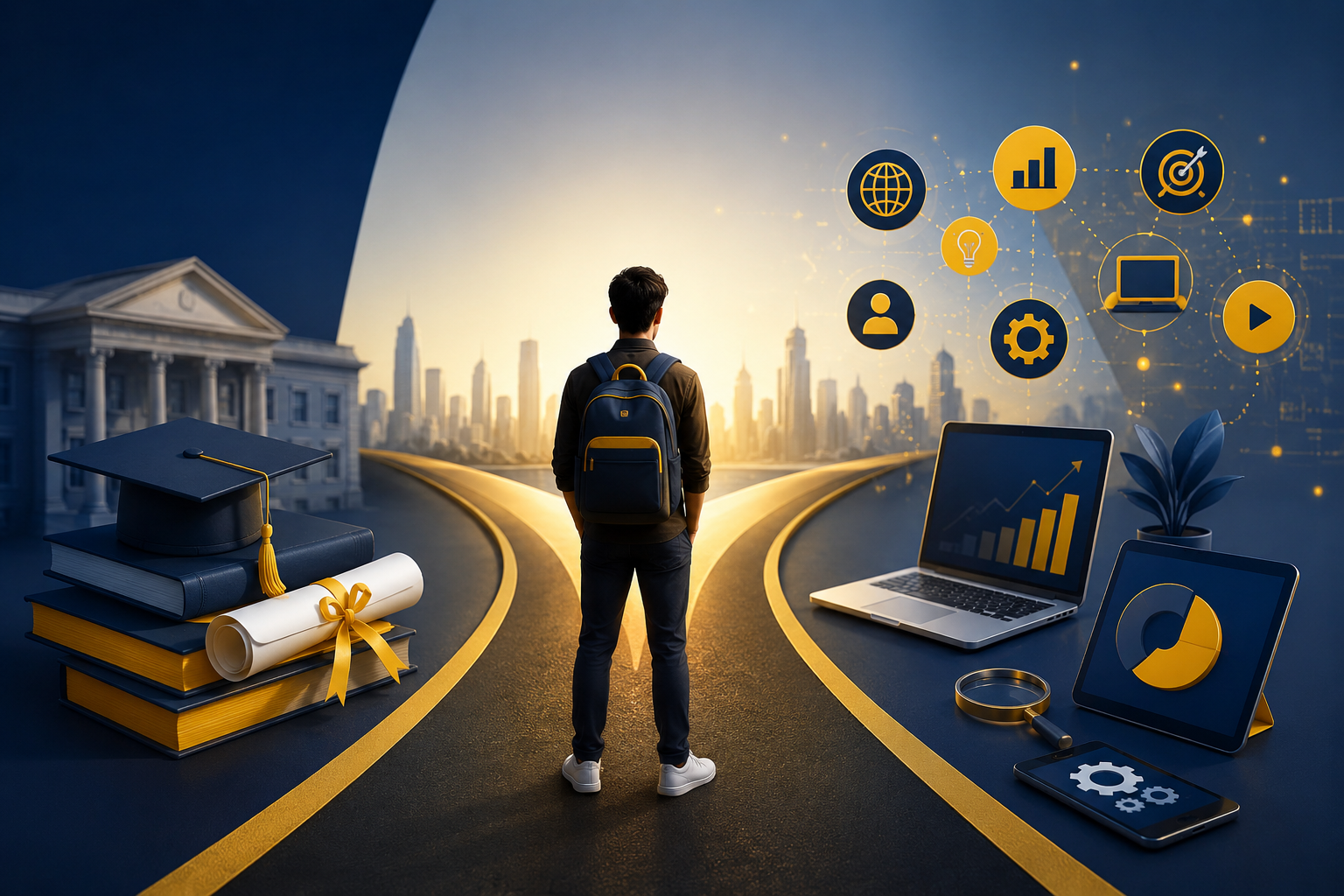
Digital Skills Gap in India: Why Having a Degree Is No Longer Enough for a Digital Career”
A college degree can prove that you completed a formal education. It does not automatically prove that you can perform a digital job.
That distinction is becoming increasingly important in India.
Employers are dealing with rapidly changing technologies, AI-powered tools, digital marketing platforms, analytics systems, cloud technologies and new ways of working. As a result, candidates are increasingly expected to demonstrate what they can actually do, not only what qualification appears on their résumé.
This does not mean degrees have become useless. A degree can still provide foundational knowledge, credibility and access to many career paths. The problem is relying on the degree as the entire career strategy.
India’s employment market is showing signs of a broader movement toward skills-based hiring. The World Economic Forum’s Future of Jobs Report 2025 says employers in India expect skills-based hiring to become more important, with 30% of surveyed companies expecting removing degree requirements to be an effective way to access talent.
So the real question is not:
“Degree or skills?”
It is:
“How can I combine my degree with practical digital skills so employers can see what I am capable of?”
This article explains the digital skills gap in India, why graduates struggle despite having degrees, what employers increasingly look for, whether certifications actually help, and how students and career changers can build a practical digital-career roadmap.
Table of Contents
- Key Takeaways
- What Is the Digital Skills Gap?
- Why Is a Degree Alone No Longer Enough?
- The Degree–Skills–Experience Gap
- What Employers Actually Want
- Technical Digital Skills
- Human Skills Still Matter
- Why Digital Marketing Is a Good Example
- Are Digital Marketing Certificates Worth It?
- Certification vs Internship vs Portfolio
- Free vs Paid Digital Learning
- A Practical Digital Skills Roadmap
- Common Mistakes Graduates Make
- How to Make Your Degree More Valuable
- Who Should Learn Digital Skills?
- The Future of Digital Careers in India
- 30-Day Action Plan
- Key Takeaways Checklist
- FAQs
- Conclusion
Key Takeaways
- A degree is still valuable, but it is increasingly only one part of employability.
- Digital employers often need candidates who can demonstrate practical skills.
- Skills such as SEO, analytics, content creation, paid advertising, social media, AI-assisted workflows and data interpretation can complement almost any degree.
- A certificate can demonstrate structured learning, but a certificate alone does not prove workplace competence.
- Projects, internships, freelance work and portfolios provide evidence of practical ability.
- Communication, problem-solving, analytical thinking and adaptability remain important alongside technical skills.
- Students should avoid trying to learn every digital tool simultaneously.
- The strongest approach is generally degree + specialised skill + projects + proof of work + communication skills.
- AI is not simply eliminating digital careers; it is changing the tasks and skills required within them.
- India’s transition toward skills-based hiring makes continuous learning increasingly important.
What Is the Digital Skills Gap?
The digital skills gap is the difference between the digital capabilities employers need and the skills many job seekers currently possess.
Someone can have a bachelor’s or master’s degree but still lack practical experience with the software, platforms, analytical methods, communication processes or digital workflows required for a particular job.
For example, a graduate may understand marketing theory but not know how to:
- conduct keyword research;
- optimise a webpage;
- create a content strategy;
- analyse Google Analytics data;
- build a social media campaign;
- run a Google Ads campaign;
- interpret campaign performance;
- create short-form video content;
- use AI responsibly in a marketing workflow;
- prepare a professional performance report.
That is the difference between knowing about a subject and being able to perform work in that subject.
India has recognised this challenge for years. NASSCOM’s Future Skilling for the Digital Economy report, hosted by NSDC’s Skills Intelligence Platform, specifically examines India’s digital talent demand-supply gap and the changing ways organisations develop digital skills.
The issue has become even more important as technology adoption accelerates.
Why Is a Degree Alone No Longer Enough?
A degree provides academic foundations, but digital employers often need evidence that a candidate can apply knowledge in practical situations.
There are several reasons for this shift.
1. Technology Changes Faster Than Traditional Curricula
A university curriculum can take considerable time to design, approve and update.
Digital tools can change much faster.
Consider digital marketing.
A student may study traditional marketing principles for several years. Those principles remain useful, but the practical environment may involve:
- search engines;
- social platforms;
- analytics dashboards;
- advertising platforms;
- content-management systems;
- AI tools;
- marketing automation;
- CRM platforms;
- e-commerce platforms.
The underlying principles matter.
But employers also need people who can apply those principles using current tools.
2. Employers Need Demonstrable Skills
Imagine two fresh graduates.
Candidate A
- Bachelor’s degree
- Good academic marks
- No projects
- No internship
- No portfolio
- Cannot explain how a digital campaign works
Candidate B
- Bachelor’s degree
- Digital marketing training
- Two practical projects
- Basic SEO knowledge
- Google Ads exposure
- Analytics experience
- Content samples
- Can explain campaign decisions
Candidate B has not necessarily received a better education.
But Candidate B has provided more evidence of job readiness.
This is an important distinction.
A portfolio does not guarantee employment. However, it gives an employer something concrete to evaluate.

The Degree–Skills–Experience Gap
One of the biggest problems for graduates is that these three things are often treated as interchangeable:
| Factor | What it demonstrates |
| Degree | Formal academic education |
| Certification | Structured learning in a specific subject |
| Skill | Ability to perform a task |
| Project | Application of a skill to a practical problem |
| Internship | Experience working in an organisational environment |
| Portfolio | Evidence of previous work |
| Interview | Ability to communicate knowledge and solve problems |
They are connected, but they are not the same thing.
A certificate can show that you completed training.
A project can show that you applied the training.
An internship can show that you experienced a workplace.
A portfolio can show an employer the result.
That is why building a digital career should not be reduced to collecting certificates.
What Employers Actually Want
Employers generally want a combination of technical ability, problem-solving, communication, adaptability and evidence that a candidate can apply those abilities.
The exact combination varies by job.
For example, a performance marketing role may require:
- advertising-platform knowledge
- analytics
- conversion tracking
- budgeting
- testing
- copywriting
- reporting
An SEO role may require:
- keyword research
- technical SEO
- on-page optimisation
- content strategy
- Search Console knowledge
- analytics
- competitor research
A content role may require:
- research
- writing
- editing
- storytelling
- SEO
- visual content
- social media
- AI-assisted workflows
The important lesson is simple:
Do not ask, “What certificate should I get?” first.
Ask:
“What job do I want, and what skills does that job require?”
Then work backwards.
The Most Useful Digital Skills to Build
There is no universal list of “guaranteed” skills.
However, several skill categories are particularly useful across digital roles.
1. Search Engine Optimisation
SEO involves helping websites become more discoverable through search engines.
Useful areas include:
- keyword research
- search intent
- on-page SEO
- technical SEO basics
- internal linking
- content optimisation
- structured data
- Search Console
- analytics
- competitor analysis
A beginner does not need to master everything at once.
Start with the fundamentals and build practical examples.
2. Content Creation
Digital businesses constantly need content.
This includes:
- blog posts
- social media posts
- short-form videos
- product descriptions
- newsletters
- landing pages
- scripts
- graphics
- educational content
But content creation is changing.
Creating content is no longer simply about producing a large number of posts.
The better skill is understanding:
Audience → Problem → Search/Intent → Content → Distribution → Measurement
3. Social Media Marketing
Social media skills go beyond posting pictures.
A competent social media professional should understand:
- audience research
- content planning
- platform differences
- hooks
- captions
- creative formats
- engagement
- analytics
- campaign objectives
- content testing
4. Paid Advertising
Digital advertising can include platforms such as:
- Google Ads;
- Meta Ads;
- LinkedIn Ads;
- other industry-specific advertising platforms.
The valuable skill is not merely knowing where to click.
You should understand:
Objective → Audience → Offer → Creative → Landing Page → Tracking → Results → Optimisation
That framework is much more valuable than memorising interface buttons.
5. Analytics and Data Interpretation
Digital professionals increasingly need to understand data.
You do not necessarily need to become a data scientist.
But you should be able to answer questions such as:
- Which channel generated traffic?
- Which page performed best?
- Where are users dropping off?
- Which campaign generated conversions?
- Why did performance change?
- What should we test next?
A person who can turn data into a business recommendation is much more valuable than someone who can simply export a report.
6. AI Literacy
AI has become another important layer of digital work.
But “knowing AI” should mean more than knowing how to write prompts.
Useful AI skills include:
- research assistance
- content ideation
- summarisation
- workflow automation
- data interpretation
- content variation
- campaign brainstorming
- quality checking
- AI-assisted productivity
- understanding AI limitations
Google’s current Digital Marketing & E-commerce Certificate, for example, includes AI applications for marketing strategy, market research, campaign decisions, email content and website copy testing.
The important skill is knowing when and how to use AI, not blindly allowing AI to make every decision.
Human Skills Still Matter
One mistake students make is assuming that digital careers are purely technical.
They are not.
The World Economic Forum’s Future of Jobs Report 2025 highlights both technology-related skills and human capabilities such as analytical thinking, resilience, leadership and collaboration as important for the future workforce.
Communication
Can you explain your work clearly?
Analytical Thinking
Can you understand why something worked or failed?
Creativity
Can you produce ideas rather than simply copy existing content?
Problem Solving
Can you investigate a performance problem and suggest a solution?
Adaptability
Can you learn a new platform when your employer starts using it?
These skills become especially important when AI automates repetitive tasks.
Why Digital Marketing Is a Good Example
Digital marketing provides a clear illustration of the skills gap because the field combines education, technology, creativity and measurable business outcomes.
Someone can have a degree in:
- BBA
- MBA
- B.Com
- BA
- journalism
- mass communication
- computer science
- engineering
- design
and still move toward digital marketing by adding relevant practical skills.
For example:
B.Com + Digital Marketing
Potential combination:
Accounting/Business Knowledge + Marketing + Analytics
BBA + Digital Marketing
Potential combination:
Business Knowledge + Marketing Strategy + Performance Marketing
Journalism + Digital Marketing
Potential combination:
Writing + Research + SEO + Content Marketing
Computer Science + Digital Marketing
Potential combination:
Technology + Analytics + SEO/Marketing Automation
The degree does not disappear.
The digital skill extends its usefulness.
Are Digital Marketing Certificates Worth It?
Yes, a good certificate can be useful, but it should be treated as evidence of learning rather than proof of complete job readiness.
This distinction is extremely important.
A recognised certificate can help you:
- structure your learning
- understand fundamentals
- demonstrate commitment
- strengthen your résumé
- learn industry terminology
- gain exposure to tools
- create a starting point for projects
But a certificate cannot automatically demonstrate:
- creativity;
- workplace communication;
- campaign judgement;
- problem-solving;
- client handling;
- practical experience;
- business understanding.
For example, Google’s India-specific Digital Marketing & E-commerce Certificate is structured as seven courses and 240 hours of learning and is designed for entry-level digital marketing and e-commerce skills.
That makes it potentially useful for structured learning.
But learners should still build practical work around what they study.
Certification vs Internship vs Portfolio
| Option | Main Value | Limitation |
|---|---|---|
| Certificate | Shows structured learning | Doesn’t automatically prove experience |
| Online Course | Flexible skill development | Quality varies |
| Internship | Workplace exposure | Availability and quality vary |
| Freelance Project | Real client/problem exposure | Requires finding opportunities |
| Personal Project | Low-risk practical experience | May lack real business constraints |
| Portfolio | Shows evidence of work | Needs regular updating |
Best combination for a beginner
Course/Training + Certificate + Projects + Portfolio + Internship/Practical Experience
You do not necessarily need all five before applying for your first job.
But building several forms of evidence can make your profile stronger.
Free vs Paid Digital Learning
You do not always need an expensive course to begin.
| Free Learning | Paid Learning |
|---|---|
| Low financial risk | Structured curriculum |
| Good for exploration | Mentorship may be available |
| Large amount of content | Often more organised |
| Self-directed | May include assignments |
| Quality varies | Quality also varies by provider |
| Requires discipline | Can provide accountability |
When free learning makes sense
Choose free resources when:
- you are exploring a field;
- you want to understand fundamentals;
- you have limited budget;
- you are comfortable learning independently.
When structured training may help
A paid program may be useful when you need:
- a curriculum;
- instructor guidance;
- practical assignments;
- feedback;
- peer learning;
- accountability;
- career guidance.
The question should not be:
“Is this course expensive?”
Instead ask:
“What will I be able to demonstrate after completing it?”
How to Choose a Digital Marketing Course
Before enrolling in a digital marketing course online, use this checklist.
Curriculum
Does it include practical topics such as:
- SEO
- content marketing
- social media
- paid advertising
- analytics
- email marketing
- AI-assisted workflows
Practical Work
Will you actually create:
- campaigns
- websites or landing pages
- content
- SEO audits
- reports
- social media plans
Feedback
Will someone review your work?
Tools
Will you work with relevant platforms rather than only watch lectures?
Portfolio
Will you leave the program with demonstrable projects?
Career Support
Does the provider explain what career support actually includes?
Be cautious about vague phrases such as “100% job guarantee” unless you carefully understand the terms and independently verify the claim.
What About Google Digital Marketing Courses?
There are several Google learning resources relevant to digital marketing.
Google’s Digital Marketing & E-commerce Certificate is designed for beginners and covers areas including digital marketing strategy, search, content marketing, email, analytics, e-commerce and customer loyalty.
Google also provides other digital marketing learning resources, including fundamentals of digital marketing and Google Ads training.
These can be useful starting points.
However, learners should remember:
Google certification ≠ automatic employment.
The certificate can support your profile.
Your ability to apply what you learned is what makes the learning more meaningful.

A Practical Digital Skills Roadmap
Instead of trying to learn everything, use a staged approach.
Stage 1: Choose One Career Direction
Pick one starting area:
- SEO;
- social media;
- content marketing;
- paid advertising;
- email marketing;
- analytics;
- e-commerce;
- content creation.
Do not start with ten specialisations.
Stage 2: Learn the Fundamentals
Spend your first phase understanding concepts.
For example, if you choose SEO:
Learn:
- Search intent
- Keyword research
- On-page SEO
- Internal linking
- Technical SEO basics
- Content optimisation
- Analytics
Stage 3: Learn the Tools
Then learn the tools relevant to your chosen area.
For SEO:
- Google Search Console
- Google Analytics
- keyword research tools
- content tools
- website CMS platforms
For advertising:
- Google Ads
- Meta Ads
- analytics
- conversion tracking
For content:
- Canva
- video editing tools
- CMS platforms
- analytics
- AI productivity tools
Stage 4: Build a Project
This is where many learners stop too early.
Create something.
For example:
SEO Project
Build an SEO plan for a fictional local business.
Include:
- target audience;
- keyword research;
- competitor analysis;
- content plan;
- on-page recommendations;
- internal linking plan.
Social Media Project
Create a 30-day content strategy for a small business.
Paid Ads Project
Create a hypothetical campaign structure with:
- audience;
- campaign objective;
- ad groups;
- creative concepts;
- landing page;
- measurement plan.
Stage 5: Build a Portfolio
Put your strongest work into a simple portfolio.
Your portfolio could contain:
- project objective;
- your approach;
- tools used;
- screenshots;
- results, where genuine;
- lessons learned.
Never invent results.
If a project is hypothetical, clearly label it as a practice project.
That actually demonstrates professionalism.
Common Mistakes Graduates Make
Mistake 1: Collecting Certificates Instead of Skills
Five certificates do not necessarily equal five useful skills.
Better approach: complete fewer courses and apply the knowledge through projects.
Mistake 2: Learning Everything at Once
SEO + Google Ads + Meta Ads + coding + graphic design + video editing + AI + analytics can quickly become overwhelming.
Better approach: choose one primary skill and two supporting skills.
Mistake 3: Ignoring Communication
Some technically capable candidates struggle to explain what they have done.
Practice explaining:
- the problem;
- your approach;
- your decision;
- the result;
- what you would improve.
Mistake 4: Copying Projects
Copying a YouTube tutorial exactly does not demonstrate much independent thinking.
After following a tutorial, change the scenario.
Create your own:
- business
- audience
- strategy
- content
- analysis
Mistake 5: Putting Every Skill on the Résumé
If you list 25 skills but cannot answer basic questions about them, the résumé becomes less convincing.
Only list skills you can actually discuss.
Mistake 6: Waiting Until Graduation
A degree does not need to finish before skill-building starts.
Students can gradually develop:
Learning → Practice → Projects → Portfolio → Internship → Job
How to Make Your Degree More Valuable
Think of your degree as the foundation, not the complete building.
A useful model is:
Degree
↓
Specialised Digital Skill
↓
Practical Projects
↓
Portfolio
↓
Internship / Experience
↓
Job Applications
↓
Continuous Upskilling
For example:
B.Com + SEO + Analytics + Content Portfolio
can create a different career profile from:
B.Com alone.
Similarly:
BA + Content Creation + SEO + Social Media
can create a different professional profile from:
BA alone.
Your degree still matters.
You are simply adding evidence of what you can do.
A Simple Skills Decision Framework
Ask yourself five questions:
| Question | If “Yes” |
|---|---|
| Do I understand the concept? | Knowledge |
| Can I use the relevant tool? | Technical ability |
| Can I complete a task independently? | Practical skill |
| Can I show the result? | Evidence |
| Can I explain my decision? | Professional readiness |
If you can only answer “yes” to the first question, you probably need more practice.
Who Should Learn Digital Skills?
Digital upskilling can make sense for:
College Students
Start building practical skills before graduation.
Fresh Graduates
Add employable skills to an academic qualification.
Career Changers
Use digital skills to enter a different professional area.
Small Business Owners
Understand digital channels well enough to manage or evaluate marketing.
Freelancers
Develop specialised skills that can be offered as services.
Working Professionals
Add digital capabilities to their existing domain expertise.
Who Should Not Chase Every Digital Course?
Not everyone needs every digital skill.
Avoid random course collecting if:
- you don’t know your target career;
- you are only collecting certificates;
- you have no time to practise;
- you are following trends without understanding your career objective.
A focused skill strategy is usually better than a large collection of unrelated courses.
The Future of Digital Careers in India
The direction of India’s employment market suggests that continuous learning will become increasingly important.
The World Economic Forum reports that employers in India expect strong growth in areas including AI and machine learning, big data and security-related roles, while also reporting that a substantial portion of the workforce will require training by 2030.
At the same time, the hiring market is not simply disappearing for freshers.
For example, an analysis of Indeed’s Hiring Tracker reported by IBEF found that fresh graduates accounted for 53% of new hires in Q4 FY25, while employers continued to report challenges related to practical skills and soft skills.
That tells us something important:
The opportunity exists, but being a graduate does not automatically make someone job-ready.
AI Will Change Digital Jobs — Not Eliminate the Need to Learn
AI can now help with:
- content drafts;
- research;
- data analysis;
- campaign ideas;
- image generation;
- repetitive tasks;
- customer communication;
- workflow automation.
That means some tasks will become faster.
But organisations still need people who can decide:
- What should we create?
- Who is the audience?
- What problem are we solving?
- Which channel should we use?
- Is the information accurate?
- Is the campaign working?
- What should change?
- What should not be automated?
The future digital professional is therefore unlikely to be someone who avoids AI.
It is more likely to be someone who understands their field and knows how to use AI intelligently.
The New Career Formula
A useful way to think about employability is:
Employability = Knowledge + Skills + Practice + Evidence + Communication + Adaptability
Not every employer will evaluate these components in exactly the same way.
But the model highlights why a degree by itself can be insufficient.
30-Day Digital Skills Action Plan
You do not need to transform your career in 30 days.
The purpose of a 30-day plan is to create momentum.
Week 1 — Choose
Day 1–2: Identify three digital careers that interest you.
Day 3: Compare their job descriptions.
Day 4: Identify the recurring skills.
Day 5: Select one primary skill.
Day 6–7: Create your learning plan.
Week 2 — Learn
Spend time learning the fundamentals.
Take notes.
Do not simply watch videos.
After each major concept, ask:
“Could I explain this to someone else?”
Week 3 — Practise
Create a practical project.
For example:
- SEO audit
- content calendar
- social media strategy
- mock advertising campaign
- analytics report
- landing-page analysis
Week 4 — Publish
Create a basic portfolio.
Include:
- About section
- skills
- projects
- tools
- certificates
- contact information
Then begin applying for:
- internships
- junior roles
- freelance projects
- apprenticeships
- relevant volunteer opportunities
Key Takeaways Checklist
Before applying for a digital role, ask:
- Do I understand my chosen digital field?
- Can I use the basic tools?
- Have I completed at least one practical project?
- Can I explain what I did?
- Do I have samples of my work?
- Have I created a professional résumé?
- Is my LinkedIn profile updated?
- Can I communicate clearly?
- Do I understand basic AI tools relevant to my field?
- Am I continuing to learn?
If you cannot tick every box, don’t panic.
Use the unchecked boxes to create your next learning plan.
Frequently Asked Questions
1. Is a degree still important for a digital career?
Yes. A degree can provide academic knowledge and may be required for some employers and career paths. However, digital roles often also require practical skills and evidence of what you can do.
2. Can I get a digital marketing job without a marketing degree?
Yes, it is possible. Digital marketing has multiple entry points, and relevant practical skills can be learned through courses, projects, internships and self-directed practice.
However, learning the skill does not guarantee employment.
3. Is a digital marketing certificate enough to get a job?
Usually, a certificate should not be treated as enough by itself.
It can demonstrate structured learning, but employers may also evaluate your practical knowledge, communication, portfolio and experience.
4. Is Google digital marketing certification useful?
It can be useful as a structured beginner-level learning credential. Google’s Digital Marketing & E-commerce Certificate covers areas such as content marketing, email marketing, analytics, e-commerce and digital marketing strategy.
Its value is stronger when combined with practical projects.
5. What is better: certification or internship?
They serve different purposes.
A certification demonstrates learning.
An internship provides workplace exposure.
For many beginners, having both can be more useful than relying on either one alone.
6. Can I learn digital marketing online?
Yes. There are many online learning options, ranging from free educational resources to structured professional programs.
Google’s India program, for example, is delivered online and designed for beginners without previous experience.
7. What digital skills should students learn?
Start with skills relevant to the career you want.
For a digital marketing path, useful foundations include:
- SEO
- content marketing
- social media;
- analytics;
- paid advertising;
- communication;
- AI literacy.
Do not attempt to master all of them simultaneously.
8. Can AI replace digital marketers?
AI can automate or accelerate some digital marketing tasks, but that does not mean every digital marketing role disappears.
Professionals still need strategy, judgement, creativity, communication, audience understanding and the ability to evaluate results.
9. How long does it take to learn digital marketing?
There is no universal timeline.
You can learn the fundamentals relatively quickly, but becoming professionally competent requires continued practice.
A useful progression is:
Fundamentals → Tools → Projects → Portfolio → Real-world experience
10. Should graduates learn digital skills even if they already have a degree?
Yes, if those skills support their intended career.
The goal is not to replace the degree.
The goal is to make the degree more useful in a changing employment environment.
11. Are online marketing courses worth paying for?
They can be, depending on the quality and your learning needs.
Before paying, check:
- curriculum;
- instructor experience;
- practical assignments;
- feedback;
- tools;
- projects;
- portfolio support;
- refund policy;
- actual career support.
12. What is more important: skills or certificates?
Skills are more important; certificates can provide supporting evidence of learning.
A candidate who can demonstrate practical ability is in a stronger position than someone who simply has a long list of certificates.
13. Can I start a digital career after a career gap?
Yes.
A career gap does not automatically prevent someone from entering digital work.
You can use courses, projects, freelance work, internships and portfolio pieces to demonstrate current skills.
14. Do I need coding to work in digital marketing?
No.
Many digital marketing roles do not require advanced programming.
However, basic technical understanding can be valuable, particularly for SEO, analytics, websites, tracking and marketing automation.
15. What is the best way to become job-ready?
Choose one target role, learn the required skills, practise them through projects, build evidence, improve communication and then gain real-world experience.
Do not wait until you feel “100% ready.”
Build skills while applying.
Conclusion
India’s digital career landscape is changing the meaning of being “qualified.”
A degree still matters.
But a degree by itself may not answer the employer’s most important question:
“What can this candidate actually do?”
That is where digital skills become valuable.
Whether you choose SEO, digital marketing, content creation, analytics, social media, paid advertising, e-commerce or another digital field, the strongest approach is not to abandon formal education.
It is to add practical capability to it.
Think of your career profile as:
Degree + Digital Skill + Projects + Portfolio + Experience + Communication
rather than:
Degree = Job
India’s movement toward skills-based hiring, the growing importance of AI and digital technologies, and the continuing concern around job readiness all point toward the same lesson: learning cannot stop at graduation.
The goal isn’t to collect every certificate available.
The goal is to become someone who can learn, apply, demonstrate and continuously improve useful skills.
Start Building Practical Digital Skills
If you’re a student, graduate, career changer or aspiring creator looking to build practical digital skills, start with one clear direction instead of trying to learn everything at once.
Explore relevant learning paths in digital marketing, SEO, content creation, social media and other practical digital skills, and choose training that gives you opportunities to practise—not just watch lessons.
Learn. Create. Grow.
Sikheya Digital Hub is a digital marketing institute and agency helping students, entrepreneurs and businesses learn and implement digital marketing, AI, social media marketing, SEO and online growth strategies.
Expertise
Digital Marketing
SEO
Social Media Marketing
Meta Ads
Google Ads
AI & Automation
Content Marketing

One Comment