How SEO Teams Stopped Guessing Which AI Search Strategies Paid Off
For years, SEO teams operated with a relatively familiar playbook.
Find the right keywords.
Create content.
Build authority.
Improve rankings.
Track impressions, clicks, and conversions.
Repeat what works.
Then search started changing.
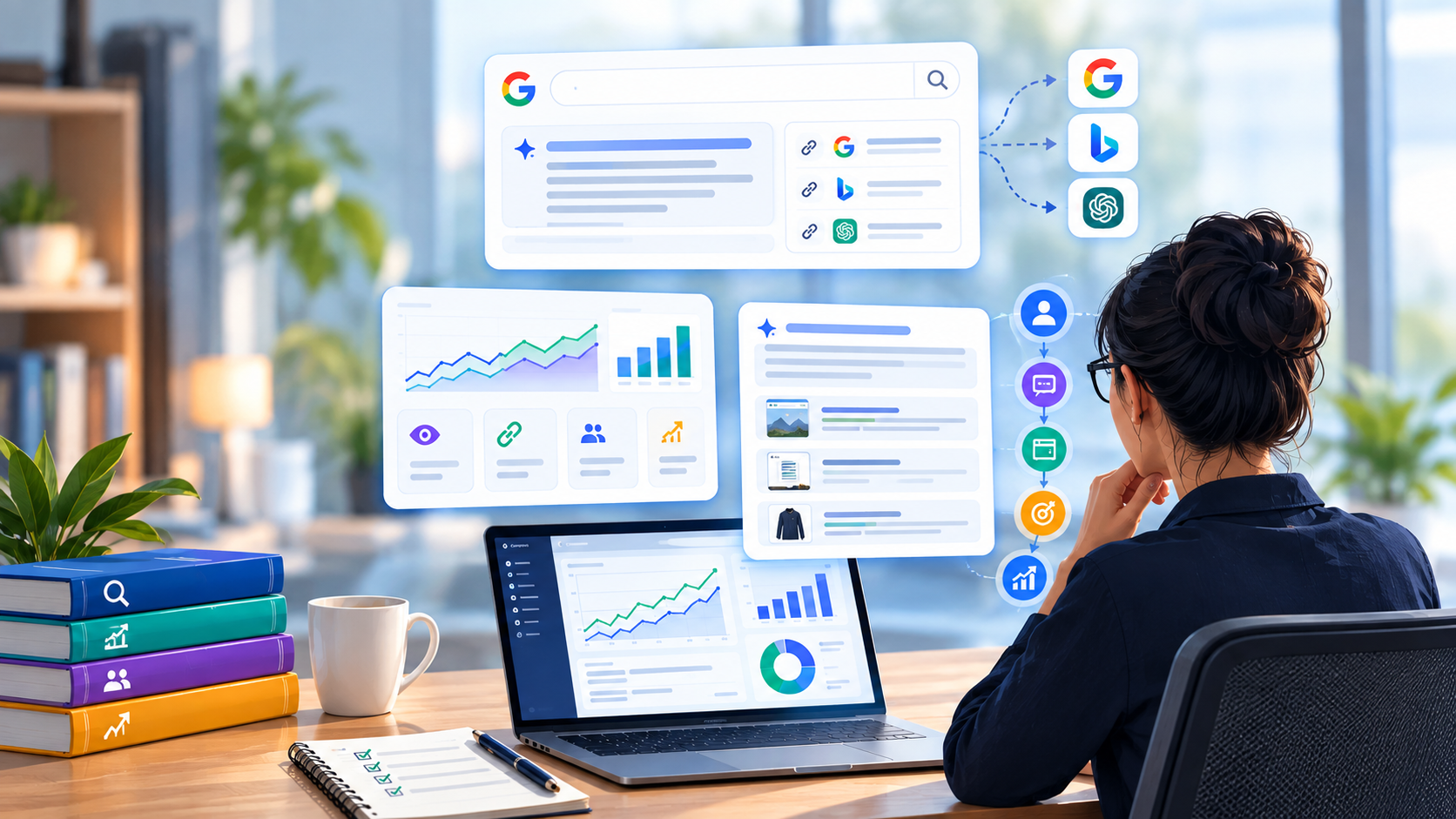
People began asking longer, more conversational questions inside AI-powered search experiences. Instead of scanning ten blue links, users could receive a synthesized answer with a handful of cited sources. Google expanded AI Overviews and AI Mode, while Microsoft introduced AI Performance reporting for citations across Copilot, Bing’s AI experiences, and selected partner integrations.
That created a new problem for SEO teams:
How do you know which AI-search strategies are actually producing business value?
It is easy to say that a page is “optimized for AI.” It is much harder to prove that the optimization increased visibility, generated qualified visitors, influenced conversions, or strengthened the brand’s presence across AI answers.
The answer is not another list of AI SEO hacks.
It is measurement.
The most sophisticated SEO teams are moving from guessing what AI systems might like to building measurement frameworks that connect AI visibility with search performance, website behavior, and ultimately business outcomes.
The Old SEO Measurement Model Is No Longer Enough
Traditional SEO reporting usually revolves around metrics such as:
- Organic impressions
- Organic clicks
- Click-through rate
- Average position
- Keyword rankings
- Organic sessions
- Backlinks
- Conversions
- Revenue
These metrics remain useful.
They have not suddenly become irrelevant because AI search exists. Google itself says its generative AI search features are rooted in its existing Search ranking and quality systems, meaning established SEO fundamentals continue to matter.
But AI search introduces another layer.
Imagine your company publishes an article called:
“Best CRM Software for Small Businesses”
Previously, you might ask:
“What position does this page rank for ‘best CRM software’?”
Now there are additional questions:
- Does an AI answer mention the company?
- Is the article cited?
- Which sections of the article are being referenced?
- Which questions trigger the citation?
- Is the brand appearing for commercial queries?
- Are competitors being cited more frequently?
- Does AI visibility lead to website visits?
- Do those visitors become leads?
- Does AI exposure increase branded searches later?
This is where AI-search measurement becomes fundamentally different.
From Rankings to Visibility
One of the biggest changes in SEO is that ranking is no longer the only representation of visibility.
A website can be useful to an AI-generated answer even when the user never sees the traditional ranking position in the same way they would have previously.
Google’s current Search Console reporting reflects this evolution. Its Generative AI performance report provides visibility into impressions from AI Overviews and AI Mode, including page-level performance and dimensions such as country and device.
Microsoft has taken a somewhat different approach.
Its AI Performance report focuses on citations. It shows:
- Pages cited in AI answers
- Total citation activity
- Average cited pages
- Grounding queries associated with cited content
- Page-level citation activity
- Citation trends over time
That distinction matters.
Google’s reporting helps answer:
“How often are we being exposed within Google’s generative search experiences?”
Bing’s reporting helps answer:
“How often is our content being used as a source in supported AI answers?”
Together, these signals give SEO teams a much better picture than keyword rankings alone.

The Biggest Shift: Stop Measuring AI SEO as a Single Metric
A common mistake is searching for one new “AI SEO metric.”
There probably won’t be one.
AI search is becoming a measurement stack, not a single KPI.
A practical framework looks like this:
Layer 1: AI Visibility
Are you appearing?
Measure:
- AI impressions
- AI citations
- Number of cited pages
- AI-search visibility by topic
- AI visibility by intent
- Brand mentions
Layer 2: AI Relevance
Why are you appearing?
Measure:
- Grounding queries
- Topics
- Search intent
- Pages associated with each topic
- Questions where your content is repeatedly cited
Layer 3: Website Engagement
What happens after someone reaches your site?
Measure:
- AI referral sessions
- Engaged sessions
- Engagement rate
- Time spent
- Pages per session
- Returning visitors
Layer 4: Business Outcomes
Does the visibility create business value?
Measure:
- Leads
- Sign-ups
- Demo requests
- Purchases
- Revenue
- Assisted conversions
- Customer acquisition cost
This creates a much more useful chain:
AI visibility → citation → visit → engagement → conversion → revenue
The further down this chain you can measure, the less dependent your SEO strategy becomes on assumptions.
Why AI Citations Matter
A traditional search result essentially says:
“Here are some pages you might want to visit.”
An AI-generated answer can instead say:
“Here is the answer, and these sources support it.”
That makes citations particularly interesting for SEO teams.
Microsoft’s AI Performance system explicitly tracks which URLs are cited and which grounding queries are associated with those citations.
This allows marketers to move beyond the vague question:
“Are we visible in AI?”
and ask:
“What subjects cause AI systems to use our content as a source?”
That is a much more actionable question.
Example: Turning Citation Data Into an SEO Strategy
Suppose an online accounting software company discovers the following pattern:
| Topic | AI Citations | Organic Traffic | Leads |
|---|---|---|---|
| Small-business accounting | High | High | High |
| Tax software comparison | High | Medium | High |
| Invoice templates | Medium | High | Low |
| Bookkeeping basics | High | High | Low |
| Payroll software | Low | Medium | High |
A traditional SEO report might celebrate the pages receiving the most organic traffic.
But the AI data tells a more complicated story.
The payroll software topic may have relatively low AI visibility but strong conversion potential.
Meanwhile, bookkeeping basics may generate enormous visibility but little commercial value.
That changes the team’s priorities.
Instead of simply publishing more content around the largest traffic opportunity, the team can investigate:
“Why are we being cited heavily for informational questions but not for high-value commercial questions?”
That question can lead to a much more strategic content program.
Grounding Queries Give SEO Teams a New Source of Insight
One of the most interesting developments is the emergence of grounding-query data.
Bing describes grounding queries as grouped phrases associated with content retrieved and cited in AI-generated answers. They are not necessarily exact user prompts, but they provide insight into the types of searches associated with citations.
This creates an opportunity.
Imagine a company thinks its main topic is:
“project management software”
But its AI citation data reveals that its pages are frequently associated with:
- project management for remote teams
- project management for agencies
- project management workflows
- client project tracking
- managing multiple projects
- project planning templates
Suddenly, the company has a much richer understanding of its actual topical footprint.
This is one reason AI-search measurement can influence content strategy rather than simply reporting on it.
AI SEO Becomes an Experimentation Problem
The biggest organizational change may be this:
SEO teams need to start thinking more like experimentation teams.
Instead of:
“AI likes concise content.”
Test it.
Instead of:
“Adding statistics will increase citations.”
Test it.
Instead of:
“Original research gets mentioned more often.”
Test it.
Instead of:
“FAQ sections help AI engines understand pages.”
Test it.
The goal isn’t to collect AI SEO theories.
The goal is to discover which changes correlate with measurable improvements.
A Practical AI SEO Experiment
Imagine an SEO team has 100 existing articles.
They divide them into two groups.
Control Group
50 pages receive no major content changes.
Test Group
50 pages receive a structured optimization treatment:
- Clearer answers near the beginning
- Better headings
- Original statistics
- Explicit definitions
- Updated facts
- Expert quotes
- Stronger internal linking
- More structured comparisons
- Better source attribution
Then the team monitors both groups over an appropriate period.
They track:
- AI impressions
- AI citations
- Organic impressions
- Organic clicks
- Rankings
- Referral traffic
- Engagement
- Conversions
The important part is not whether every test produces a positive result.
Some experiments should fail.
A failed experiment is still useful if it prevents the team from investing months into an ineffective tactic.
The Difference Between Correlation and Causation
This is where mature SEO teams need to be careful.
Suppose citation volume increases immediately after you update 200 articles.
It is tempting to conclude:
“The content updates caused the increase.”
But several other things could have happened.
For example:
- Search demand increased.
- Google changed its AI systems.
- Bing changed its AI retrieval systems.
- The topic became newsworthy.
- Competitors changed their content.
- User behavior changed.
- The model changed how it selects sources.
Bing explicitly warns that changes in citation trends cannot automatically be attributed to a specific content update, model change, or other individual cause.
This is an important lesson:
AI visibility data is evidence, not automatic proof of causation.
The best SEO teams therefore use controlled comparisons wherever possible.
Build a Before-and-After Measurement System
A simple starting point is to establish a baseline.
Before changing a content cluster, record:
Search Performance
- Organic impressions
- Organic clicks
- CTR
- Average position
AI Visibility
- AI impressions
- AI citations
- Cited URLs
- Grounding queries
- Topic visibility
Business Performance
- Organic leads
- Organic sales
- Revenue
- Assisted conversions
Then make the changes.
Afterward, compare the same metrics.
For example:
Before
AI impressions: 20,000
AI citations: 350
Organic clicks: 8,500
Leads: 180
After
AI impressions: 31,000
AI citations: 610
Organic clicks: 9,400
Leads: 245
The SEO team now has multiple signals rather than relying on a statement like:
“Our AI visibility improved.”
Google Search Console Changes the Measurement Game
Google’s introduction of a dedicated Generative AI performance report is particularly significant.
As of August 31, 2026, Google says the report has rolled out worldwide. It provides data about site performance in generative AI features on Google Search, including AI Overviews and AI Mode.
The report can be analyzed by dimensions such as pages, allowing SEO teams to investigate which URLs receive the most generative-AI impressions.
That makes it possible to create reports such as:
AI Visibility by Content Cluster
| Content Cluster | AI Impressions | Organic Clicks | Leads |
|---|---|---|---|
| Beginner guides | 120K | 21K | 350 |
| Comparisons | 85K | 17K | 520 |
| Product guides | 62K | 14K | 680 |
| Templates | 40K | 12K | 190 |
This tells a more meaningful story than simply saying:
“We published 50 articles this quarter.”
But Impressions Are Not Revenue
This distinction is critical.
A page can receive enormous AI visibility without generating meaningful business results.
Imagine an informational article gets:
500,000 AI impressions
but only:
300 website visits
and:
2 customers.
Meanwhile, a smaller commercial page gets:
30,000 AI impressions
and generates:
1,500 visits
and:
100 customers.
The second page may be much more commercially important.
That’s why SEO teams should avoid turning AI impressions into a vanity metric.
The real question is:
What happens downstream from AI visibility?
Connect AI Search With Analytics
Search Console can tell you about search visibility and clicks.
Analytics can tell you what happens after the visitor arrives.
Google specifically recommends combining Search Console with analytics tools to understand conversions and on-site behavior.
A useful reporting structure is:
AI impression
↓
AI citation / search appearance
↓
Website visit
↓
Engaged session
↓
Lead / purchase
↓
Revenue
That allows an SEO manager to tell the leadership team something much more valuable than:
“Our AI rankings improved.”
They can instead say:
“The content cluster increased AI visibility, generated additional qualified organic traffic, and contributed to more conversions.”
That is the language of business.
Don’t Ignore Branded Search
AI search may also influence users without immediately generating a click.
Someone might encounter your company in an AI answer.
They don’t visit your website.
A day later, they search your brand name on Google.
Then they visit your site.
Then they become a customer.
If your measurement system only looks for a direct AI referral, you may miss part of that journey.
This is one reason AI-search measurement should include:
- Branded search volume
- Direct traffic
- Organic traffic
- Assisted conversions
- New-user behavior
- Returning-user behavior
Some AI referrals may also be difficult to identify cleanly in analytics, depending on how the platform and referral information are passed. Industry analysis has documented cases where AI-originated visits can become difficult to distinguish from direct or unassigned traffic.
So teams should avoid assuming:
“No AI referral = no AI influence.”
AI Visibility Is Not the Same as AI Traffic
This distinction deserves its own section.
There are at least three different outcomes:
1. Mention
An AI system discusses your brand.
2. Citation
Your website is used as a source.
3. Referral
A user clicks from the AI experience to your website.
These are different.
You might have:
High citations + low referrals
or:
Low citations + high referral quality
or:
High AI visibility + high branded search growth
Therefore, an effective dashboard should not combine everything into a single number.
Measure Topics, Not Just Pages
One page is rarely the entire SEO strategy.
Suppose you have 30 articles about:
“Email Marketing.”
Instead of measuring each article separately, group them into a topic cluster.
Then measure:
- AI visibility
- Citation frequency
- Organic visibility
- Traffic
- Conversions
at the topic level.
This reveals whether the business is becoming more visible around an important subject.
Bing’s newer AI visibility capabilities include topic and intent analysis, alongside citation share and comparison functionality, specifically to help publishers understand broader thematic visibility.
That is an important evolution.
SEO reporting is moving from:
keyword → page
toward:
topic → intent → page → outcome
Search Intent Becomes More Important
AI search encourages users to ask questions that are much more detailed.
Instead of:
“CRM software”
someone might ask:
“What CRM should a 20-person sales team use if they need automation but have a limited budget?”
That query contains multiple dimensions:
- Product category
- Company size
- Use case
- Budget
- Feature requirements
An SEO team can analyze its AI visibility across these intent categories.
For example:
| Intent | AI Visibility | Conversion Rate |
|---|---|---|
| Educational | High | Low |
| Research | High | Medium |
| Comparison | Medium | High |
| Commercial | Medium | Very High |
| Navigational | Low | High |
This helps the team identify where AI visibility is strong and where commercially important visibility may still be missing.
Citation Share Adds Another Layer
Simply counting citations can be misleading.
Suppose your site receives:
1,000 citations
That sounds impressive.
But what if the entire AI answer ecosystem generated:
100,000 citations
for the same set of queries?
Your share of the citation space could still be relatively small.
Microsoft’s Citation Share capability is designed to provide this kind of directional context by measuring the percentage of citations attributed to a site for a particular grounding query. Microsoft also emphasizes that this is an observational metric rather than a ranking or competitive scoreboard.
This is useful because AI visibility isn’t simply:
“Are we present?”
It can also be:
“How consistently are we represented within this topic?”
Create an AI Search Opportunity Matrix
A useful SEO team can combine visibility and business value into a working matrix.
Quadrant A — High Visibility / High Business Value
Protect and improve.
These are strategic assets.
Quadrant B — High Visibility / Low Business Value
Look for ways to connect informational content with relevant commercial journeys.
Quadrant C — Low Visibility / High Business Value
Potential optimization priorities.
Quadrant D — Low Visibility / Low Business Value
Lower priority unless strategically important.
This isn’t a ranking of political or public choices; it is simply an internal business-analysis framework for allocating SEO resources.
What AI SEO Teams Should Actually Test
Rather than blindly following “GEO hacks,” teams can test concrete variables.
1. Content Freshness
Does updating outdated information improve AI citations or impressions?
Test:
- Old version
- Updated version
Track changes over time.
2. Original Research
Does proprietary data make content more likely to be cited?
Test:
- Generic industry explanation
- Explanation supported by original research
Measure citation activity and downstream traffic.
3. Answer Structure
Does placing a concise answer near the beginning improve visibility?
Test:
Version A: Long introduction before answer.
Version B: Direct answer followed by detailed explanation.
4. Expert Contributions
Does adding identifiable subject-matter expertise influence visibility?
Measure:
- AI citations
- Organic impressions
- Engagement
- Conversions
5. First-Hand Experience
Compare generic content with content containing:
- Original examples
- Case studies
- Screenshots
- Product testing
- Real observations
- Data
The objective is not to assume AI systems reward these elements.
The objective is to measure whether they do for your specific site and topic.
A Better SEO Team Workflow
A modern SEO workflow can look like this:
Step 1 — Identify Business Topics
Start with revenue, leads, products, and customer questions.
Step 2 — Map Search Intent
Group queries into:
- Informational
- Research
- Commercial
- Transactional
- Navigational
- Local
- Problem-solving
Step 3 — Establish Baselines
Record:
- Organic performance
- AI visibility
- Citations
- Traffic
- Conversions
Step 4 — Find Gaps
Ask:
Where are competitors visible but we aren’t?
And:
Where are we visible but not converting?
Step 5 — Create a Hypothesis
Example:
“Adding original research to our comparison pages may increase citation visibility for commercial research queries.”
Step 6 — Run the Experiment
Change a defined group of pages.
Step 7 — Measure
Compare against:
- Historical performance
- Control pages
- Similar content clusters
Step 8 — Document the Result
Record:
What changed?
What happened?
What didn’t change?
What could have influenced the result?
Step 9 — Scale Carefully
If the evidence is consistent, apply the approach to a larger group.
The New SEO Dashboard
A mature AI-search dashboard might contain five sections.
Section 1: Search Visibility
- Organic impressions
- Organic clicks
- CTR
- Average position
Section 2: AI Visibility
- AI impressions
- AI citations
- Cited pages
- AI visibility by topic
- AI visibility by intent
Section 3: AI Discovery
- Grounding queries
- Topics
- Cited URLs
- Citation share
Section 4: User Behavior
- AI-assisted sessions
- Engaged sessions
- Returning visitors
- Time spent
- Key page visits
Section 5: Business Outcomes
- Leads
- Purchases
- Revenue
- Assisted conversions
- Conversion rate
The dashboard should make it possible to move from:
“What happened?”
to:
“Why might it have happened?”
to:
“What should we test next?”
What SEO Teams Should Stop Doing
The AI-search era also requires abandoning several habits.
Stop Chasing Every AI SEO Hack
There will always be another claim:
“Use this heading structure.”
“Add this schema.”
“Write exactly 40 words.”
“Use this magic prompt.”
Some tactics may help.
Others may not.
Treat them as hypotheses, not universal laws.
Stop Treating AI Visibility as a Ranking Position
AI-generated answers aren’t simply a new version of position #1.
A page can be cited alongside several other sources.
The context of the citation matters.
So does the query.
So does the user’s journey afterward.
Stop Reporting Traffic Without Business Context
100,000 additional visits sound great.
But if they produce no meaningful business outcome, the SEO team needs to understand why.
Conversely, a smaller traffic increase can be valuable if it attracts highly qualified users.
Stop Assuming Correlation Proves Success
If AI citations rise after an optimization, investigate.
Don’t immediately declare victory.
Look for:
- Control groups
- Longer observation periods
- Search-demand changes
- Algorithm/model changes
- Seasonal effects
- Competitor changes
Good SEO measurement requires skepticism.
The Future of SEO Is Becoming More Scientific
The biggest change isn’t simply that Google and Bing are adding AI.
The deeper change is that SEO is becoming a more measurable experimentation discipline.
The old question was:
“How do we rank #1?”
The new question is closer to:
“Where does our content become visible in AI-mediated discovery, what causes that visibility, and does it create business value?”
That is a much bigger question.
And it requires more than keyword tracking.
It requires:
Search data + AI visibility data + analytics + experimentation + business outcomes.
Google’s new generative-AI reporting and Microsoft’s AI Performance reporting are signs that the measurement infrastructure itself is evolving.
Final Takeaway
SEO teams don’t need to predict exactly what every AI system will do.
They need to build systems that learn from what actually happens.
The winning mindset is therefore not:
“We know what AI wants.”
It is:
“We have a hypothesis, we can measure it, and we will change our strategy based on evidence.”
That changes AI SEO from a guessing game into an experimentation loop:
Measure → Hypothesize → Test → Analyze → Learn → Scale
The teams that adopt this approach won’t necessarily have perfect visibility into every AI answer. No measurement system currently provides that.
But they can make something much more valuable possible:
They can understand which parts of their AI-search strategy are producing measurable visibility, traffic, engagement, and business results—and which aren’t.
And that is ultimately how SEO stops guessing and starts learning.
Sources
- Google Search Central — Generative AI performance report
- Bing Webmaster Tools — AI Performance
- Google Search Central — Optimizing for generative AI features
- Microsoft Bing — AI Visibility Insights

Sikheya Digital Hub is a digital marketing institute and agency helping students, entrepreneurs and businesses learn and implement digital marketing, AI, social media marketing, SEO and online growth strategies.
Expertise
Digital Marketing
SEO
Social Media Marketing
Meta Ads
Google Ads
AI & Automation
Content Marketing