How SEO Teams Can Measure What Actually Works in AI Search
AI has changed the way people search for information.
Today, users are not relying only on traditional Google search results. They are also asking platforms such as ChatGPT, Claude, Gemini, and other AI-powered search experiences for recommendations, answers, comparisons, and information.
For SEO teams, this creates a new challenge:
How do you know which SEO strategies are actually helping your brand appear in AI search?
Simply seeing your website mentioned by an AI platform is not enough. SEO teams need a practical way to track visibility, test changes, and understand what is contributing to better AI search performance.
Why Traditional SEO Testing Doesn’t Always Work for AI Search
For years, SEO teams have used familiar testing methods.
You can change a title tag, update a landing page, improve content, or test different elements and then compare the results.
AI search is different.
You cannot run a traditional A/B test on an AI language model in the same way you would test two website pages. AI-generated responses can vary depending on the platform, prompt, sources, and other factors.
This makes it difficult to answer a simple question:
“Did this SEO change actually improve our visibility in AI search?”
As a result, teams can sometimes mistake an early increase in mentions or citations for a proven SEO improvement.
A better approach is to build a structured testing process.
AI Search Requires a Different Measurement Approach
Different AI search platforms do not necessarily work in exactly the same way.
They may use different crawling systems, source-selection processes, citation patterns, and methods for generating answers.
For example, appearing as a source in one AI platform does not automatically mean the same strategy will produce the same result on another platform.
This means SEO teams should look beyond simply asking:
“Are we appearing in AI search?”
They should also ask:
- Which prompts are producing visibility?
- Which pages are being cited?
- Which topics are generating mentions?
- What changes happened before visibility increased?
- Can the improvement be repeated?
- Does the same pattern appear across different AI platforms?
This moves AI SEO from occasional monitoring toward a more repeatable measurement process.
What Does an AI Search Testing Program Look Like?
A practical AI search testing strategy can focus on three important areas.
1. Choose the Right AI Prompts to Track
You don’t necessarily need to track every possible question someone could ask an AI tool.
Instead, identify the prompts that matter most to your business.
For example, an SEO agency might track prompts such as:
- Best SEO agency for small businesses
- Affordable SEO services for startups
- How to improve local SEO
- Best SEO tools for small businesses
These prompts can then be organized into groups based on topic, customer intent, or business importance.
The goal is to create a consistent set of prompts that can be monitored over time.
2. Create a Testing Structure
Traditional A/B testing may not work directly with AI-generated answers.
However, SEO teams can still create a structured comparison system.
For example, you can monitor a defined group of AI prompts before and after making specific content or SEO changes.
Then track changes in areas such as:
- Brand mentions
- Website citations
- Visibility for important topics
- Pages being referenced
- Competitor mentions
- Changes across different AI platforms
This doesn’t create a perfect laboratory-style test, but it provides a more organized way to understand changes in AI search visibility.
3. Combine AI Data With First-Party SEO Data
AI search visibility should not be viewed separately from your existing SEO data.
Your own website and search data can provide additional context.
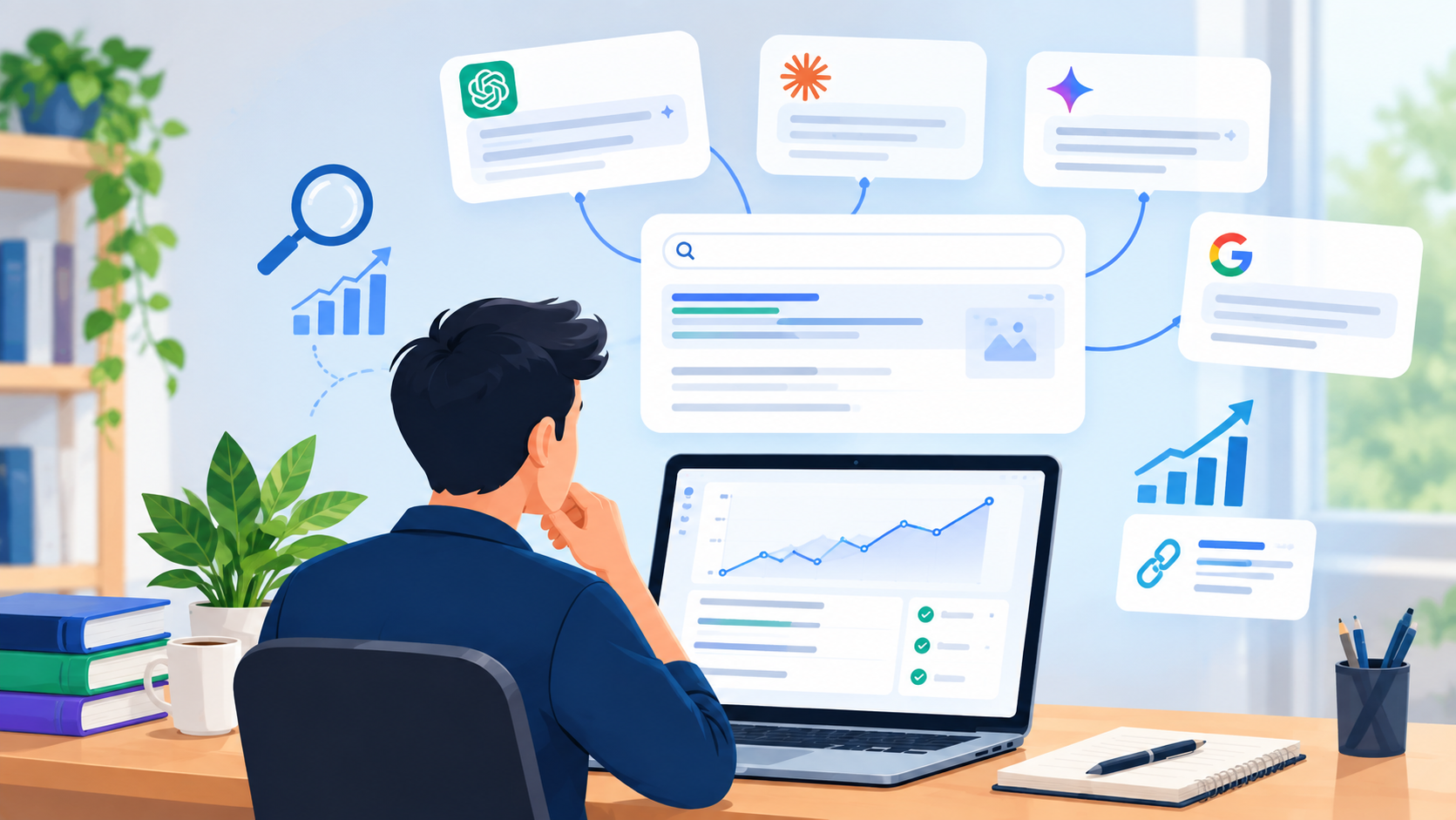
For example, Google Search Console and other first-party analytics can help you understand changes in organic search performance, while AI-search monitoring can help identify how your brand is appearing in AI-generated answers.
Looking at these signals together can give SEO teams a more complete picture of search visibility.
From AI Mentions to a Repeatable SEO Process
Getting mentioned by ChatGPT, Gemini, Claude, or another AI platform can be interesting.
But one mention doesn’t necessarily prove that your SEO strategy is working.
The bigger opportunity is to understand why your website is being mentioned and whether the same approach can produce similar results over time.
That requires a process:
Track → Test → Measure → Learn → Improve
Instead of making SEO changes based only on assumptions, teams can use structured tracking to identify patterns and make more informed decisions.
What Should SEO Teams Track?
A simple AI SEO measurement framework could include:
| Area | What to Monitor |
|---|---|
| AI Prompts | Important questions related to your business |
| Brand Mentions | How often your brand appears |
| Citations | Which pages are referenced |
| Topics | Subjects where your website gains visibility |
| Competitors | Brands appearing alongside or instead of yours |
| Organic Search | Changes in traditional search performance |
| Content Changes | Updates made before visibility changes |
| AI Platforms | Performance across different AI search experiences |
The exact metrics will depend on the business and the AI platforms being monitored.
Why AI SEO Measurement Matters
AI search is becoming another important part of the search ecosystem.
For businesses, the challenge is no longer only about ranking on traditional search engine results pages.
It is increasingly about being discoverable, useful, and credible across different search experiences.
That makes measurement especially important.
When SEO teams create a repeatable testing process, they can move away from simply asking:
“Are we showing up in AI search?”
and start asking more useful questions:
“Where are we showing up?”
“Why are we showing up?”
“Which changes may have contributed to that visibility?”
“Can we measure the change consistently?”
Final Thoughts
AI search is changing how people discover information, products, services, and brands.
For SEO professionals, this means measurement needs to evolve as well.
Traditional SEO metrics still matter, but AI visibility introduces additional signals that businesses need to monitor.
The goal shouldn’t be to chase every AI mention.
Instead, build a structured process for tracking important prompts, monitoring citations and mentions, connecting AI visibility with first-party data, and testing changes systematically.
The future of SEO isn’t just about being visible. It’s about understanding what creates that visibility and building a process that can be measured and improved.

Sikheya Digital Hub is a digital marketing institute and agency helping students, entrepreneurs and businesses learn and implement digital marketing, AI, social media marketing, SEO and online growth strategies.
Expertise
Digital Marketing
SEO
Social Media Marketing
Meta Ads
Google Ads
AI & Automation
Content Marketing