Meta Ads: The Complete Guide to Facebook & Instagram Advertising
Meta Ads have become one of the most powerful ways for businesses, creators, educators, service providers and e-commerce brands to reach potential customers online.
Whether you want to generate leads, promote a service, sell products, increase website traffic, grow awareness or bring more people into conversations through Instagram and Facebook, Meta’s advertising ecosystem gives businesses multiple ways to reach their target audience.
But running an ad is not the same as running a successful advertising campaign.
A campaign can receive thousands of impressions and still generate poor-quality leads. On the other hand, a well-planned Meta Ads campaign can help a business reach relevant people, generate enquiries and build a predictable marketing system.
This guide explains Meta Ads from beginner to advanced level, including campaign objectives, targeting, budgets, creatives, lead generation, Meta Ads Manager, optimization, common mistakes and practical strategies.
If you are a beginner looking to learn Meta Ads or a business owner considering paid advertising, this guide will help you understand how the platform works and what actually matters when building campaigns.
Table of Contents
- What Are Meta Ads?
- How Meta Ads Work
- Facebook Ads vs Instagram Ads
- Why Businesses Use Meta Ads
- Meta Ads Manager Explained
- Meta Ads Campaign Structure
- Choosing the Right Campaign Objective
- Meta Ads Targeting
- Broad vs Detailed Targeting
- Meta Ads Creatives
- Reels Ads and Video Advertising
- Meta Lead Generation Ads
- Website Conversion Campaigns
- Click-to-Message Ads
- Meta Ads Budget
- How Much Should You Spend on Meta Ads?
- Cost Per Lead vs Lead Quality
- Meta Ads Optimization
- Meta Ads Metrics You Should Track
- Common Meta Ads Mistakes
- Meta Ads for Local Businesses
- Meta Ads for Service Businesses
- Meta Ads for E-commerce
- Meta Ads for Education and Training Institutes
- Meta Ads vs Google Ads
- How to Learn Meta Ads
- Frequently Asked Questions
- Final Thoughts
What Are Meta Ads?
Meta Ads are paid advertisements distributed across Meta’s advertising ecosystem, including platforms such as Facebook and Instagram, along with other available Meta placements.
Businesses can use Meta Ads to reach specific audiences based on factors such as location, interests, behaviours, engagement signals and other available advertising signals.
Unlike traditional advertising, Meta Ads allow advertisers to control important campaign elements such as:
- Audience
- Budget
- Creative
- Campaign objective
- Placement
- Conversion location
- Performance goal
- Schedule
- Measurement
For example, a digital marketing institute in Jalandhar could create a campaign designed to generate enquiries from people interested in learning digital marketing.
A local business could instead use Meta Ads to encourage people to send a WhatsApp or Instagram message.
An e-commerce company could use advertising to drive people toward a product page and optimize toward purchases.
The strategy changes according to the business goal.
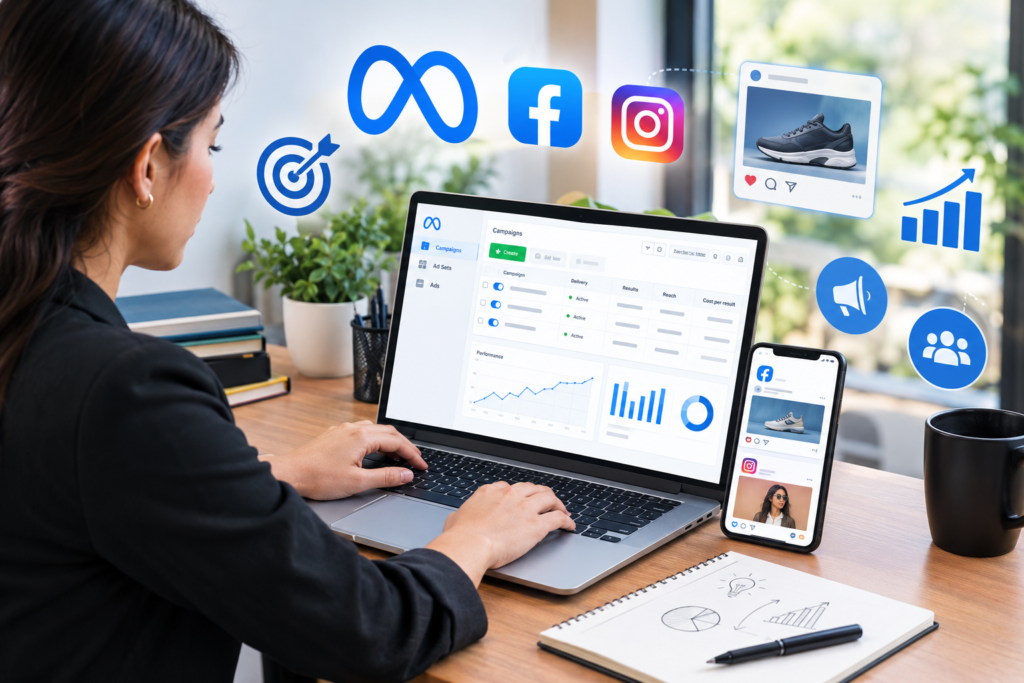
How Do Meta Ads Work?
Meta Ads work through an advertising auction and delivery system.
When eligible users browse Meta platforms, advertisers compete for opportunities to show their ads.
However, the advertiser simply offering the highest amount does not automatically guarantee the best delivery.
Meta’s system considers multiple factors when deciding which ad to deliver, including the advertiser’s bid, estimated action rate and ad quality or relevance-related signals.
This means successful advertising is not simply about spending more money.
Your campaign needs the right combination of:
Audience + Offer + Creative + Objective + Budget + Landing Experience + Follow-Up
If one part is weak, campaign performance can suffer.
For example:
Great targeting + weak offer = poor response
Great creative + wrong audience = wasted impressions
Good leads + slow follow-up = lost opportunities
Low-cost leads + poor lead quality = misleading performance
This is why professional Meta Ads management involves much more than simply pressing the “Boost” button.
Facebook Ads vs Instagram Ads
Facebook and Instagram are both part of the Meta advertising ecosystem.
Advertisers can potentially reach people across different placements depending on the campaign setup and available delivery options.
Facebook Ads
Facebook can be useful for:
- Local businesses
- Community-based businesses
- Service providers
- Lead generation
- Retargeting
- Older demographic segments
- Content promotion
Instagram Ads
Instagram can be particularly useful for visually driven businesses and younger audiences.
It is commonly used for:
- Reels
- Stories
- Product promotion
- Creator-led advertising
- Brand building
- Lifestyle businesses
- Education
- Beauty and fashion
- Food businesses
The best platform is not always about choosing Facebook or Instagram.
A well-structured Meta campaign can use multiple placements and allow the delivery system to identify opportunities.
Why Do Businesses Use Meta Ads?
There are several reasons businesses invest in Meta advertising.
1. Reach Relevant Audiences
Businesses can use available targeting and delivery options to reach people who may be interested in their offer.
2. Generate Leads
Lead campaigns can help businesses collect enquiries through Meta’s lead-generation experiences.
3. Generate Messages
Businesses can encourage potential customers to start conversations through available messaging destinations.
4. Drive Website Traffic
Meta Ads can bring users to websites, landing pages, blogs, product pages and other online destinations.
5. Generate Sales
E-commerce businesses can use conversion-focused campaigns to support online purchases.
6. Build Brand Awareness
Businesses can also use advertising to increase visibility and introduce their brand to new audiences.
What Is Meta Ads Manager?
Meta Ads Manager is the primary platform advertisers use to create, manage and analyze advertising campaigns.
Inside Ads Manager, advertisers can manage:
- Campaigns
- Ad sets
- Ads
- Budgets
- Audiences
- Placements
- Creatives
- Tracking
- Reporting
- Performance
Understanding Ads Manager is an important skill for anyone who wants to work professionally in paid social media advertising.
Meta also provides official learning resources through Meta Blueprint covering campaign objectives, advertising setup, lead generation, measurement and other areas.
Meta Ads Campaign Structure
One of the first concepts beginners need to understand is the campaign hierarchy.
A typical Meta Ads structure contains three levels:
Campaign
The campaign level generally defines the overall marketing objective.
For example:
Campaign: Digital Marketing Course – Lead Generation
Ad Set
The ad set level controls elements such as audience, budget-related settings, placements and conversion-related settings depending on the campaign setup.
Example:
Ad Set: Jalandhar + Nearby Areas
Ad
The ad is the actual creative people see.
It can include:
- Video
- Image
- Carousel
- Primary text
- Headline
- Call-to-action
Example:
Ad: Student Testimonial Video
Understanding this structure makes campaign management much easier.
Choosing the Right Meta Ads Objective
One of the biggest mistakes beginners make is choosing an objective simply because it sounds attractive.
Your objective should match the actual business outcome you want.
For example:
Awareness
Useful when the goal is to introduce or increase awareness of a business or offer.
Traffic
Useful when you want to drive people toward a destination such as a website or landing page.
Engagement
Can be used when the campaign is focused on engagement-related outcomes.
Leads
Designed for businesses that want to generate leads through available lead-generation solutions.
Sales
Used when the primary business goal is to generate purchases or other sales outcomes.
Meta’s current advertising education emphasizes selecting campaign objectives and aligning conversion locations and performance goals with the desired business outcome.
The important principle is simple:
Choose the objective based on what you ultimately want the customer to do.
Meta Ads Targeting
Targeting is one of the most discussed parts of Meta advertising.
Depending on the campaign and available options, advertisers can use different audience approaches.
These may include:
- Location
- Age
- Gender
- Interests
- Behaviours
- Custom audiences
- Lookalike audiences
- Engagement audiences
- Website-based audiences
- Customer data
- Broader audience approaches
However, targeting should not be unnecessarily complicated.
More targeting does not automatically mean better targeting.
Broad vs Detailed Targeting
A common beginner strategy is to add dozens of interests.
For example:
Digital Marketing + SEO + Google Ads + Facebook + Instagram + Entrepreneurship + Business + Freelancing + Marketing + Online Education
This can create an unnecessarily complicated audience.
Modern Meta advertising increasingly relies on automated delivery and AI-powered optimization.
For some campaigns, broader audiences can give the system more opportunities to identify people likely to take the desired action.
The right approach depends on the campaign, offer, location, creative, conversion event and available data.
The key is to test instead of assuming.
How to Create Meta Ads That People Notice
Your audience sees countless pieces of content every day.
Your advertisement has to earn attention.
A strong Meta ad usually has four important components:
1. Hook
The first few seconds or first line should create curiosity or communicate relevance.
Example:
“Still getting views but no enquiries?”
2. Problem
Identify the problem your audience understands.
3. Solution
Explain how your product, service or offer can help.
4. Call to Action
Tell people what to do next.
For example:
Send Message
Learn More
Book Now
Get Quote
Apply Now
Sign Up
The CTA should match the campaign goal.
Meta Ads Creative Strategy
Creative quality can have a major impact on advertising performance.
You can experiment with:
- Short-form videos
- Reels
- Static images
- Carousels
- Testimonials
- Product demonstrations
- Before-and-after concepts
- Educational videos
- Founder videos
- Problem-solution videos
- Customer stories
- FAQs
Instead of creating one advertisement and leaving it unchanged for months, develop multiple creative angles.
For example, a digital marketing course could use:
Creative 1 – Career Angle
“Want to build practical digital marketing skills?”
Creative 2 – Problem Angle
“Degree hai, but practical skills nahi?”
Creative 3 – Testimonial Angle
“Here’s what our student’s parent says about the learning experience.”
Creative 4 – Educational Angle
“3 digital marketing skills businesses are hiring for.”
Testing different messages helps you understand what resonates with the audience.
Meta Reels Ads
Short-form video has become an important part of social advertising.
Meta’s own guidance recommends creative designed specifically for Reels, including vertical video, quality audio and keeping key messages within the safe zone.
For Reels advertising, consider:
- 9:16 vertical format
- Strong opening hook
- Clear audio
- Fast pacing
- Captions where appropriate
- Simple messaging
- Strong visual storytelling
- One clear CTA
Do not make the advertisement feel like a traditional television commercial.
For many businesses, a natural-looking Reel can feel more native to the platform.
Meta Lead Generation Ads
Lead generation is one of the most useful Meta Ads applications for service-based businesses.
Instead of sending someone to a website, businesses can use available Meta lead-generation experiences to collect information such as:
- Name
- Phone number
- Location
- Business requirement
- Course interest
- Other qualifying questions
Meta’s official lead-generation resources specifically cover lead forms, messaging and other methods for generating and nurturing leads.
How to Improve Meta Lead Quality
Getting more leads is not always the same as getting better leads.
Suppose a campaign generates:
100 leads at ₹50 each
That sounds excellent.
But if only 5 people are genuinely interested, the campaign may not be profitable.
Now consider:
40 leads at ₹100 each
If 15 of those leads are genuinely interested and several become customers, the second campaign could be much more valuable.
Therefore, businesses should track:
Lead → Contacted → Qualified → Appointment → Sale
rather than stopping at:
Lead → Cost Per Lead
Qualifying Questions in Lead Forms
For some businesses, adding qualifying questions can improve lead quality.
For example, a digital marketing institute could ask:
Which course are you interested in?
- Digital Marketing
- SEO
- Meta Ads
- Google Ads
- Content Creation
Another question could ask:
Preferred learning mode?
- Offline
- Online
- Not sure
However, adding too many questions can reduce completion rates.
The right balance depends on the business.
Click-to-Message Meta Ads
Another useful approach is advertising that encourages people to start conversations.
Depending on the available setup, businesses can direct conversations through supported messaging destinations.
This can be useful for businesses where customers have questions before making a decision.
For example:
“Want to know which digital marketing course is right for you? Send us a message.”
The conversation can then help qualify the person.
Meta’s lead-generation guidance includes messaging-based lead generation and recommends designing chat flows around clear expectations and useful qualifying questions.
Meta Ads Budget
There is no single budget that works for every business.
Your budget depends on:
- Industry
- Location
- Competition
- Audience size
- Offer
- Creative quality
- Conversion rate
- Customer value
- Campaign objective
- Sales process
A business should not decide its advertising budget only by copying another company’s budget.
Instead, work backward from the economics.
For example:
If your average customer generates ₹10,000 in revenue and your business can profitably spend ₹2,000 to acquire that customer, you have a very different advertising capacity from a business that earns ₹1,000 per customer.
How Much Should You Spend on Meta Ads?
For a small local business, it can make sense to start with a controlled test budget rather than immediately spending a large amount.
The goal of the initial campaign is to learn:
- Which creative works?
- Which audience responds?
- Which offer attracts attention?
- What does a lead cost?
- Are the leads qualified?
- What percentage becomes customers?
After collecting meaningful data, the campaign can be refined and scaled.
Do not scale simply because you received cheap leads.
Scale when the business result justifies the additional spending.
Cost Per Lead vs Lead Quality
Cost per lead is one of the most misunderstood Meta Ads metrics.
A low CPL is not automatically a successful campaign.
Imagine two campaigns:
| Campaign | Leads | CPL | Qualified Leads |
|---|---|---|---|
| A | 100 | ₹50 | 8 |
| B | 50 | ₹100 | 20 |
Campaign A looks better if you only examine CPL.
Campaign B may be much better from a business perspective because it generated more qualified opportunities.
This is why professional advertising should focus on cost per qualified lead and cost per customer, not only cost per lead.
Meta Ads Optimization
Optimization is an ongoing process.
After launching a campaign, monitor performance and identify where the problem exists.
If impressions are low:
Check:
- Budget
- Audience size
- Campaign setup
- Delivery
- Creative
- Restrictions
If impressions are high but clicks are low:
Review:
- Hook
- Creative
- Offer
- Copy
- Audience relevance
If clicks are high but leads are low:
Review:
- Landing page
- Form
- Offer
- Page speed
- Message consistency
If leads are high but sales are low:
Review:
- Lead quality
- Sales process
- Follow-up speed
- Qualification
- Offer
- Sales team
This approach helps you diagnose the actual bottleneck instead of randomly changing campaign settings.
Important Meta Ads Metrics
Here are some metrics every advertiser should understand.
Impressions
The number of times your advertisement was displayed.
Reach
The number of unique people who saw your ad.
CPM
Cost per 1,000 impressions.
CTR
Click-through rate.
It helps indicate how often people clicked after seeing the advertisement.
CPC
Cost per click.
Leads
The number of leads generated through the selected lead-generation setup.
CPL
Cost per lead.
Conversion Rate
The percentage of users who complete the desired action.
Frequency
An indication of how often the average person has been exposed to your advertisement.
ROAS
Return on ad spend.
For example:
If you spend ₹10,000 and generate ₹40,000 in tracked revenue:
ROAS = 4X
However, ROAS needs to be interpreted alongside margins and other business costs.
Common Meta Ads Mistakes
Mistake 1: Boosting Every Post
Boosting a post is not the same as building a complete advertising strategy.
Mistake 2: Focusing Only on Likes
Likes do not necessarily translate into customers.
Mistake 3: Using One Creative
One creative may work today and decline later.
Mistake 4: Changing Campaigns Too Frequently
Constant changes can make it difficult to understand what is actually working.
Mistake 5: Targeting Everyone
Broad targeting can be useful in some campaigns, but “everyone” without a clear offer or strategy is not a marketing plan.
Mistake 6: Ignoring Lead Quality
A campaign that generates cheap but irrelevant leads can waste both advertising and sales resources.
Mistake 7: Slow Follow-Up
A good lead can lose interest if nobody contacts them promptly.
Mistake 8: No Tracking
Without proper measurement, you cannot confidently identify which campaigns generate actual business results.
Meta Ads for Local Businesses
Meta Ads can be especially useful for local businesses.
Examples include:
- Salons
- Gyms
- Coaching institutes
- Restaurants
- Clinics
- Immigration consultants
- Real estate businesses
- Education institutes
- Digital marketing agencies
- Event businesses
- Local service providers
A local campaign can focus on a specific geographic area instead of advertising to an entire country.
For example, a Jalandhar-based training institute may build campaigns around people who can realistically attend its offline classes.
But location targeting alone does not guarantee quality.
The advertisement, offer, creative and follow-up process still matter.
Meta Ads for Service Businesses
Service businesses often use Meta Ads to generate enquiries rather than immediate online purchases.
Examples include:
- Digital marketing services
- Web development
- Immigration services
- Interior design
- Real estate
- Photography
- Education
- Consulting
- Professional services
For these businesses, the customer journey may look like:
Ad → Lead → Qualification → Consultation → Proposal → Customer
Therefore, campaign performance should be evaluated across the entire journey.
Meta Ads for E-commerce
E-commerce businesses have a different advertising journey.
A simplified funnel may look like:
Ad → Product Page → Add to Cart → Checkout → Purchase
E-commerce advertisers can test:
- Product videos
- UGC-style creatives
- Product demonstrations
- Offers
- Testimonials
- Carousels
- Collection-style experiences
- Retargeting
Measurement becomes particularly important because the final goal is usually a purchase rather than simply a click.
Meta Ads for Education & Training Institutes
Education businesses can use Meta Ads to generate enquiries for:
- Digital marketing courses
- SEO courses
- Google Ads courses
- Meta Ads courses
- Video editing courses
- Content creation courses
- Professional training
- Workshops
- Career programs
For an institute, a strong campaign could combine:
Educational content + student testimonials + practical demonstrations + lead generation
Instead of simply saying:
“Join our course.”
A stronger advertisement might communicate:
What students will learn + who the course is for + practical experience + next step.
Meta Ads vs Google Ads
Meta Ads and Google Ads can both be effective, but they often work differently.
Meta Ads
People generally discover your offer while using Meta platforms.
This makes Meta particularly useful for:
- Demand generation
- Visual advertising
- Social discovery
- Reels
- Audience building
- Lead generation
- Brand discovery
Google Ads
Google Ads can capture people actively searching for a product or service.
For example:
“digital marketing course in Jalandhar”
The user has already expressed search intent.
This makes Google Ads particularly useful for capturing existing demand.
The two platforms do not have to compete.
A business can potentially use both as part of a broader digital marketing strategy.
Meta Ads and AI-Powered Advertising
Meta advertising continues to incorporate automation and AI into campaign delivery, creative and optimization.
For advertisers, this means the role of the marketer is changing.
Instead of manually controlling every small campaign setting, marketers increasingly need to focus on:
- Strong offers
- Better creative
- Quality customer data
- Clear conversion signals
- Accurate measurement
- Testing
- Customer experience
Meta’s current training resources also highlight Advantage+ solutions and the use of AI and automation for campaign optimization.
The future of Meta Ads is therefore not simply about knowing where to click inside Ads Manager.
It is about understanding marketing strategy + creative + data + customer behaviour.
How to Learn Meta Ads
If you want to learn Meta Ads professionally, do not focus only on memorizing the Ads Manager interface.
Learn the complete process:
Step 1: Understand Digital Marketing Fundamentals
Learn:
- Customer journey
- Target audience
- Offers
- Funnels
- Conversion
- Copywriting
Step 2: Learn Meta Ads Manager
Understand:
- Campaigns
- Ad sets
- Ads
- Objectives
- Audiences
- Placements
- Budgets
- Reporting
Step 3: Learn Creative Strategy
Practice creating:
- Reels
- Static ads
- Hooks
- Headlines
- Primary text
- CTAs
Step 4: Run Practical Campaigns
Theory alone is not enough.
Work with practical campaign structures and analyze actual results.
Step 5: Learn Measurement
Understand:
- CTR
- CPC
- CPM
- CPL
- Conversion rate
- ROAS
- Qualified leads
- Customer acquisition cost
Step 6: Learn Optimization
Learn how to diagnose performance rather than randomly changing settings.
Learn Meta Ads in Jalandhar with Sikheya Digital Hub
If you are looking for Meta Ads training in Jalandhar, practical learning can help you understand advertising beyond theory.
At Sikheya Digital Hub, Meta Ads is included among the digital marketing skills offered through its practical, industry-focused learning approach. The institute’s website highlights hands-on assignments, live tools, industry projects and agency exposure as part of its learning model.
You can explore Sikheya’s digital marketing courses and learn skills related to:
- Meta Ads
- Google Ads
- SEO
- Social Media Marketing
- AI Marketing
- Content Marketing
- Content Creation
- Video Production
- Copywriting
For learners who want to build practical digital marketing skills, the focus should not only be on completing a course but on understanding how marketing campaigns are planned, executed, measured and improved.
Explore the Digital Marketing Course at Sikheya Digital Hub and discover a practical learning path for digital marketing and paid advertising.
Frequently Asked Questions About Meta Ads
What are Meta Ads?
Meta Ads are paid advertisements that businesses can use across Meta’s advertising ecosystem to reach audiences and achieve objectives such as awareness, traffic, engagement, leads or sales.
Are Meta Ads the same as Facebook Ads?
Facebook Ads are part of Meta advertising. Today, advertisers can manage advertising across multiple Meta platforms and placements through Meta Ads Manager.
Are Meta Ads good for small businesses?
Yes, Meta Ads can be useful for small businesses, especially when the campaign has a clear objective, relevant offer, suitable creative and proper measurement.
How much do Meta Ads cost?
There is no universal fixed price. Advertising costs vary based on factors such as audience, competition, objective, creative, location and campaign performance.
Can Meta Ads generate leads?
Yes. Meta provides lead-generation solutions that allow businesses to collect leads through available forms, messaging and other conversion experiences.
Is a low cost per lead always good?
No. A low CPL can still produce poor-quality leads. Businesses should also evaluate qualification rates, appointments and actual customers.
What is Meta Ads Manager?
Meta Ads Manager is the platform used to create, manage, monitor and analyze Meta advertising campaigns.
Are Instagram Ads and Facebook Ads different?
They are different placements/platform experiences within the broader Meta advertising ecosystem, but they can be managed through Meta’s advertising tools.
Do I need a website to run Meta Ads?
Not necessarily. Depending on the campaign goal, businesses can use options such as lead forms or messaging. However, a strong website or landing page can be valuable for many conversion strategies.
How long does it take to learn Meta Ads?
The basics can be learned relatively quickly, but becoming proficient requires practical campaign experience, creative testing, data analysis and continuous learning.
Should beginners use Meta Ads?
Beginners can learn Meta Ads, but it is important to understand the fundamentals before spending significant advertising budgets.
Final Thoughts
Meta Ads are much more than Facebook or Instagram promotions.
A successful campaign combines:
Strategy + Audience + Creative + Offer + Budget + Measurement + Follow-Up
The most important lesson is that advertising performance should not be judged by one number.
A campaign generating inexpensive clicks may not generate customers.
A campaign generating expensive leads may still be profitable if those leads convert into valuable customers.
Therefore, the real question is not:
“How much does a Meta lead cost?”
The better question is:
“How much does it cost us to acquire a qualified customer?”
That shift in thinking is what separates basic ad boosting from professional performance marketing.
Whether you are a business owner, freelancer, marketer or student learning digital marketing, understanding Meta Ads can become a valuable part of your digital skill set.
And the best way to improve is to combine knowledge with practical experience, testing and continuous optimization.
Ready to learn digital marketing and Meta Ads practically?
Explore Sikheya Digital Hub and take the next step toward building practical, career-focused digital skills.
Learn. Create. Grow.
Sikheya Digital Hub is a digital marketing institute and agency helping students, entrepreneurs and businesses learn and implement digital marketing, AI, social media marketing, SEO and online growth strategies.
Expertise
Digital Marketing
SEO
Social Media Marketing
Meta Ads
Google Ads
AI & Automation
Content Marketing