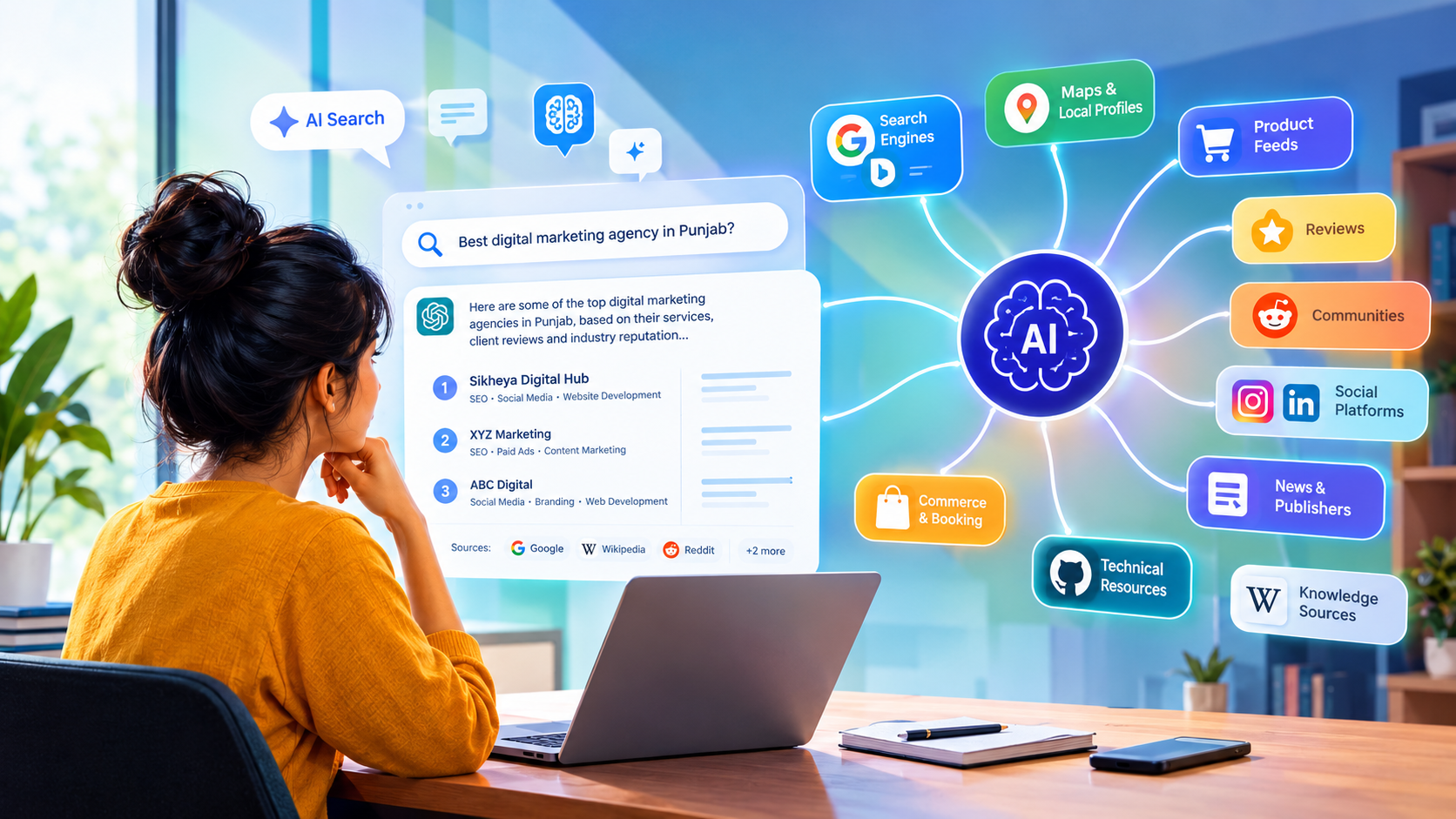
Which Data Sources Should You Care About For AI Search?
AI search is changing the way people discover businesses, products, services, and information. Here’s why your business needs to think beyond Google rankings.
For years, digital marketing had a relatively simple search equation:
Customer searches on Google → Google shows results → Customer visits a website.
That model is changing.
Today, people can ask AI-powered tools questions such as:
- “Which digital marketing agency should I choose?”
- “What are the best SEO companies for a small business?”
- “Where can I buy women’s suits online?”
- “Which restaurants are good for a family dinner?”
- “Compare these three software products.”
- “What is the best option for a beginner?”
Instead of returning only a list of links, AI systems can generate an answer using information gathered from different sources.
That creates a new question for marketers:
Where does AI get its information from?
And perhaps more importantly:
Where should your business be visible if you want to be discovered through AI search?
This is where Generative Engine Optimization (GEO) becomes increasingly important.
What Is AI Search?
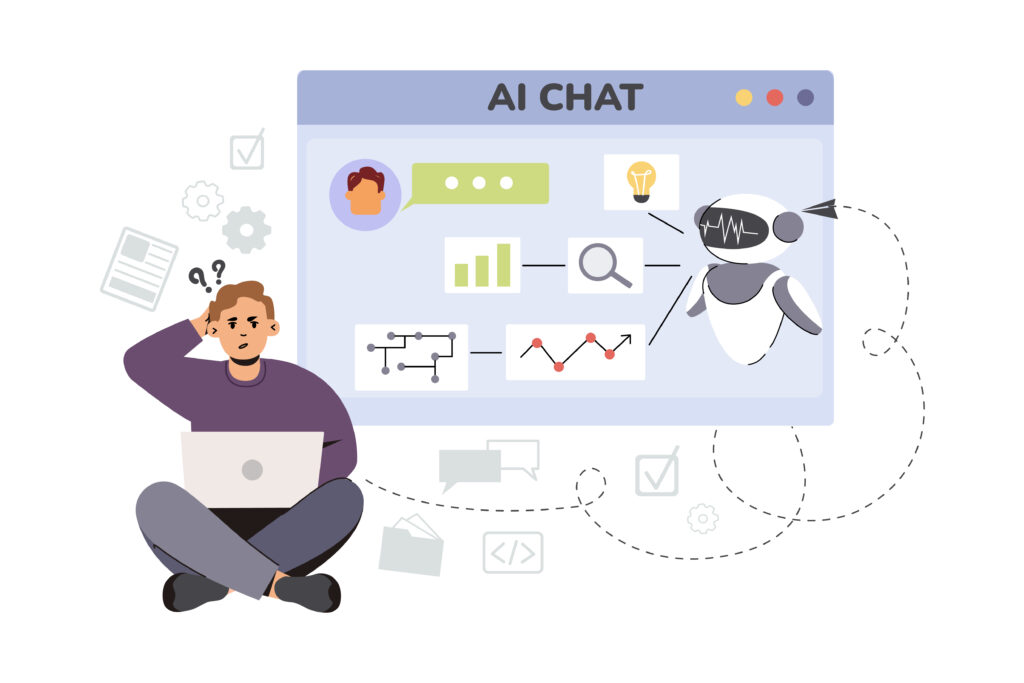
AI search refers to search experiences where artificial intelligence helps users discover, understand, compare, and act on information.
Traditional search generally provides a list of results.
AI-powered search can synthesize information from multiple sources and present it as a conversational response.
For example, a traditional search might show:
“Best SEO agency in Punjab”
followed by multiple websites.
An AI search experience may instead provide a summary of several agencies, explain their services, mention relevant factors, and potentially cite the sources used to generate the response.
This means businesses are no longer competing only for:
Google rankings.
They are increasingly competing for:
visibility inside AI-generated answers.
Why Data Sources Matter for AI Search
AI systems need information.
That information can come from different types of sources, depending on the system, product, query, and retrieval method.
The Search Engine Journal analysis published in September 2026 categorized potential AI data sources into four broad evidence tiers:
| Tier | Meaning |
|---|---|
| Tier 1 | Confirmed and current — used for retrieval, grounding, or actions |
| Tier 2 | Confirmed and current — primarily associated with training or licensing |
| Tier 3 | Historically confirmed — associated with pretraining |
| Tier 4 | Strong evidence or highly likely, but not fully confirmed |
The original analysis also cautions that the AI-search ecosystem changes quickly, so the importance of individual sources can change over time.
For marketers, this leads to an important lesson:
Don’t assume that Google is the only source that matters for AI visibility.
1. Google Search Still Matters
It might sound surprising, but the growth of AI search does not automatically make Google irrelevant.
Google Search can be used as a current web-grounding source for Google’s AI systems, allowing responses to connect with real-time web information and source URLs.
This means traditional SEO fundamentals can still matter.
Businesses should continue working on:
- useful website content
- technical SEO
- relevant service pages
- product pages
- internal linking
- local SEO
- authoritative information
- crawlability
- clear business information
The rise of GEO should therefore not be interpreted as:
SEO is dead.
A more practical way to look at it is:
SEO is becoming one part of a larger search-visibility strategy.
2. Bing Is Part of the AI Search Ecosystem
Bing is another important search source in the AI landscape.
Microsoft has documented the use of Bing results to enhance Copilot responses.
For marketers, this reinforces a broader point:
Your business should not be optimized around a single search environment.
The web is increasingly becoming an interconnected information ecosystem.
Your website, business listings, reviews, publications, social platforms, product feeds, and other digital properties can all contribute to how your brand is represented online.
3. Google Merchant Center Matters for Products
If you sell products online, AI search introduces another important consideration:
structured product information.
Google Merchant Center provides product information that supports Google’s shopping surfaces.
This means an e-commerce business shouldn’t think only about creating attractive product pages.
It should also think about whether its product information is:
- accurate
- complete
- structured
- current
- consistent
- easy for platforms to understand
For example, an online suit store should clearly communicate:
Product: Punjabi Suit
Material: Cotton
Size: S–XXL
Colour: Blue
Price: ₹1,499
Availability: In stock
Delivery: Available across India
The more clearly your product information is represented across relevant systems, the easier it becomes for digital platforms to understand what you’re selling.
4. Product Feeds Are Becoming More Important
AI shopping is also creating opportunities for businesses to provide structured product information directly to platforms.
The source analysis identifies merchant and retail feeds as another important category.
For example, OpenAI’s commerce documentation describes merchant feeds containing information such as:
- product identifiers
- descriptions
- prices
- inventory
- images
- fulfillment information
The source notes that these feeds can be refreshed frequently, helping AI systems surface more accurate product information.
This is particularly relevant for e-commerce businesses.
Imagine a customer asking:
“Find me a women’s suit under ₹2,000 that is available for delivery.”
For an AI shopping experience, accurate product information becomes extremely important.
A website with outdated prices or unavailable products creates a poor experience.
5. Google Maps and Business Profiles Matter for Local Businesses
Local businesses need to pay special attention to location data.
A customer might ask:
“Find a good digital marketing agency near me.”
Or:
“Where can I get a women’s suit stitched near me?”
Or:
“Which restaurants are open nearby?”
In these situations, location information becomes extremely important.
The source analysis identifies Google Maps and Google Business Profile among the important local and places data sources.
For local businesses, that means maintaining accurate information across local platforms is no longer simply a traditional local SEO task.
It can also contribute to broader AI discoverability.
6. Reviews and Local Platforms Matter
Reviews can provide valuable information about businesses.
The source identifies Yelp as a current local data source for OpenAI, including reviews, photos, and business information. It also notes that this information can support local recommendations and actions such as reservations and quote requests.
For marketers, the broader lesson is important:
Your online reputation exists beyond your website.
A business should monitor:
- customer reviews
- business information
- photos
- opening hours
- location
- contact information
- service descriptions
In India, the most relevant platforms may differ by industry and market.
So GEO research should be localized rather than blindly copying a platform strategy from another country.
7. Wikipedia and Knowledge Sources
AI systems also need structured reference information.
The source analysis identifies Wikipedia and Wikimedia as important knowledge and reference sources.
This highlights the importance of entity understanding.
Suppose your company is:
Sikheya Digital Hub
An AI system should ideally be able to understand:
- what Sikheya is
- what industry it operates in
- what services it provides
- where it operates
- what topics it is associated with
- what other reliable sources say about it
This is one reason marketers increasingly talk about entities rather than only keywords.
Keywords Are Not the Whole Story Anymore
Traditional SEO often starts with:
“Which keywords should we rank for?”
GEO requires a broader question:
“What does the internet need to understand about this business?”
For example, consider a digital marketing agency.
A keyword strategy might focus on:
- digital marketing agency
- SEO company
- social media marketing
- website development
An entity-focused strategy also asks:
- Who is the company?
- What services does it provide?
- Which locations does it serve?
- Who are its customers?
- What expertise does it demonstrate?
- Where is the company mentioned?
- What independent information supports its claims?
This creates a more complete digital identity.
8. Reddit and Community Content
Community-generated information can also play a role in AI search.
The source identifies Reddit as a confirmed current source in certain AI/search contexts and notes Google’s access to Reddit’s structured, real-time content through a data agreement.
This is important because customers often ask real people questions before making decisions.
For example:
“Has anyone tried this SEO agency?”
“Which laptop should I buy for graphic design?”
“Is this software worth it for a small business?”
“Where can I find affordable wedding suits?”
Community discussions can contain firsthand experiences that aren’t available on a company’s own website.
But businesses should not respond by creating fake discussions or manipulating communities.
The better approach is to build a genuine reputation and participate where participation is appropriate.
9. Social Platforms Can Contribute to Digital Visibility
The source also identifies social platforms and online communities as likely data categories, while distinguishing confirmed evidence from broader inference.
This reinforces an important idea:
Your website is not your entire digital presence.
For many businesses, customers encounter the brand through:
- YouTube
- community websites
- review platforms
- directories
A business with consistent information across these channels creates a stronger overall digital footprint.
10. News and Publisher Content
Another important category is news and publisher content.
The source analysis distinguishes between:
Live publisher pages
These can be reached through search grounding and retrieval.
Licensed publisher content
Some AI providers have explicit content partnerships with publishers.
The analysis mentions partnerships involving organizations such as the Financial Times, Axel Springer, AP, and News Corp.
For businesses, this reinforces the value of legitimate digital PR.
If a company has genuinely newsworthy information, being covered by relevant publications can create another layer of digital authority.
Examples could include:
- new product launches
- original research
- industry reports
- business milestones
- expert commentary
- community initiatives
- significant partnerships
The objective should not be to manufacture mentions.
It should be to create something worth mentioning.
11. GitHub and Technical Sources
For technology businesses, developer platforms can be particularly important.
The source analysis identifies GitHub as a confirmed current technical data source and also identifies Stack Overflow and technical documentation as relevant categories.
This is particularly useful for:
- SaaS companies
- software developers
- APIs
- open-source projects
- developer tools
- technical products
For these businesses, publishing useful documentation may be more valuable than simply producing generic marketing articles.
12. Travel and Commerce Data
AI search is also moving beyond information retrieval into actions.
The source identifies Google Hotel Center feeds as a current source for hotel information and notes that Google has been expanding AI-assisted travel and booking capabilities.
This illustrates a major development:
AI search isn’t always stopping at an answer.
It can increasingly connect information with actions.
The future search journey can look more like:
Question → Recommendation → Comparison → Transaction
rather than:
Question → Website visit
This has major implications for e-commerce, travel, restaurants, appointments, and other transaction-based businesses.
What Does This Mean for SEO?
The biggest mistake would be to treat GEO as completely separate from SEO.
There is considerable overlap.
Traditional SEO helps businesses create:
- crawlable websites
- useful content
- structured information
- relevant pages
- authoritative resources
- strong internal linking
- clear entities
GEO adds another layer:
- Where does AI get information?
- Which sources influence answers?
- Which sources are missing?
- What does AI currently say about the brand?
- Which competitors are being mentioned?
- Which sources are being cited?
- Is the brand information accurate?
So the modern search strategy becomes broader.
Traditional SEO
Optimize the website.
GEO
Optimize the broader information ecosystem around the business.
A Practical GEO Strategy for Businesses
Here is a simple framework businesses can start using.
Step 1: Identify Your Important Questions
Don’t begin with keywords alone.
Write down 20–50 questions your customers might ask AI.
For example:
- Who provides SEO services in Punjab?
- How much does SEO cost?
- Which digital marketing agency works with small businesses?
- What should I look for in an SEO company?
- What are the best social media marketing services?
Step 2: Test Those Questions
Ask the same questions across relevant AI search platforms.
Record:
- Which businesses appear?
- Which websites are cited?
- Which sources are mentioned?
- What information is included?
- What information is missing?
- Is your business represented accurately?
The original source recommends studying generated results for queries customers are likely to search and looking for gaps that businesses can address.
Step 3: Find the Sources AI Is Using
Suppose you ask:
“Best digital marketing agencies in Punjab”
and notice that several businesses are repeatedly associated with:
- business directories
- reviews
- publications
- social profiles
- websites
- community discussions
That gives you useful competitive intelligence.
You can then ask:
Where is my business missing from this ecosystem?
Step 4: Improve Your Information
Make sure your business information is consistent.
Check:
Website
- Business name
- Services
- Location
- Contact details
- About page
- Service pages
Local profiles
- Address
- Phone number
- Hours
- Category
- Reviews
- Photos
Social profiles
- Bio
- Website
- Services
- Location
- Brand description
Third-party sources
- Industry listings
- Relevant directories
- Publications
- Reviews
- Community profiles
Consistency matters because conflicting information can make it harder for users—and potentially systems—to understand the business.
Step 5: Create Original Content
Don’t build your entire strategy around rewriting information that already exists.
Create something new.
For example:
Instead of:
“What is SEO?”
create:
“SEO Lessons We Learned From Helping 25 Local Businesses”
Instead of:
“Digital Marketing Tips”
create:
“A Digital Marketing Checklist for Small Businesses in Punjab”
Instead of:
“Best Marketing Strategies”
create:
“What Local Businesses Should Track Before Spending Money on Ads”
Original experiences, data, examples, and insights give your content something distinctive.
Step 6: Build Genuine Authority
Authority doesn’t come from publishing 100 AI-generated articles.
It can come from demonstrating expertise.
Consider:
- case studies
- expert interviews
- original research
- customer success stories
- useful guides
- industry contributions
- legitimate PR
- reviews
- partnerships
- expert commentary
The goal is to become a useful source of information within your niche.
GEO for a Small Indian Business
Let’s take a simple example.
Imagine a small business selling Punjabi suits online.
The business has:
- WhatsApp Business
- website
- Google Business Profile
- product catalog
- customer reviews
A traditional SEO strategy might focus on:
Punjabi suits online
A broader GEO strategy would also make sure the business clearly communicates:
Who: Women’s ethnic fashion store
What: Punjabi suits and ethnic wear
Location: Punjab / India
Price range: ₹999–₹2,999
Delivery: Pan-India
Products: Cotton suits, party wear, Punjabi suits, festive collections
Customer information: Sizes, materials, return policy, delivery details
Then the business can create useful content around questions such as:
- How to choose the right Punjabi suit?
- What fabric is best for summer?
- What Punjabi suit should I wear to a wedding?
- How should I choose my suit size online?
- What is the difference between cotton and rayon suits?
This helps create a broader information ecosystem around the brand.
GEO Is Not About “Tricking” AI
This is an important distinction.
GEO should not mean:
“How do I manipulate ChatGPT into saying my company is the best?”
Instead, think:
“How can I make my business information accurate, useful, authoritative, and easy to discover?”
That is a much healthier long-term approach.
Avoid tactics such as:
- fake reviews
- fake citations
- spam mentions
- manufactured community discussions
- misleading claims
- keyword stuffing
- mass-produced low-value content
The goal is not to fool AI.
The goal is to build a digital presence that deserves to be discovered.
The Future of Search Is Becoming More Diverse
One of the strongest ideas from the source article is that marketers should avoid “source myopia”—the assumption that only traditional search engines matter.
AI systems can interact with a much wider information ecosystem.
Depending on the platform and use case, that ecosystem can include:
Search engines
↓
Maps & local profiles
↓
Product feeds
↓
Reviews
↓
Communities
↓
Social platforms
↓
News & publishers
↓
Knowledge bases
↓
Technical resources
↓
Commerce and booking systems
This is why modern SEO is gradually becoming less about one ranking page and more about overall digital discoverability.
What Should Marketers Do Now?
You don’t need to optimize for every possible platform at once.
Start with the sources that matter to your business.
If you’re a local business:
Focus on:
- Google Business Profile
- Google Maps
- reviews
- local directories
- website
- local content
If you’re an e-commerce business:
Focus on:
- product pages
- structured product information
- merchant feeds
- product reviews
- marketplaces
- accurate inventory and pricing
If you’re a SaaS company:
Focus on:
- website
- technical documentation
- GitHub where relevant
- developer communities
- comparison content
- reviews
- authoritative publications
If you’re a professional service:
Focus on:
- website
- expert content
- professional profiles
- reviews
- case studies
- industry publications
- local listings where relevant
The Most Important GEO Skill: Research
GEO isn’t just about creating content.
It’s about understanding where information comes from.
The practical process is:
Ask → Observe → Identify Sources → Find Gaps → Improve Information → Monitor
For example:
Ask
“What are the best SEO agencies for small businesses?”
Observe
Which companies appear?
Identify
Which websites and platforms are being referenced?
Find gaps
Why is your business not being represented?
Improve
Strengthen your website, profiles, content, authority, and relevant third-party presence.
Monitor
Repeat the research periodically.
This approach is more useful than blindly following a list of “100 GEO hacks.”
Final Thoughts
AI search is creating a broader definition of search visibility.
The question is no longer only:
“Does my website rank on Google?”
Businesses increasingly need to consider:
“Where does AI get information about my business?”
Search engines, maps, business profiles, product feeds, reviews, communities, publishers, knowledge sources, technical platforms, and commerce systems can all form parts of the wider digital ecosystem.
The exact importance of each source can vary by platform, query, industry, country, and time. The source analysis itself warns that the AI-search landscape can change quickly.
For businesses, the practical lesson is simple:
Don’t optimize only your website. Build a trustworthy digital presence across the places where customers—and increasingly AI systems—can discover information about you.
For SEO professionals, this means the role is expanding.
You are no longer just optimizing pages.
You are helping businesses become discoverable, understandable, and credible across an increasingly complex search ecosystem.
And that is where SEO and GEO begin to meet.
About Sikheya
At Sikheya, we focus on practical digital marketing, SEO, AI, and digital business skills that help students, freelancers, entrepreneurs, and businesses understand how the digital world is changing.
As search continues to evolve, learning how platforms discover, understand, and present information will become an increasingly important digital skill.

Sikheya Digital Hub is a digital marketing institute and agency helping students, entrepreneurs and businesses learn and implement digital marketing, AI, social media marketing, SEO and online growth strategies.
Expertise
Digital Marketing
SEO
Social Media Marketing
Meta Ads
Google Ads
AI & Automation
Content Marketing