How AI Search Is Changing Local SEO: How Customers Find Businesses in 2026
A customer looking for a digital marketing agency, dentist, restaurant, salon or visa consultant used to search Google, scan several results and make the decision themselves.
That behavior is changing.
Today, people can ask an AI-powered search system a much more specific question:
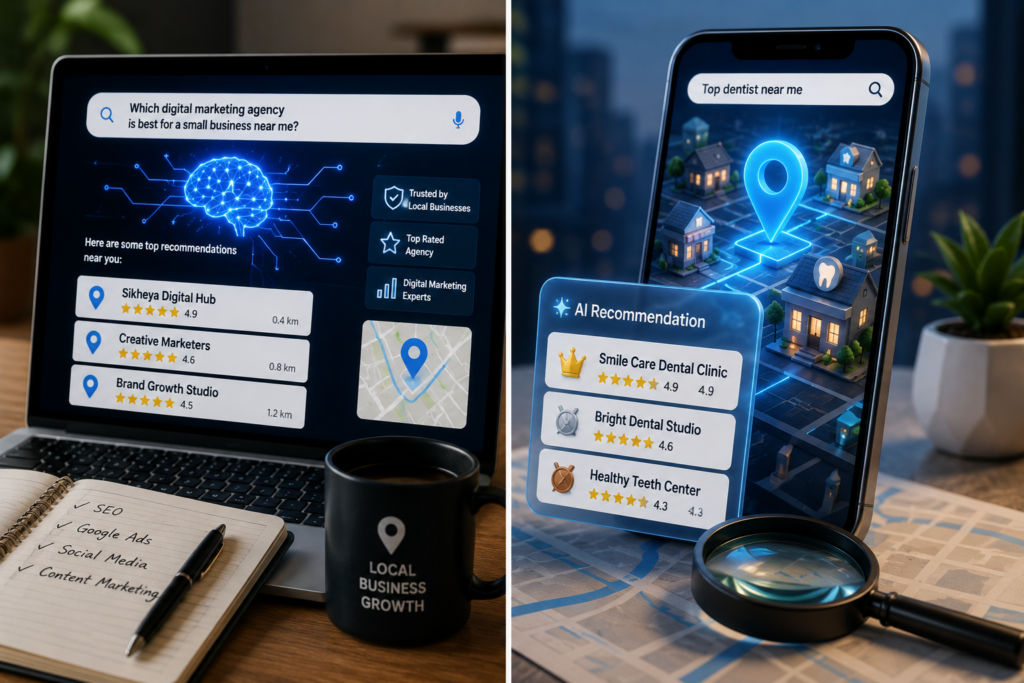
“Which digital marketing agency is best for a small business near me?”
Instead of simply receiving ten blue links, they may receive a summarized answer, a shortlist of businesses, supporting sources, maps or other information that helps them make a decision.
That creates a new challenge for local businesses: being visible in search is no longer only about ranking a webpage. Your business information needs to be accurate, trustworthy, consistent and understandable across the web.
Google says its AI features, including AI Overviews and AI Mode, continue to rely on foundational SEO and its existing Search systems. Google also says there are no special technical requirements specifically required to appear in these AI features beyond being indexed and eligible for Search. (Google for Developers)
So what does this mean for a local business in 2026?
It means local SEO isn’t disappearing.
It is expanding.
Table of Contents
- What Is AI Search?
- How Local Search Worked Before AI
- How AI Is Changing Local Business Discovery
- AI Search vs Traditional Google Search
- Why Local SEO Still Matters
- What Information Does AI Need About a Business?
- Google Business Profile and AI Search
- Reviews and Reputation
- Business Listings and Citations
- Website Content and AI Search
- Local Keywords Are Becoming More Conversational
- Why Consistency Matters
- The Importance of Real-World Business Information
- AI Search and Local Businesses in Jalandhar
- How to Optimize Your Business for AI Search
- The Local AI Visibility Checklist
- Common AI Search & Local SEO Mistakes
- What Businesses Should Stop Doing
- How to Measure AI Visibility
- AI Search vs Local SEO: What Actually Changes?
- The Future of Local Search
- FAQs
- Conclusion
Key Takeaways
- AI is changing how people discover and compare businesses.
- Traditional SEO still matters for AI-powered search.
- Google says its AI Search features use existing Search and ranking systems as part of generating answers. (Google for Developers)
- A complete and accurate Google Business Profile remains important for local visibility.
- Reviews can contribute to a business’s prominence and reputation.
- Consistent business information across important platforms helps reduce confusion.
- Your website should clearly explain what your business does, where it operates and who it serves.
- AI visibility cannot currently be reduced to one simple ranking factor.
- Businesses should monitor what AI systems actually say about them rather than assuming their information is correct.
Local SEO is becoming more conversational, contextual and reputation-driven
1. What Is AI Search?
AI search is a search experience in which artificial intelligence helps interpret a user’s question, retrieve information and generate or organize an answer instead of simply presenting a traditional list of links.
Examples include Google’s AI features and ChatGPT Search.
Google’s AI Overviews and AI Mode can help users explore complicated questions and discover supporting webpages. Google explains that AI features can use existing Search systems to retrieve relevant information and provide links to supporting sources. (Google for Developers)
ChatGPT Search can also search the web and provide answers with relevant sources. OpenAI states that ChatGPT Search can use location information to provide more relevant local recommendations when location sharing is enabled. (OpenAI Help Center)
This matters to local businesses because a user doesn’t always have to begin with:
“Best SEO company in Jalandhar.”
They might instead ask:
“Which SEO agency in Jalandhar is suitable for a small business?”
Or:
“I need a digital marketing company in Jalandhar that can help with SEO and Google Ads. What should I look for?”
These are more conversational queries.
And AI systems are designed to understand conversational questions.
2. How Local Search Worked Before AI
Traditional local search was relatively straightforward.
A user searched for something such as:
“dentist near me”
Google could display:
- Google Maps results
- Local Pack results
- Business Profiles
- Organic webpages
- Reviews
- Contact information
The user then compared the options.
They might click:
- Business A
- Business B
- Business C
Then decide which one looked trustworthy.
Google says local results are primarily influenced by relevance, distance and prominence. Complete business information helps Google understand relevance, while reviews and other signals can contribute to prominence. (Google Help)
But AI search can add another layer.
Instead of forcing the customer to compare every option themselves, AI may help summarize the choices.
That changes the customer’s journey.
3. How AI Is Changing Local Business Discovery
The biggest change isn’t simply that AI can answer questions.
The bigger change is decision compression.
Imagine a customer needs a digital marketing company.
Traditional journey
Search → 10 results → open websites → compare → check reviews → make decision
AI-assisted journey
Question → AI interprets intent → retrieves information → summarizes options → customer evaluates shortlist
This doesn’t mean AI always chooses the final business.
It doesn’t.
Customers still make decisions.
But AI can influence which businesses enter the customer’s consideration set in the first place.
That is a major difference.
A recent Search Engine Journal analysis describes this shift as AI assistants narrowing local searches to a smaller set of businesses before customers reach individual websites. It also notes that Google’s AI features are grounded in Search systems and indexed information. (Search Engine Journal)
4. AI Search vs Traditional Google Search
| Traditional Local Search | AI-Assisted Search |
| User scans multiple results | AI may summarize information |
| Keywords are often short | Queries can be conversational |
| User compares websites | AI can help compare information |
| Reviews are visible separately | Reputation may influence the information available to AI |
| Business information is distributed | AI attempts to combine information |
| Customer does more research | AI can reduce research time |
| Ranking is highly visible | AI visibility can be less transparent |
The important point is this:
AI Search doesn’t replace SEO.
It changes how SEO information may be consumed.
Google explicitly states that its existing SEO best practices remain relevant for AI Overviews and AI Mode. (Google for Developers)
5. Why Local SEO Still Matters
One of the biggest misconceptions about AI Search is:
“SEO is dead because AI answers questions.”
That’s not accurate.
AI systems still need information.
They need webpages, business information, reviews, structured data, directories, locations and other sources from which they can understand the real world.
Google’s guidance says pages need to be indexed and eligible to appear in Google Search to be eligible as supporting links in AI Overviews or AI Mode. (Google for Developers)
That means foundational SEO still matters.
Think of it this way:
Traditional SEO helps search engines discover and understand your business.
AI Search adds another layer where systems may interpret and summarize that information.
So businesses shouldn’t abandon SEO.
They should make their existing SEO more useful.
6. What Information Does AI Need About a Business?
A local business should make basic facts extremely clear.
For example:
Business identity
- Business name
- Website
- Phone number
- Address
- Location
- Business category
Services
- What you offer
- Who you serve
- Areas you serve
- Specific specialties
- Pricing information where appropriate
Trust
- Reviews
- Testimonials
- Case studies
- Credentials
- Experience
- Professional profiles
Practical information
- Opening hours
- Contact methods
- Booking information
- Directions
- Service areas
The goal isn’t to “feed AI keywords.”
The goal is to create clear, verifiable information about your business.
7. Google Business Profile and AI Search
For local businesses, Google Business Profile remains an important foundation.
Google recommends verifying your business and keeping business information complete and accurate. Google also says local ranking is influenced mainly by relevance, distance and prominence. (Google Help)
Your profile should therefore accurately communicate:
- Correct business name
- Correct category
- Address
- Phone number
- Website
- Opening hours
- Services
- Photos
- Business description
- Reviews
Don’t treat your Business Profile as a one-time setup.
Businesses change.
Phone numbers change.
Services change.
Hours change.
Locations change.
If your website says one thing and your business listing says something different, customers can become confused.
And inaccurate information can create problems for both humans and search systems.
8. Reviews and Reputation
Reviews are not just about getting a higher star rating.
They tell potential customers what an experience with your business may actually be like.
For example, imagine two businesses.
Business A
4.8 stars
Reviews:
“Great service.”
“Very good.”
“Nice team.”
Business B
4.7 stars
Reviews:
“They helped us set up our Google Ads campaign and explained the reporting clearly.”
“The team helped improve our local SEO and website visibility.”
“Good communication and practical guidance.”
Business B’s reviews contain more context.
That context can help prospective customers understand what the business actually does.
This doesn’t mean businesses should manipulate reviews or ask customers to use artificial keywords.
Instead:
Encourage genuine feedback about the real customer experience.
Google also identifies reviews as one of the factors associated with prominence in local results. (Google Help)
9. Business Listings and Citations
Your business may appear on many websites:
- Business directories
- Industry websites
- Local directories
- Social platforms
- Review websites
- Professional profiles
- Maps
- Community websites
These references can contribute to your overall digital footprint.
But quantity isn’t everything.
Having 500 low-quality directory profiles doesn’t automatically create strong local authority.
A better strategy is:
Accuracy + relevance + consistency + quality.
For example, if your business name is:
Sikheya Digital Hub
Don’t randomly create versions such as:
- Sikheya Digital
- Sikheya Digital Hub Jalandhar
- Best Sikheya Digital Marketing
- Sikheya Digital Hub India
just to insert keywords.
Your real business identity should remain consistent.
10. Website Content and AI Search
Your website is one of the most important assets you control.
A local business website should answer basic questions quickly.
Who are you?
Clearly state your business name.
What do you do?
Explain your services.
Where do you operate?
Mention genuine service locations.
Who do you serve?
Students? Businesses? Professionals? Entrepreneurs?
Why should customers trust you?
Show:
- Experience
- Projects
- Testimonials
- Team information
- Certifications where relevant
- Case studies
- Real examples
How can customers contact you?
Make this obvious.
Don’t hide important information inside images.
Important business information should be available as crawlable text.
11. Local Keywords Are Becoming More Conversational
Traditional keyword research often focuses on phrases such as:
“digital marketing company Jalandhar”
But customers may naturally ask:
“Which digital marketing agency in Jalandhar is good for a small business?”
or:
“Where can I learn digital marketing in Jalandhar?”
or:
“What should I check before hiring an SEO company?”
These are not necessarily identical keyword phrases.
But they represent related search intent.
This is why local businesses should create content around questions, problems and decisions—not just keyword variations.
Instead of creating:
Digital Marketing Company in Jalandhar
again and again…
Create useful pages such as:
- How to Choose a Digital Marketing Company in Jalandhar
- How Much Does Local SEO Cost?
- SEO vs Google Ads for Local Businesses
- How to Get More Customers From Google Maps
- How Reviews Affect Local Business Visibility
- What Is AI Search and Why Does It Matter for Local Businesses?
This gives your website topical depth.
12. Why Consistency Matters
Imagine these five sources:
Website:
Sikheya Digital Hub
Google Business Profile:
Sikheya Digital Hub
LinkedIn:
Sikheya Digital Hub
Directory:
Sikheya Digital Hub
Instagram:
Sikheya Digital Hub
Now imagine the phone number is also consistent.
The website URL is consistent.
The location information is consistent.
The service descriptions make sense across platforms.
That creates a clearer digital identity.
Now imagine:
- Different phone numbers
- Different addresses
- Different business names
- Old website URLs
- Conflicting opening hours
That’s a much weaker digital footprint.
This is why local SEO isn’t simply about creating more listings.
It’s about creating a trustworthy and coherent business presence.
13. The Importance of Real-World Business Information
One of the most interesting developments in AI Search is that businesses increasingly need to think beyond traditional website rankings.
AI systems can encounter information about your business in multiple places.
That means you should periodically search for your own business.
Try queries such as:
“What is Sikheya Digital Hub?”
“What services does Sikheya Digital Hub offer?”
“Where is Sikheya Digital Hub located?”
“Digital marketing training in Jalandhar”
“Content creation training in Jalandhar”
Then check what different search experiences show.
You may discover:
- Incorrect addresses
- Old information
- Missing services
- Wrong categories
- Incorrect opening hours
- Confusing descriptions
A recent Search Engine Journal report highlighted the importance of checking what AI systems actually say about businesses because AI-generated local information can sometimes be inaccurate. (Search Engine Journal)
This gives businesses a new task:
Don’t only monitor rankings. Monitor representation.
14. AI Search and Local Businesses in Jalandhar
For a business targeting Jalandhar, local relevance is particularly important.
Suppose someone searches:
“Best digital marketing training in Jalandhar for beginners”
A useful local SEO strategy isn’t simply adding “Jalandhar” 50 times to a page.
Instead, your website should clearly explain:
- Where you are located
- What training you provide
- Who the training is for
- What students learn
- Whether practical projects are included
- Whether classes are online/offline
- What support is available
- How to contact you
For Sikheya Digital Hub, this could naturally support topics around:
Digital Marketing Course in Jalandhar
SEO Training
Content Creation
Social Media Marketing
AI for Digital Marketing
Google Ads
and related services.
The goal is to build a complete local topical ecosystem, rather than creating hundreds of thin pages.
15. How to Optimize Your Business for AI Search
There isn’t a secret “AI ranking button.”
Google specifically says there are no additional technical requirements specifically required for appearing in AI Overviews or AI Mode. Foundational SEO remains important. (Google for Developers)
Instead, use this framework.
Step 1: Fix your business information
Create a master record containing:
- Official business name
- Address
- Phone
- Website
- Opening hours
- Categories
- Services
- Social profiles
Use the same core information consistently.
Step 2: Optimize your Google Business Profile
Check:
- Verification
- Primary category
- Secondary categories where appropriate
- Business description
- Services
- Photos
- Hours
- Website
- Phone
- Reviews
Google recommends keeping Business Profile information complete and accurate. (Google Help)
Step 3: Improve your website’s local pages
Your homepage should clearly communicate:
What + Who + Where
For example:
Sikheya Digital Hub provides digital marketing training and digital solutions for students, professionals, creators and businesses in Jalandhar.
Then explain the services and value properly.
Step 4: Create useful local content
Don’t create content simply because a keyword exists.
Create content because customers have a question.
Examples:
“How Much Does SEO Cost for a Small Business in Jalandhar?”
“Google Ads vs SEO: Which Is Better for a Local Business?”
“How Can a Local Business Get More Customers From Google?”
“How AI Search Is Changing Local SEO in 2026”
Step 5: Build genuine reviews
Ask real customers for honest feedback.
Don’t write fake reviews.
Don’t purchase reviews.
Don’t create a review network.
Instead, create a process where satisfied customers can voluntarily share their experience.
Step 6: Build relevant mentions
Look for legitimate opportunities such as:
- Local business directories
- Industry associations
- Community websites
- Relevant publications
- Local events
- Partnerships
- Interviews
- Educational resources
The objective is not:
“Get 1,000 backlinks.”
The objective is:
“Build credible references to the business.”
Step 7: Make important information crawlable
Don’t put everything inside:
- Images
- Videos
- PDFs
- JavaScript-only components
- Decorative graphics
Important information should also exist in accessible HTML text.
Step 8: Use structured data correctly
Where appropriate, implement relevant Schema.org structured data such as:
- Organization
- LocalBusiness
- Article
- BreadcrumbList
- Course
- Person
Only use properties that genuinely describe your business.
Structured data can help search engines understand a page, but it isn’t a guarantee that an AI system will recommend your business.
16. The Local AI Visibility Checklist
Use this checklist every month.
Business Identity
- Business name consistent
- Phone number consistent
- Website consistent
- Address accurate
- Hours accurate
- Categories accurate
- Business Profile verified
- Services updated
- New photos added when appropriate
- Reviews monitored
- Customer questions answered
Website
- Homepage clearly explains business
- Location is clear
- Services are clearly described
- Contact information is easy to find
- Important pages are indexable
- Website is mobile-friendly
Reputation
- Reviews are genuine
- Reviews are monitored
- Negative feedback is handled professionally
- Business information is consistent
AI Search
- Search your business name
- Ask AI about your business
- Check local queries
- Look for incorrect information
- Record which sources appear
- Fix information gaps
17. Common AI Search & Local SEO Mistakes
Mistake 1: Thinking AI Search means traditional SEO no longer matters
It does.
Google explicitly states that foundational SEO remains relevant to its AI Search experiences. (Google for Developers)
Mistake 2: Stuffing AI-related keywords everywhere
Adding phrases like:
- AI SEO
- AEO
- GEO
- AI optimization
- ChatGPT SEO
to every page won’t automatically improve visibility.
Write for the customer first.
Mistake 3: Creating fake reviews
This can damage trust and violates the principle of authentic reputation building.
Mistake 4: Creating hundreds of directory listings
More listings aren’t automatically better.
Focus on quality and accuracy.
Mistake 5: Ignoring your Google Business Profile
A beautiful website doesn’t compensate for an incomplete or inaccurate local profile.
Mistake 6: Publishing generic AI-written content
AI can help with research and drafting.
But publishing hundreds of generic pages with little original value is not a strong strategy.
Google’s 2026 guidance emphasizes valuable, unique, people-first content rather than special “AI SEO tricks.” (Google for Developers)
Mistake 7: Assuming an AI recommendation is permanent
AI answers can change.
They can depend on:
- Query wording
- Location
- Available information
- Sources
- Search systems
- Time
- User context
Therefore:
AI visibility should be monitored, not assumed.
18. What Businesses Should Stop Doing
Stop thinking:
“How many times can I put my keyword on this page?”
Start thinking:
“What information would a customer need to confidently choose this business?”
Stop thinking:
“How many directories can I submit to?”
Start thinking:
“Which sources genuinely help establish my business identity?”
Stop thinking:
“How can I manipulate AI?”
Start thinking:
“How can I make my business easier for search systems and humans to understand?”
That shift is more sustainable.
19. How to Measure AI Visibility
This is one area where businesses should be realistic.
AI visibility isn’t currently as simple as checking:
“I rank #1 in AI.”
There isn’t one universal AI ranking position.
Google has introduced reporting for generative AI visibility in Search Console, although the reporting does not provide the same level of query detail businesses may want. Search Engine Journal notes that Google’s generative AI reporting can show impressions by page, country, device and date, but doesn’t expose the query or clearly tell you whether the business was recommended versus merely appearing as a source. (Search Engine Journal)
So use several measurement methods.
Method 1: Search Console
Monitor:
- Organic impressions
- Clicks
- CTR
- Pages
- Countries
- Search performance
Method 2: Local rankings
Track important searches such as:
- digital marketing company Jalandhar
- SEO company Jalandhar
- digital marketing course Jalandhar
Method 3: AI query monitoring
Create a fixed list of prompts.
For example:
“Best digital marketing companies in Jalandhar”
“Digital marketing course in Jalandhar for beginners”
“SEO agencies in Jalandhar for small businesses”
Run them periodically and record:
- Which businesses appear
- Which websites are cited
- What information is displayed
- Whether your business appears
- Whether the information is accurate
This isn’t a perfect ranking metric.
It’s a visibility observation system.
20. AI Search vs Local SEO: What Actually Changes?
The biggest change is not that businesses suddenly need a completely new SEO system.
The change is that the customer journey is becoming more conversational.
Old mindset
Rank → Click → Visit → Convert
Emerging mindset
Question → AI interpretation → Sources/business information → Shortlist → Visit/Contact → Convert
This means businesses should optimize the entire information ecosystem.
Your website matters.
Your Business Profile matters.
Your reviews matter.
Your reputation matters.
Your local relevance matters.
Your business information across the web matters.
And your actual customer experience matters.
21. The Future of Local Search
The next phase of local search is likely to become increasingly interactive.
A customer might eventually say:
“Find me a digital marketing agency nearby that works with small businesses, has good reviews and offers SEO and Google Ads.”
That’s very different from typing:
“digital marketing agency near me.”
The first query contains multiple requirements.
AI systems are designed to interpret this kind of natural-language intent.
Google has also been developing agentic experiences where AI can perform tasks on behalf of users. Its public materials describe agents as systems capable of carrying out tasks such as making reservations or comparing options. (Search Engine Journal)
For local businesses, this could eventually make the quality of their digital information even more important.
Imagine an AI agent trying to determine:
- Does this business offer the service?
- Is it open?
- Where is it located?
- Can I book?
- How can I contact them?
- Is the business information trustworthy?
- Does the website actually work?
A business with a clear digital infrastructure will be easier to interact with.
22. A Practical 30-Day Local AI SEO Plan
If you’re a small business owner, you don’t need to change everything overnight.
Use this roadmap.
Week 1 — Business Information
Day 1–2
Audit your:
- Google Business Profile
- Website
- Social profiles
Day 3–4
Check:
- Name
- Address
- Phone
- Website
- Hours
Day 5–7
Correct inconsistent information.
Week 2 — Website
Improve:
- Homepage
- About page
- Service pages
- Contact page
- Location information
Make sure customers can immediately understand:
What you do + where you operate + who you help.
Week 3 — Reputation
Review:
- Customer reviews
- Testimonials
- Business mentions
- Directory profiles
Create a process for collecting genuine customer feedback.
Week 4 — Content & AI Monitoring
Publish useful content around real customer questions.
Then test searches across:
- Google AI experiences where available
- ChatGPT Search
- Other relevant AI search tools
Record what you find.
23. FAQ
Is AI Search replacing Google Search?
No. AI features are becoming part of search experiences, but traditional Search remains important. Google says its AI features continue to use foundational Search and SEO systems. (Google for Developers)
Does SEO still matter for AI Search?
Yes. Google says existing SEO best practices remain relevant for AI Overviews and AI Mode. (Google for Developers)
How can my local business appear in AI Search?
Start with the fundamentals: maintain accurate business information, build a useful website, maintain a legitimate Google Business Profile, develop genuine reviews and create helpful content.
There is no guaranteed method for getting recommended by an AI system.
Does Google Business Profile affect AI Search?
A Business Profile is an important part of your local search presence. Google says complete and accurate Business Profile information helps local visibility and identifies relevance, distance and prominence as key local-ranking factors. (Google Help)
However, businesses shouldn’t assume that one profile alone determines AI recommendations.
Do reviews matter for local SEO?
Yes. Google identifies reviews and other information about a business as factors associated with prominence in local results. (Google Help)
The focus should be on genuine customer experiences rather than artificially generating reviews.
Should I optimize my website specifically for ChatGPT?
Don’t build your strategy around one AI platform.
Build a technically sound, crawlable, useful website with accurate information.
OpenAI says websites should allow OAI-Searchbot to crawl the site to be included in ChatGPT Search. (OpenAI Help Center)
What is AEO?
AEO usually means Answer Engine Optimization.
It generally refers to structuring content so that answer-oriented search systems can understand and potentially surface it.
However, don’t treat AEO as a magic replacement for SEO.
What is GEO in SEO?
GEO is commonly used to mean Generative Engine Optimization.
The terminology is still evolving, and different marketers use the term differently.
The underlying objective is generally similar: make useful information easier for generative search systems to discover, understand and cite.
Should I add AI keywords to my website?
Not unless they genuinely describe what you offer.
Keyword stuffing AI-related phrases won’t automatically make a business more visible.
Can AI recommend a business without the customer visiting its website?
Yes, an AI-powered search experience can provide information about businesses and sources without requiring the user to browse several websites first.
That’s one reason local businesses should pay attention to their broader digital presence.
Can I guarantee that ChatGPT or Google AI will recommend my business?
No.
No legitimate SEO professional should guarantee that a specific AI system will recommend a business.
Search results and AI-generated answers can change based on query, context, location and available information.
How often should I check my AI visibility?
For a small local business, checking a fixed set of important queries monthly can be a useful starting point.
For competitive businesses, weekly monitoring may provide more insight.
Does having more backlinks guarantee AI visibility?
No.
Backlinks can contribute to traditional search authority, but AI visibility cannot be reduced to a single factor.
Focus on relevant, trustworthy digital references and useful content.
Is local SEO still important in 2026?
Absolutely.
AI makes high-quality local information potentially more valuable because AI systems need reliable information to answer local questions.
The strategy is evolving, not disappearing.
Conclusion
Local SEO Is Moving From Rankings to Reputation, Relevance and Representation
The biggest mistake a local business can make in 2026 is treating AI Search as a completely separate marketing universe.
It isn’t.
The fundamentals still matter:
Be discoverable.
Be accurate.
Be useful.
Be locally relevant.
Build genuine reputation.
Make your information consistent.
Create content that answers real customer questions.
Google’s own guidance reinforces this: businesses don’t need a secret AI-specific SEO formula. Strong technical foundations, crawlable pages and helpful, reliable, people-first content remain the foundation for appearing in Google’s AI Search experiences. (Google for Developers)
The difference is that customers increasingly have another way to consume that information.
Instead of comparing ten businesses themselves, they may ask an AI system to help them narrow the options.
So the question for a local business is no longer only:
“Where does my website rank?”
A better question is:
“If a customer asks an AI system about businesses like mine, does the web contain enough accurate, useful and trustworthy information for my business to be understood correctly?”
That’s the new local SEO mindset.
Sikheya Digital Hub
Is Your Business Ready for AI-Powered Local Search?
AI is changing how customers discover, compare and evaluate local businesses.
At Sikheya Digital Hub, we help businesses strengthen their digital presence through SEO, local SEO, digital marketing, content creation, social media marketing and AI-focused digital strategies.
If you’re a local business in Jalandhar and want to understand how your website, Google Business Profile, content and online presence can work together, start with a proper digital visibility audit.
Learn. Create. Grow.

Sikheya Digital Hub is a digital marketing institute and agency helping students, entrepreneurs and businesses learn and implement digital marketing, AI, social media marketing, SEO and online growth strategies.
Expertise
Digital Marketing
SEO
Social Media Marketing
Meta Ads
Google Ads
AI & Automation
Content Marketing





2 Comments