How AI Search Trends Are Changing PPC Campaign Structures – Ask A PPC
Ask A PPC: If AI search is becoming more conversational, predictive and AI-powered, should your PPC campaigns still be structured the same way they were five years ago?
The short answer is: not necessarily.
For years, PPC campaign structures were built around a relatively predictable model:
Keyword → Ad Group → Ad → Landing Page → Conversion
Advertisers carefully divided campaigns into tightly themed ad groups, selected exact and phrase-match keywords, wrote ads around those keywords, and sent users to carefully chosen landing pages.
That structure still has value.
But search behavior is changing.
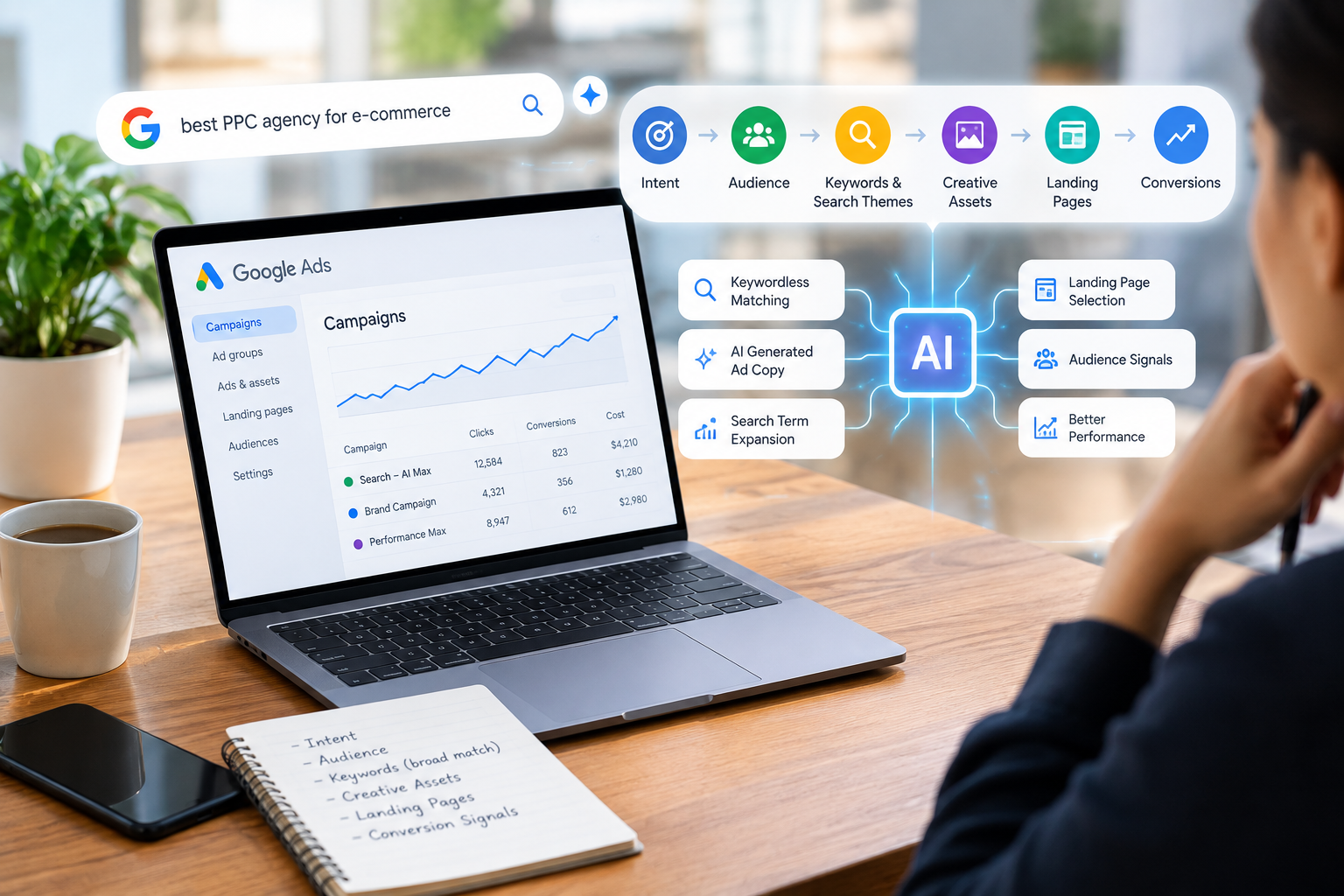
People are increasingly using longer, more conversational queries. AI-powered search experiences can interpret intent beyond the exact words typed into a search box. Google’s current AI Max for Search campaigns, for example, combines broader search-term matching, AI-generated creative variations and landing-page selection to expand beyond traditional keyword-based targeting.
Microsoft Advertising has also introduced AI Max for Search, with features designed to understand more complex and conversational searches, customize ad messaging and select relevant landing pages.
The result?
PPC campaign structure is moving from a keyword-first model toward an intent-and-signal-first model.
And that changes how advertisers should think about campaigns, ad groups, keywords, creative, landing pages and measurement.
The Traditional PPC Campaign Structure
Let’s start with the structure many advertisers are familiar with.
A traditional Google Search campaign might look like this:
Campaign: Digital Marketing Services
Ad Group 1
- digital marketing agency
- digital marketing company
- digital marketing services
Ad Group 2
- SEO services
- SEO agency
- SEO company
Ad Group 3
- PPC services
- Google Ads agency
- PPC management
Each ad group would have:
- Closely related keywords
- Responsive Search Ads
- Relevant headlines
- Relevant descriptions
- A dedicated landing page
The thinking was simple:
The more tightly you organize keywords, ads and landing pages around a specific search term, the more relevant the experience becomes.
That principle hasn’t disappeared.
But AI-powered advertising is changing how much manual segmentation is necessary.

Search Is Becoming More Conversational
Imagine someone searching for a PPC agency five years ago.
They might type:
“PPC agency near me”
Today, a user might search:
“I run a small e-commerce business and I’m spending too much on Google Ads. What type of PPC agency can help me improve my ROAS?”
The second query contains much more information.
It communicates:
- Business type
- Problem
- Advertising platform
- Desired outcome
- Potential pain point
- Commercial intent
AI-powered search systems are designed to interpret this type of context.
Microsoft describes AI search as a shift from traditional keywords toward conversations and more context-aware discovery.
This creates a major implication for PPC:
Your campaign should not only understand keywords.
It should be able to respond to intent.
From Keywords to Search Intent
This is one of the biggest changes advertisers need to understand.
Traditional PPC planning often starts with:
What keywords should I target?
AI-driven PPC increasingly encourages another question:
What customer intent do I want to capture?
For example, instead of thinking only about:
- PPC agency
- Google Ads agency
- PPC management
you might organize your strategy around:
Problem-Based Intent
“I am wasting money on Google Ads.”
Solution-Based Intent
“I need someone to manage my Google Ads.”
Comparison Intent
“PPC agency vs freelancer.”
Commercial Intent
“Google Ads management pricing.”
Local Intent
“PPC agency near me.”
High-Intent Service Search
“Hire Google Ads agency for e-commerce.”
These are different expressions of the same broader business problem.
An AI-powered advertising system can use contextual signals to help connect ads with relevant searches beyond the exact keyword list.
Google AI Max Is Changing Search Campaign Architecture
One of the most important developments for PPC advertisers is AI Max for Search campaigns.
Google describes AI Max as a suite of AI-powered features that operates as an optimization layer within existing Search campaigns rather than as a completely separate campaign type.
Its capabilities include:
- Search-term matching
- Broad-match expansion
- Keywordless matching
- AI-generated text assets
- Final URL expansion
- Location-of-interest signals
- Brand controls
- URL inclusions and exclusions
- Enhanced reporting
This is important because it changes the role of the campaign structure.
Instead of manually creating a separate ad group for every possible variation, advertisers can provide stronger inputs and allow Google’s systems to find additional relevant opportunities.
Google says AI Max uses keywords, ads, landing pages and other contextual signals to identify relevant searches that advertisers might otherwise miss.
Does This Mean Keywords Are Dead?
No.
This is one of the biggest misconceptions surrounding AI-powered PPC.
Keywords still provide valuable signals.
They communicate:
“This is the type of customer demand I’m interested in.”
The change is that keywords are increasingly becoming one signal among many, rather than the entire architecture of the campaign.
Google’s AI Max documentation describes search-term matching as combining broad match, asset-based and landing-page-based technology.
So the modern PPC structure can look more like:
Business Goal
↓
Intent / Audience
↓
Campaign
↓
Keywords + Search Themes + Landing Pages + Creative + Conversion Signals
↓
AI Matching & Optimization
↓
Conversion
The advertiser supplies the strategic direction.
The system increasingly handles some of the matching complexity.
Campaigns Should Be Organized Around Business Goals
One of the most important structural changes is moving away from unnecessary campaign fragmentation.
For example, an advertiser might once create separate campaigns for:
- Exact keywords
- Phrase keywords
- Broad keywords
- Different keyword variations
- Different match types
- Hundreds of small ad groups
The problem?
Too much fragmentation can split data across campaigns.
When conversion-based automated bidding is being used, concentrated conversion data can be valuable for optimization.
AI-driven systems need enough meaningful signals to learn.
Therefore, the question becomes:
Does this campaign division represent a meaningful business difference?
If the answer is no, the segmentation may not be necessary.
When Should You Still Separate Campaigns?
AI does not mean “put everything into one campaign.”
Campaign separation can still make sense when there is a genuine difference in:
Budget
Example:
- Brand campaign
- Non-brand campaign
Geography
Example:
- India
- United States
- United Kingdom
Product
Example:
- Shoes
- Clothing
- Accessories
Business Objective
Example:
- Lead generation
- E-commerce sales
- Store visits
Audience or Customer Value
Example:
- New customers
- Existing customers
Economics
Example:
A high-margin service may justify different bidding and budget decisions from a low-margin product.
The principle is:
Structure campaigns around meaningful business decisions—not arbitrary keyword variations.
AI Search Makes Ad Creative More Important
Here’s another major change.
If users are asking more detailed questions, generic advertisements become less useful.
Consider this ad:
Headline: Best PPC Agency
Description: We provide PPC services. Contact us today.
Now compare it with messaging that addresses a specific intent:
Headline: Reduce Wasted Google Ads Spend
Description: PPC management for e-commerce brands focused on improving conversion efficiency and ROAS.
The second message communicates:
- Problem
- Audience
- Service
- Outcome
AI-powered ad systems can also generate or customize text assets.
Google’s AI Max text customization feature can use information from existing ads, landing pages, domains and keywords to generate additional headlines and descriptions relevant to a user’s search.
That means your website and existing ad assets become increasingly important inputs into your PPC system.
Your Website Is Becoming Part of Your Ad Strategy
This is a critical point.
In an AI-driven PPC environment, your landing page is not simply the destination after the click.
It can also become a source of context for ad optimization.
Google’s AI Max includes Final URL Expansion, which can select a more relevant URL from the website when the system expects that URL to improve performance.
This means your website architecture matters.
Imagine a digital marketing agency has these pages:
/seo-services//local-seo//google-ads-management//social-media-marketing//ecommerce-marketing/
A search about Google Ads management shouldn’t necessarily send every visitor to:
/digital-marketing-services/
A highly relevant service page may provide a better experience.
Therefore:
Better website architecture can support better PPC relevance.
Landing Pages Need to Become More Intent-Specific
AI search may broaden the queries your ads can reach.
That makes landing-page relevance even more important.
Suppose the search is:
“Google Ads management for dental clinics”
A generic page titled:
Digital Marketing Services
may not be ideal.
A more relevant page could be:
Google Ads Management for Dental Clinics
with content about:
- Dental PPC campaigns
- Appointment leads
- Local targeting
- Call tracking
- Conversion tracking
- Budget management
- Landing pages
The more clearly your website communicates what you actually offer, the more useful it becomes as a destination and as a contextual signal.
The New PPC Structure: Intent + Assets + Signals
A modern PPC campaign can be thought of as five connected layers.
Layer 1: Business Objective
What are you trying to achieve?
Examples:
- Leads
- Sales
- Revenue
- App installs
- Store visits
- Qualified calls
Layer 2: Customer Intent
What problem is the customer trying to solve?
Examples:
- “Need PPC management”
- “Want more leads”
- “Reduce ad spend”
- “Improve ROAS”
- “Launch Google Ads”
Layer 3: Search & Targeting Signals
These can include:
- Keywords
- Broad match
- Search-term patterns
- Location
- Brand controls
- Landing-page relevance
- Audience signals
- Other contextual inputs
Layer 4: Creative Assets
Your inputs can include:
- Headlines
- Descriptions
- Images where applicable
- Videos where applicable
- Offers
- Calls to action
- Landing-page messaging
AI can increasingly help adapt these assets to different queries.
Layer 5: Conversion Signals
The system needs to understand what success means.
Examples:
- Purchase
- Qualified lead
- Phone call
- Booking
- Demo request
- Revenue
- Offline sale
The better your conversion data, the more useful automated optimization can become.
Conversion Tracking Is Becoming More Important
When AI has more control over targeting and creative, advertisers need better signals to tell the system:
“This is a valuable customer.”
Suppose your campaign generates 100 leads.
But only 10 become paying customers.
If your advertising platform optimizes only for the initial lead, it may prioritize inexpensive leads rather than valuable customers.
A better strategy may be to feed stronger downstream signals where technically and operationally appropriate.
For example:
Click
↓
Lead
↓
Qualified Lead
↓
Sales Opportunity
↓
Customer
↓
Revenue
This allows your optimization strategy to move closer to actual business value.
Search Terms Still Matter
AI does not eliminate the need to understand what people are searching for.
In fact, search-term analysis may become even more important.
Why?
Because broader matching can uncover queries you did not explicitly plan for.
Google’s AI Max reporting includes additional views intended to help advertisers understand AI Max search-term contributions and customer journeys.
Regularly reviewing search terms can help identify:
New opportunities
Queries worth incorporating into your messaging or website.
Irrelevant traffic
Queries that should be excluded.
New customer problems
Questions you didn’t know your audience was asking.
New landing-page ideas
Topics that deserve dedicated pages.
Search-term reports can therefore become a market research tool, not just a negative-keyword tool.
Negative Keywords Still Have a Role
Automation does not mean advertisers should stop controlling relevance.
Negative keywords can still help prevent unwanted traffic.
For example, a premium PPC agency may not want searches related to:
- Free PPC course
- PPC jobs
- PPC salary
- PPC internship
- Free Google Ads training
if the business is selling PPC management services.
The exact negative-keyword strategy depends on the campaign and business.
The important point is:
AI expands reach, while exclusions help establish boundaries.
Brand Controls Become More Important
As targeting becomes more automated, advertisers may worry about where their brand appears and what it is associated with.
Google’s AI Max includes brand settings that allow advertisers to specify brands they want associated with their campaigns or exclude certain brands.
This reflects an important principle:
Automation needs boundaries.
The goal isn’t maximum automation.
The goal is:
Useful automation + meaningful control.
AI Search Is Also Changing User Intent
AI can compress the customer journey.
A person may begin with a broad question:
“How does PPC advertising work?”
Then ask an AI system:
“What should I budget for Google Ads?”
Then:
“Which PPC agencies specialize in e-commerce?”
Then:
“Compare these agencies.”
Then:
“Which one should I contact?”
By the time that person reaches a traditional search engine, their intent may be much stronger.
Microsoft describes this trend as a compression of the customer journey, with AI handling more early exploration while search can become a place where consumers compare and validate options.
This has major implications for PPC.
PPC May Need Fewer Campaigns but Better Inputs
This sounds contradictory.
But consider the difference.
Old approach
More campaigns
More ad groups
More keyword variations
More manual segmentation
Emerging approach
Fewer unnecessary divisions
Better conversion data
Better landing pages
Better creative assets
Better business signals
Smarter automated matching
The goal isn’t to reduce structure for the sake of simplicity.
The goal is to remove unnecessary structure while keeping meaningful control.
Example: E-Commerce PPC Campaign
Let’s imagine an online clothing store.
Traditional structure
Campaign 1: Women’s Dresses
Ad groups:
- summer dresses
- party dresses
- casual dresses
- maxi dresses
- cotton dresses
Campaign 2: Women’s Suits
Ad groups:
- formal suits
- office suits
- designer suits
- women’s suits online
And so on.
A modern structure might still separate major product categories, but use broader intent and stronger product/landing-page signals rather than creating hundreds of tiny ad groups.
For example:
Campaign: Women’s Fashion
↓
Relevant product/category signals
↓
High-quality product pages
↓
Strong creative assets
↓
Conversion-focused bidding
↓
Search-term analysis
The exact structure depends on account size, product economics, inventory, geography and performance data.
Example: Local Service PPC Campaign
Imagine a local SEO agency.
Instead of creating dozens of campaigns:
Campaign: Local SEO Leads
Potential themes:
- local SEO services
- Google Maps SEO
- Google Business Profile SEO
- GMB SEO services
- local SEO company
- Google Business Profile optimization
Landing pages:
- Local SEO
- Google Business Profile SEO
- Google Maps SEO
- SEO services
Conversion signals:
- Contact form
- Phone call
- WhatsApp inquiry
- Consultation booking
- Qualified lead
The campaign structure should reflect actual business differences rather than simply creating a separate campaign for every keyword variation.
AI Search Doesn’t Mean “Set It and Forget It”
This is perhaps the most important warning.
AI automation can reduce manual work.
It does not eliminate strategy.
Advertisers still need to monitor:
- Search terms
- Conversion quality
- CPA
- ROAS
- Budget
- Landing pages
- Creative performance
- Geographic performance
- Brand relevance
- Negative keywords
- Customer quality
Google itself provides experimentation functionality for AI Max so advertisers can compare AI Max-enabled traffic with a control portion of an existing Search campaign.
That reflects a sensible approach:
Test → Measure → Learn → Adjust
rather than:
Turn on AI → Walk away
The PPC Manager’s Role Is Changing
The PPC manager of the future may spend less time manually creating thousands of keyword combinations.
Instead, more time can go into:
Strategy
Which customers should we acquire?
Economics
Which customers are profitable?
Data
Are conversion signals accurate?
Creative
What message should the brand communicate?
Landing Pages
Does the website answer the customer’s actual question?
Experimentation
Which automation settings produce better business results?
Analysis
What does the search data tell us about customer behavior?
In other words:
PPC management is moving from campaign construction toward system design and business optimization.
What Should PPC Advertisers Do Now?
Here is a practical 2026 checklist.
1. Audit Your Campaign Structure
Ask:
- Do we have unnecessary campaigns?
- Are ad groups too fragmented?
- Are campaigns separated for real business reasons?
- Are we splitting data unnecessarily?
2. Review Your Conversion Tracking
Ask:
- Are we tracking the right conversions?
- Are leads qualified?
- Can we connect leads to revenue?
- Are offline conversions available to import?
3. Improve Landing Pages
Every major commercial intent should have a relevant destination.
Don’t send every paid click to the homepage.
4. Strengthen Your Ad Assets
Create messaging around:
- Problems
- Benefits
- Offers
- Differentiators
- Proof
- Customer outcomes
AI can help generate variations, but your original business positioning still matters.
5. Analyze Search Terms
Look for:
- New opportunities
- Irrelevant searches
- New customer questions
- New content ideas
- Negative keywords
6. Test AI-Powered Features
Don’t adopt AI features simply because they’re new.
Test them against your business objectives.
Google provides AI Max experiments that can help advertisers compare AI Max settings with a control within the same campaign.
7. Protect Brand Relevance
Use available controls to establish appropriate boundaries around:
- Brands
- Locations
- URLs
- Search terms
- Landing pages
The Future of PPC Campaign Structure
The future isn’t necessarily:
No keywords.
And it isn’t necessarily:
AI does everything.
Instead, PPC is moving toward a hybrid model.
Humans provide:
- Business strategy
- Customer understanding
- Offers
- Brand positioning
- Conversion definitions
- Budget decisions
- Constraints
AI systems increasingly provide:
- Query expansion
- Matching
- Creative variation
- Landing-page selection
- Real-time optimization
- Pattern recognition
The competitive advantage will increasingly come from how well these two sides work together.
Ask A PPC: What Should You Remember?
If you’re wondering how AI search trends are changing PPC campaign structures, remember these five principles:
1. Stop thinking only in keywords.
Think about intent.
2. Don’t over-segment campaigns.
Separate campaigns when there is a meaningful business reason.
3. Treat your landing pages as PPC assets.
Your website increasingly provides context for automated systems.
4. Improve your conversion signals.
AI optimization is only as useful as the goals and data it receives.
5. Test automation instead of blindly trusting it.
Use experiments, search-term analysis and business metrics to evaluate performance.
Final Thoughts
AI isn’t eliminating PPC.
It is changing what PPC management looks like.
Search is becoming more conversational. AI systems are interpreting broader context. Google is expanding Search campaigns with AI-powered matching, creative generation and landing-page selection. Microsoft Advertising is also introducing AI-driven capabilities designed around conversational queries and automated campaign optimization.
As a result, campaign structure is moving away from an obsession with manually mapping every possible keyword variation.
The new question is:
How can we give the advertising system enough high-quality information, assets, conversion signals and strategic boundaries to find the right customers?
That means modern PPC isn’t just about keywords.
It’s about:
Intent + Data + Creative + Landing Pages + Conversion Signals + Automation + Human Strategy.
The advertisers who adapt their campaign structures around these principles can be better prepared for an increasingly AI-driven search environment.
And that’s the real answer to Ask A PPC:
AI isn’t replacing PPC strategy. It’s raising the level at which PPC strategy needs to operate.
Frequently Asked Questions
Is AI changing Google Ads campaign structure?
Yes. Google’s AI Max for Search introduces AI-powered search-term matching, creative optimization and landing-page expansion within Search campaigns.
Are keywords becoming obsolete in PPC?
No. Keywords remain useful signals, but AI-powered systems can use additional contextual signals and broader matching technologies to identify relevant searches beyond an advertiser’s exact keyword list.
Should PPC campaigns have fewer ad groups?
Not automatically. The better principle is to remove unnecessary segmentation while maintaining meaningful distinctions based on business goals, products, locations, audiences or economics.
What is AI Max for Search?
AI Max is a suite of AI-powered features within Google Search campaigns. It can expand search-term matching, customize ad text and select relevant landing pages, among other capabilities.
Will AI completely automate PPC?
AI is automating more parts of targeting, creative and optimization, but advertisers still need to provide business strategy, conversion signals, budgets, creative direction and appropriate controls.
How should businesses prepare for AI-powered PPC?
Start by improving conversion tracking, simplifying unnecessary campaign fragmentation, creating strong landing pages, developing useful creative assets, analyzing search terms and testing AI-powered campaign features against measurable business outcomes.
Sikheya Digital Hub is a digital marketing institute and agency helping students, entrepreneurs and businesses learn and implement digital marketing, AI, social media marketing, SEO and online growth strategies.
Expertise
Digital Marketing
SEO
Social Media Marketing
Meta Ads
Google Ads
AI & Automation
Content Marketing